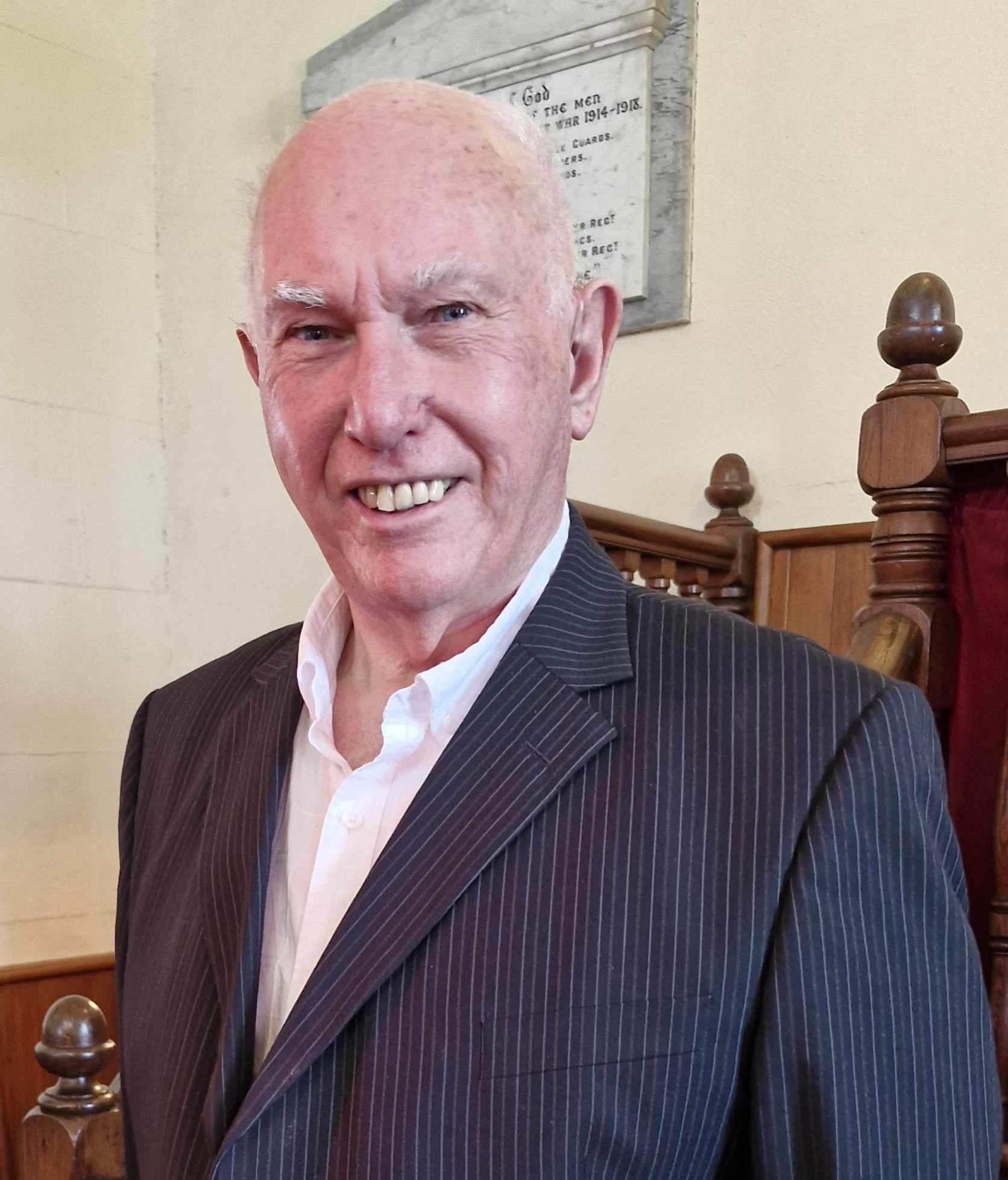
October 12th 2025: Ian Jones

Reading: Joshua 2.
Text: Hebrews 11:31.

to watch this service, click on the link to our YouTube channel: https://youtu.be/o0So2XFgsSM?si=fHUxUerW4XPl45kB

Introduction.

            The story of Rahab’s salvation is set within the context of the Lord’s conquest of Canaan led by Joshua. In Joshua chapter 2 we find two spies are sent out into Jericho. We should remember that many years before this, twelve spies were sent out to spy Canaan by Moses. Why did Joshua need to spend out more spies? He probably had all the intelligence he needed from the more comprehensive exploration done by the twelve spies under Moses. It seems to me that the main point of Joshua chapter two is to show us the salvation of Rahab, the Jerichoite prostitute. We are reminded of Jesus’ visit to see the woman of Samaria at Jacob’s well in John chapter four. He was determined to go north through that region in order to meet with her, rather than go the normal way which would have avoided travelling through Samaritan lands. It is very likely therefore, that the Holy Spirit wants us to know that the reason for the two spies trip to Jericho was (in the main) to effect the salvation of Rahab.

            God had been at work in Rahab’s life. Consider what she confesses, how she helped the spies, and her desire for her family to be saved. Now we shall consider as our text the commentary on Joshua chapter two which we find in Hebrews 11:31.

By faith the harlot Rahab did not perish with those who did not believe, when she had received the spies with peace.

The writer of the letter to the Hebrews wants his readers, (Jewish Christians), to see Rahab’s faith in the midst of great difficulties. See here a woman whose nation and peoples faced imminent death and destruction, but Rahab’s faith saved her! In many ways we too are in the same boat. Jericho was about to be destroyed, but the whole world awaits the coming judgment of God when Christ returns. And here we see Rahab trusting in God. Her faith is very visible. It is not merely an intellectual agreement but something living and active. Now Jericho is the first city that would fall in Canaan, and given what we read of in the opening chapter we might have expected that such would be the focus of chapter two. But what we see instead is the mercy of God! There is no doubt that Jericho deserved God’s judgment, but before we see that we are presented with this historical tale which speaks of God’s grace and mercy! The Lord says in Ezekiel that He has “no pleasure in the death of the wicked, but that the wicked turn from his way and live” (Ezekiel 33:11). And then what is even more remarkable is the object of the Lord’s mercy. Whom would we think of rescuing from such a place about to be destroyed? One with great intellect? Or one who shows great promise for the future? Or maybe one who is greatly wealthy or able to make money? Or perhaps someone who might seem to deserve rescuing? A noble or one of royal birth? What we find though is that it is a prostitute (“harlot”) who is rescued. Oh the mercy of God! None is too much of a sinner that cannot be rescued! But are we willing? Are we like Rahab who had heard about Israel and God and was prepared to go against her own folk and trust in the God who judges sin?

            As a youngster I remember that children’s chorus: ‘wide, wide as the ocean.’

Wide, wide as the ocean, high as the heaven above
Deep, deep as the deepest sea is my Saviour’s love
I, though so unworthy, still am a child of His care
For His Word teaches me that His love reaches me everywhere!

The Lord’s love reaches into everywhere, even into the city doomed to destruction! Why did the Lord save me? Of all the people He could have saved – but I need to remember that there is no depth and no height that He could not reach to. Amazing grace that saved a wretch like me! Salvation is of grace and by no means something we can drum up by self effort or earn. Rahab’s saving faith separated her from the rest who were doomed to destruction.

            Let us look at four features of Rahab’s faith.

[1] By faith.

            Everyone in Jericho knew about Israel’s crossing of the Red Sea, and of the defeat of the two Amorite kings across the other side of the Jordan. Look at what she declares speaking on behalf of all the people of Jericho:

For we have heard how the Lord dried up the water of the Red Sea for you when you came out of Egypt, and what you did to the two kings of the Amorites who were on the other side of the Jordan, Sihon and Og, whom you utterly destroyed. (Joshua 2:10).

She also testified to the great terror and fear that the people felt.

I know that the Lord has given you the land, that the terror of you has fallen on us, and that all the inhabitants of the land are faint hearted because of you. … And as soon as we heard these things, our hearts melted; neither did there remain any more courage in anyone because of you. (Joshua 2:9,11).

Now Rahab believed and had faith in the God of Israel, whereas all the rest of Jericho did not. Perhaps the others in Jericho thought that the Israelites were never likely to be able to cross the Jordan, or perhaps they thought that the walls of Jericho were impregnable, or maybe they thought they had an unbeatable army? But Rahab had true faith. How do we know that she had true faith? Look at which she personally declares:

I know that the Lord has given you the land … for the Lord your God, He is God in heaven above and on earth beneath. (Joshua 2:9,11).

Rahab heard the same news that everyone in Jericho had heard, but the difference between her and the rest was that she believed in the God of the Israelites and the rest did not. Rahab asks the spies for some “true token” that will bring salvation to her and to her family (Joshua 2:12). Rahab knew that Jericho was doomed, but she displays faith in God. Consider the thief on the cross who asked the Lord Jesus to remember him when the Lord came into His kingdom. And the Lord replied: “today you will be with Me in Paradise” (Luke 23:43). Now even today, whoever hears the Lord’s word (as Rahab did) will receive everlasting life (John 3:16,36).

[2] Rahab’s faith is self denying faith.

            Rahab dared to risk her whole life. If it had been found out that she had been hiding the spies, there is no doubt that she (and her own family) would have been executed. The Amorites were a wicked people. James points out that Rahab’s faith is observed by the works that she did:

Likewise, was not Rahab the harlot also justified by works when she received the messengers and sent them out another way? (Joshua 2:25).

Maybe we might think that Rahab should have been loyal to the people of Jericho? But these were a wicked people, and Rahab was prepared to give her loyalty to Israel and Israel’s God. She hid the spies, and she sent the king away on a wild goose chase! Her faith is demonstrated by her actions. Moses forsook the pleasures of Egypt because he saw “Him who is invisible” (i.e. The Lord) (Hebrews 11:24-27). Rahab was not moved by fear of the people or by the king of Jericho. She demonstrated her faith in her actions in keeping the spies safe so that they would return.

[3] Rahab’s faith is a sympathising faith.

            We also see how Rahab was not just concerned for herself, for she asks for mercy for her whole family too:

12 Now therefore, I beg you, swear to me by the Lord, since I have shown you kindness, that you also will show kindness to my father’s house, and give me a true token, 13 and spare my father, my mother, my brothers, my sisters, and all that they have, and deliver our lives from death. (Joshua 2:12,13).

Do we not also want our families to share in the salvation we know? When the Lord opened our eyes and showed us the truth, was it not so wonderful that we wanted our nearest and dearest to come to know it all too? Where true faith is seen, that is, where a person has been brought to true faith, there is also a desire within such a saved person that others might know the same joy of salvation. It is impossible to see the true value of salvation without also wanting others to share in what you have come to know. The gospel accounts show that the Lord Jesus had amazing compassion. Are we not like Him?

            There was no guarantee that any would be safe outside Rahab’s house where the red cord was placed. If they remained within Rahab’s house then they would be safe and their blood would be the responsibility of the Israelites. But if they stepped outside their blood was on their own heads. This meant that each member of the family must come into Rahab’s house. Go out and you face judgment, come in and your life is secure. It was the responsibility of each member of Rahab’s family to come into the house where the scarlet cord was found. That scarlet cord represents the blood of the Saviour. In the Exodus the Israelites had to daub the blood of  lamb on the lintels and doorposts of their doors to escape the judgment from the angel that was passing over. Are we looking to the shed blood of Christ?

[4] Rahab’s faith is a sanctifying faith.

            Scripture refers to Rahab as a harlot. But she was not going to continue in such a profession. Her faith was that which also led to her sanctification. Rahab was given special privilege among Israel after being rescued (Joshua 6:25). And then wonderfully we discover that Rahab becomes mother to Boaz, who married Ruth the Moabitess, from whom came Obed, then Jesse, and then David. Boaz was a godly man as the record in Ruth shows. Where did he gain such godliness? Surely, he would have learned from his mother Rahab who was saved out of Jericho? Rahab features in the genealogy of the Lord Jesus (Matthew 1:5). Rahab, a Gentile prostitute, by faith in the Lord,f comes to feature as an ancestor of the Lord Jesus! How great is our God!

September 21st 2025: Jeremy Bailey

Isaiah 42:1-17

           The first word in our text is “behold.” It comes the idea of gazing intently upon someone or something. This is essentially the main point of the passage and of our message today. Do you remember when you were first saved and entered into the way of Christ? You could not get enough of this wonderful Jesus! Before you conversion you never gave Him a thought, but now you love Him and you begin to love what He loves. You love the brethren and the church, then you begin to develop a great love for the Bible.

            But then there is this great difficulty. The Bible is made up of 66 different books and some of them, like Isaiah, are quite long. Maybe as a young believer you started with the New Testament. I was encouraged to read Mark’s gospel to start with. It’s all about Jesus. Its quite short. It is dynamic with things happening straight away or immediately. The other gospels gather attention next because they too are about Jesus. Then we look at the letters which explain things concerning Jesus and the gospel. This is a message for and to all of the world not just to a single nation (Israel). Even if we are unsure about the teaching of Revelation at least we come to know the certainty of Christ coming back once more.

            What about the Old Testament? To many it is just ‘old’ and so not so important as the New Testament. But we do know differently don’t we? All Scripture is God-breathed and God has spoken through the prophets o old. Isaiah is made up of 66 chapters and in a way it is a mini Bible. There are some difficult and tough parts, but it is all about Jesus too! We learn this from what Jesus said to the disciples after the resurrection (see Luke 24:26,27,44-46). Whilst the New Testament announces the arrival of Jesus Christ and concerns His appearing, ministry, and the implications of all He did, the Old Testament prepares the way and continually points towards the first advent of Christ. There is much in the Old Testament which describes both the Person and the work of Christ. In Isaiah we have a number of ‘Servant Songs’ of which our passage is one example. And in it we get a glimpse of the nature and work of the prophesied Messiah.

            Now in our text we see three wonderful pictures of Christ. First, He is a great King. Before Isaiah 6 we have a series of sermons from the prophet, but then in chapter 6 we are hear of the death of king Uzziah. Wonderfully, it was at this very point in time that Isaiah “saw the Lord sitting on a throne, high and lifted up” (Isaiah 6:1). When a monarch dies there is a great period of uncertainty. How will the successor to the throne act? What will their reign be like? Isaiah might have thought that the next king would not be as good as Uzziah? But Isaiah is given this vision of a King who would never die and is way above all others. The apostle John quoted from Isaiah and identified this One whom the prophet saw with the Lord Jesus (John 12:37-41).  Second, from Isaiah 35 to 55 the focus is upon the coming One as “the Servant of the Lord.” Chapter 42 begins with the Father speaking of His Son. Our Lord and Saviour did not come to rule as an earthly king but came as a servant and to give His life as a ransom for many (Matthew 20:28; Mark10:45). Third, in the last section, from chapter 56 up to chapter 66, we see the promised Messiah depicted as the One who conquers.

            In our passage we have Christ as the “Servant of the Lord.” How can we be sure that this is a picture of the Lord Jesus? After healing a man with a withered hand on the sabbath, the Pharisees wanted to destroy Him (Matthew 12:13,14). And when Jesus knew of their plots He withdrew from that place but continued to heal many warning them not to make Him known, and then Matthew comments that Christ’s actions were prophesied of by Isaiah quoting our passage of Isaiah 42 (Matthew 12:15-21). So Jesus Christ is clearly “the Servant of the Lord” as depicted in Isaiah.

            I want to draw from Isaiah 42 three themes in relation to this “Servant of the Lord.”

[1] The Servant of the Lord and His commission.

            God the Father invites us to consider, or to “behold,” this delightful One known as “the Servant of the Lord.” We are to think deeply, to gaze intently, and to meditate thoughtfully on this dear One. Now God has many servants at His disposal. There are the angels, for example, who do His will (Psalm 104:4). There are His people called to various tasks. But the work of saving people form their sins and disaster was so special and intricate a task, that He was never going to trust it to men nor to angels. Men, of course, were discounted because of being sinners. Angels are mightily powerful but only His Son could do this vital task. Salvation is of such importance that only the Son of God was called upon to carry out this mission. ?

            Do you struggle with difficulties? Are you depressed and set about with anxious thoughts? Are you suffering grave temptations that are difficult in your life at this time? Our great problem is that we focus on the problem. We look to ourselves, our condition, our troubles, when all we really need to do is to “behold” the Lord’s Servant,Jesus Christ.

            There is a tiny village chapel like Penuel near to Colchester in Essex. It is sited on a high hill near to a road called ‘artillery street.’ In 1850 there sat a young man in the pews by the name of Charles Haddon Spurgeon. He couldn’t get to his normal place of worship due to the snow, so he ended up in this little chapel. The man due to speak was taken ill, and so one of the church members got up to preach. His text was:

Look to Me, and be saved, all you ends of the earth! For I am God, and there is no other. (Isaiah 45:22).

The man speaking was not particularly gifted but he pressed his text earnestly upon the congregation and even pointed directly to Spurgeon saying ‘young man you look particularly miserable, look to Christ.’ It was at this point that Spurgeon came to faith in the Lord, merely by looking with intent at the Saviour. As an aside there was a young man in our church called ‘Jonathan’ who had Down’s Syndrome. The young people used to leave after the third hymn for their youth teaching and as he was leaving he looked back at us in the congregation and said ‘cheer up!’ Sometimes Christians can look and appear so dour!

            In the New Testament we see the Lord Jesus calling Nicodemus to do what the Israelites did in the wilderness when they were plagued by snakes. Do you remember that incident? It is recorded in Numbers 21:7-9. The people had sinned and were plagued by snakes. After praying the Lord told Moses to make a bronze pole with a snake on it. The people were told to look to the pole and they would be healed. The Lord Jesus made reference to this and transferred the focus to Himself:

14 And as Moses lifted up the serpent in the wilderness, even so must the Son of Man be lifted up, 15 that whoever believes in Him should not perish but have eternal life. (John 3:14,15).

Look to Jesus! The Father sent the Son and upholds the Saviour who died for sins. The Holy Spirit honours the Saviour and convicts sinners of their need applying all that the Lord Jesus gained to those who look to Him. This is a work of the blessed trinity, Father, Son,and Holy Spirit. Have you looked to the Saviour?

[2] How the Servant of the Lord carried out His task.

            The Lord Jesus Christ carried out His wonderful work of salvation with modesty and with gentleness. He did not shout out in the street (Isaiah 42:2). The Lord was not given to raising His voice, except briefly in regard to the Pharisees upon whom He pronounced several woes (Matthew 23). For the vast majority of His life He lived quietly as a carpenter in Galilee. When He began His ministry there was no fanfare or trumpeting, and there was marketing or publication. He simply went and preached the good news. He was especially gentle in His dealings and interactions with people. He was no ‘pushover,’ but He was never belligerent nor bombastic, demanding to be heard. He understood the people and their need. He did not ‘pull His punches,’ and always spoke the truth. To the woman of Samaria He pointed out her condition in sin, but He was always gentle leading people to see the truth and their need of Him. Matthew 11:28-30 records how He issued a general call for all who were burdened and laden down to come to Him. In Isaiah 42:3 we read these beautiful words:

A bruised reed He will not break, and smoking flax He will not quench; He will bring forth justice for truth. (Isaiah 42:3).

You often see reeds by the riverside bent over after a violent storm and rain. It is a simple matter to just break the bent reed as you pass by on your walk. Naturally the reeds are not easy to break due to the fibrous nature and structure. But if the reed is bent over by some violent force it becomes a lot easier to break off. We do not use candles very often but when they get down to the very bottom and the wick is sputtering and barely glowing it is a simple thing to lick your fingers and snuff the dying embers out. Now these two illustrations are pictures of fallen human beings. We can barely stand up among the forces that buffet us,and there are but the dying embers of life left. Hebrew is a very different language to English. The negative is put here to imply the opposite positive. In saying that this Servant of the Lord will not break a bruised reed and will not quench a smoking flax, the Lord is really saying that He would restore structure and bring back to life. The Lord will cup His hand around the smouldering wick and will gently blow upon it to fan the flames back to life! The Lord knows us. He knows our frame. He knows we are weak and frail. He knows we sometimes are clinging to life. Well He is gentle and incredibly loving! What-is-more, he is our Creator and knows what to do!

[3] The people to whom the Servant of the Lord came.

            Those who are not yet saved are bruised and smouldering. But even the saved are still bruised and still struggle with life ‘going out’ like a smouldering wick. We are works in progress. Our justification is secured, but we are in need of sanctification and ongoing repair. We mentioned Spurgeon’s conversion a moment ago. He was very miserable as a teenager and needed to hear the Lord’s call. He was, it seems, a very religious person, but he needed to be bruised before he came to faith. Mankind is very proud. If all is going well and there are no problems in view then what need does he have of God? He may be very successful in career, in family, in relationships and so on, so what need is there of God? He has great need, of course, but he is unaware of it and does not see his need. The Lord allows us to be bruised by the world, by our sin, and even by Satan’s misdemeanours. He does this to bring us to see our lost and hopeless condition. We are bruised and in need of repair. Think too of the prodigal son (Luke 15). He had to be brought to a point when he came to his senses and saw his desperately low condition, before he returned to his father. Man is bruised so that he can be led back to the Lord.

            Now even as Christians we are sometimes bruised and sometimes become like a smouldering wick. But why is this? It is so that we would value Christ even more. It is so that our hold of the things of this world will become lighter. It is so that we might become more holy, more like Christ, and more alive! See how the ‘giants of faith’ in Scripture were sometimes bruised. Peter was bruised by the Lord and made to see his over confidence in himself. David was bruised too. He was made to see the wickedness of his actions and brought to deep and sorrowful confession (see Psalm 38 and Psalm 51). Paul too was bruised. He had his ‘thorn in the flesh’ which the Lord would not remove to keep the apostle humble and trusting. Those whom Jesus has saved may be bruised at times, and this in order for them to gaze deeper into the Lord’s face. Even little children are forgetful of their parents until they fall and graze their knees. But them as they pour out their tears they look into the face of their mum or dad in hope that all will be made better. How much more will a bruised saint gaze into the face of Jesus who died for them? Remember this above all else. We have a Saviour who was “wounded for our transgressions,” and who was “bruised for iniquities,” (Isaiah 53:5). His bruising was for our salvation. Our bruising is for His glory and to make us more like Him.

September 14th 2025: Mike Viccary

1 Corinthians 1:9

Introduction.

            A church is made up of sinners saved by the grace of God, but each member is a ‘work in progress.’ Now Paul is very clear about the nature of the church in Corinth. Here are some of the things he affirms concerning the Corinthian believers from chapter 1:

[1] They are “the church of God” (v2).

[2] They are the “sanctified in Christ Jesus” and so are united with Him (v2,30).

[3] They are “called to be saints” (v2).

[4] They are among a very great number of others all of whom “call on the name of Jesus Christ our Lord” (v2).

[5] They are the recipients of “the grace of God” given freely “by Christ Jesus” (v4).

[6] They have been “enriched in everything by Him” (v5).

[7] They have “the testimony of Christ” within and this confirmed even to the end when Christ returns (v6).

[8] They have received gifts of the Spirit (v7).

[9] They are ones who see “the message of the cross” as “the power of God” (v18).

[10] Though they be weak and foolish in the world’s sight yet they are chosen of God so that “no flesh should glory in His presence” (v29).

And yet there were some serious problems in the Corinthian church! Such is true to varying degrees of all churches, otherwise we would have none of Paul’s epistles or the opening chapters of the book of Revelation! What we read of in Hebrews is pertinent here:

For by one offering He has perfected forever those who are being sanctified. (Hebrews 10:14).

We have been saved and justified, but we are still being sanctified and made holy. Now I do not want to focus upon the issues noted here in verses 10 through to 17. What I want us to do is to focus our attention on verse 9:

God is faithful,

by whom you were called

into the fellowship of His Son,

Jesus Christ our Lord.

Paul was adept at making sure and certain statements about God and His work which formed the basis and ground for his application to those to whom he was writing. These statements in 1Corinthians 1:9 are universal. They are truths which form the very essence of our faith. So today we are simply going to draw some thoughts from verse 9 as it stands. My aim is to encourage you to love Jesus Christ more!

[1] God is faithful.

            In Scripture there are a number of “God is” statements which tell us important things about the nature of God and about His attributes:

  1. God is God of gods and Lord of lords. (Deuteronomy 10:17).
  2. God is the King of all the earth. (Psalm 47:7).
  3. God is greater than all gods. (2Chronicles 2:5).
  4. God is not a man, that He should lie. (Numbers 23:19).
  5. God is a consuming fire. (Deuteronomy 4:24).
  6. God is great. (Job 36:26).
  7. God is a jealous God. (Deuteronomy 6:15).
  8. God is merciful. (Psalm 116:5 – See Deuteronomy 4:11).
  9. God is gracious. (2Chronicles 30:9).
  10. God is a just judge. (Psalm 7:11).
  11. God is the God of salvation. (Psalm 68:20).
  12. God is a sun and shield. (Psalm 84:11).
  13. God is holy. (Psalm 99:9; 1Corinthians 3:17).
  14. God is righteous in all the works. (Daniel 9:14).
  15. God is true. (John 3:33).
  16. God is Spirit. (John 4:24).
  17. God is light. (1John 1:5).
  18. God is love. (1John 4:8,16).

We also have the statement from 1Corinthians 1:9 that “God is faithful,” and Paul repeats this truth a further two times  (1Corinthians 10:13; 2Corinthians 1:18). There are many other “God is …” statements which have to do with Him being our refuge, our strength, and so on. [God is your refuge. (Deuteronomy 33:27). God is my strength and power, and He makes my way perfect. (2Samuel 22:33). God is a merciful God. (Deuteronomy 4:11)]. All of these statements tell us what God is like.

            The statement “God is faithful” is interesting because it brings certainty and true confidence to mind. The term “faithful” indicates an attitude of being true and reliable to someone or something. It speaks about being trustworthy and reliable. There are three key aspects to this term “faithful” which we should consider:

            [a] Constancy,

[b] Truth,

[c] Faith.

[a] Constancy

            Perhaps the first idea that comes to mind in this term “faithful” is the idea of loyalty or stick-ability. The faithful wife or husband does not cheat. The faithful employee does his/her job. We need to ask a couple of questions at this point. First, how is the faithfulness of God described for us in Scripture? In Jeremiah’s book Lamentations His faithfulness is described as being great (Lamentation 3:23). This truth is shown elsewhere in Scripture, for example in the Psalms where we read that the Lord’s faithfulness “reaches to the clouds” (Psalm 36:5). The Lord is described as “a faithful Creator” (1Peter 4:19), and therefore His faithfulness “endures to all generations” for He “established the earth, and it abides” (Psalm 119:90). The Lord is, of course, always faithful because it is impossible for Him to be anything else but true: “If we are faithless, He remains faithful; He cannot deny Himself” (2Timothy 2:13). Man’s faithfulness (if he is ever faithful) is always limited. He may be a faithful employee but a hopeless family man! With the Lord we may even say that He exudes faithfulness or that His faithfulness is the very atmosphere and environment He dwells in because the Psalmist declared that there was none mighty like Him for His faithfulness “surrounds” Him (Psalm 89:8). And as if that were not enough we are also taught in the same Psalm that the Lord will “not allow” His “faithfulness to fail” (Psalm 89:33).

            Our second question about the faithfulness of God is to ask: in what way is God faithful? How do we see His faithfulness in action? Well I can see seven areas where the Lord God is and has always been faithful. First He is faithful to His word. The Lord told John twice in the vision he experienced that the words He was giving John were “true and faithful” (Revelation 21:5; 22:6). The Psalmist tells us that “all” of God’s “commandments are faithful,” that His “testimonies” are “very faithful,” whilst Isaiah informs us that His “counsels of old are faithfulness and truth” (Psalm 119:86,138; Isaiah 25:1). Second, we learn that the Lord is faithful to His covenants (agreements), for He is “the faithful God who keeps covenant and mercy” (Deuteronomy 7:9). Third, the Lord is faithful in His high priestly functions, for He is  “a merciful and faithful High Priest in things pertaining to God, to make propitiation for the sins of the people” (Hebrews 2:17). Fourth, as a result of His sacrifice for sin He is faithful in forgiveness: “If we confess our sins, He is faithful and just to forgive us our sins and to cleanse us from all unrighteousness” (1John 1:9). Fifth, we find the Lord faithful in regard to help when we face temptations: “God is faithful, who will not allow you to be tempted beyond what you are able” (1Corinthians 10:13). Sixth we find also that the Lord is faithful in our sanctification. We are not alone! The Spirit aids us. Paul prayed that the Lord would “sanctify” the Thessalonians “completely” and went on to state that “He who calls you is faithful, who also will do it” (1Thessalonians 5:23,24). Sometimes our sanctification involves afflictions, but these too are faithfully given to us by the Lord: “I know, O Lord, that Your judgments are right, and that in faithfulness You have afflicted me” (Psalm 119:75). Seventh the Lord is faithful in protecting us from the evil one: “but the Lord is faithful, who will establish you and guard you from the evil one”  (2Thessalonians 3:3).

[b] Truth.

            To be faithful also means to be true. It means to be accurate. It means to be precise. Three times the Lord Jesus is called “faithful” in Revelation, and twice this attribute is linked with truth. He is “the faithful witness,” “the Faithful and True Witness,” and He is “Faithful and True” (Revelation 1:5; 3:14; 19:11). No one has ever see God at any time but the Lord Jesus having come from heaven has declared the whole truth to us. The Lord was true to the Father and revealed exactly those things the Father wanted us to know, as well as those things we needed to know (John 5:19,30). The night before He died in His ‘High priestly’ prayer the Lord could say these words to God the Father:

  • I have finished the work which You have given Me to do (John 17:4).
  • I have manifested Your name to the men whom You have given Me out of the world. (John 17:6).
  • I have given to them the words which You have given Me. (John 17:8).

Truth is vital. We live at a time when truth is what a person decides to be true. But there are absolute truths and these stem from the fact that Jesus Himself is “the truth,” and He also stated that the word of the Lord was “truth” (John 14:6; 17:17) and it is by this truth that we are to be sanctified:“Sanctify them by Your truth. Your word is truth.” (John 17:17).

            God is true. Four times He is described as the “God of truth” (Deuteronomy 32:4; Psalm 31:5; Isaiah 65:16(x2)). God cannot lie (Titus 1:2; Hebrews 6:18). So the faithfulness of God is demonstrated in that He is always true and always speaks truth. Since Scripture, (what is written) is His word, it follows that the Bible is true.

[c] Faith.

            To be faithful means to be always true to someone or something. To be faithful means to be trustworthy, that is one that you can trust and rely on. To be faithless means that you have no trust nor faith in someone or something. Paul wrote: “If we are faithless, He remains faithful; He cannot deny Himself” (2Timothy 2:13). Saying that God is faithful amounts to saying that He is trustworthy. You can trust Him! As God is faithful, and we have been given faith (the ability to trust in God and all He has done), let us continue in faith (Psalm 37)!

            Now this incredible faithfulness of the Lord leads us to ask this question: how should we then live? Well, to begin with, remember as a born again believer, born of the Spirit of God, that faithfulness is one of the fruits of the Spirit (Galatians 5:22). These fruits are born out of our love for the Lord and they are to be evident in our lives. Are we faithful to the Lord? Surely seeing the Lord’s faithfulness to us will lead in turn to our faithfulness to Him. And so this means that we will continue in faith. We will exercise the faith that God gives to us. Consider this exhortation from Hebrews:

Let us hold fast the confession of our hope without wavering, for He who promised is faithful.  (Hebrews 10:23).

To aid us in our faithfulness to the Lord we should feed on the faithfulness of God as the Psalmist tells us: “Trust in the Lord, and do good; dwell in the land, and feed on His faithfulness” (Psalm 37:3). And then also we should give testimony to the faithfulness of God in our lives:

I will sing of the mercies of the Lord forever; with my mouth will I make known Your faithfulness to all generations. (Psalm 89:1).

[2] by whom you were called.

            The calling of the Lord is a wonderful truth to behold. God calls people not to a system nor to a rule, but to Himself.

28 Come to Me, all you who labour and are heavy laden, and I will give you rest. 29 Take My yoke upon you and learn from Me, for I am gentle and lowly in heart, and you will find rest for your souls. 30 For My yoke is easy and My burden is light.” (Matthew 11:28-30).

As always we learn that what the Son does is none other than what the Father and the Spirit do too. Our Lord Jesus taught that those who come to Him were in fact called of, or taught by the Father. He said: “everyone who has heard and learned from the Father comes to Me” (John 6:47). The Lord Jesus also spoke about the Father’s electing love and declared that “All that the Father gives Me will come to Me, and the one who comes to Me I will by no means cast out” (John 6:37). And then at the very end of Scripture we find that the Spirit too calls people to join the Lord:

And the Spirit and the bride say, “Come!” And let him who hears say, “Come!” And let him who thirsts come. Whoever desires, let him take the water of life freely. (Revelation 22:17).

And so we learn from all of these words that it is God, Father, Son, and Holy Spirit working in unison who have called us. This calling gives us immense confidence because God is faithful. He who calls is He who can save. He who calls is He who can deliver! The world makes a grave mistake in thinking that the Christian faith is all about mankind seeking God. Ask anyone in the world and they will probably tell you that to be a Christian is to make a conscious choice or decision to throw in one’s lot with God. But this is very far from the truth. Paul quoted from Psalm 14 and 53 showing plainly that no one seeks God:

10 As it is written: “there is none righteous, no, not one; 11 There is none who understands; there is none who seeks after God. (Romans 3:10,11).

The entire Bible is testament to this truth. Ever since Adam sinned in the garden, man has continually run away from God desperate to seek answers for himself, but in His grace God has constantly pursued man. But not all who hear the calling of God – the preaching of His word the gospel – will take notice of it. To the one who hears the message of God’s calling and who embraces all that God has said there is greater blessing. But to the one who hears the calling of God in the gospel and turns aside and pays no heed to it, there is only one outcome: they will perish.

For the message of the cross is foolishness to those who are perishing, but to us who are being saved it is the power of God. (1Corinthians 1:18).

But this idea of calling also has within it the notion of being named.

But now, thus says the Lord, who created you, O Jacob, and He who formed you, O Israel: “fear not, for I have redeemed you; I have called you by your name; you are Mine.” (Isaiah 43:1).

There is within this calling of the Lord the idea of redemption and even adoption. Bathe yourself in these words that the apostle John wrote:

Behold what manner of love the Father has bestowed on us, that we should be called children of God! Therefore the world does not know us, because it did not know Him. (1John 3:1).

Think of the many times that the Lord came to various peoples such as Abraham, Jacob, Joseph, Moses … who all received Him and were led by Him throughout their lives! Paul speaks about this type of calling being part of the great work of God in the salvation of many:

28 And we know that all things work together for good to those who love God, to those who are the called according to His purpose. 29 For whom He foreknew, He also predestined to be conformed to the image of His Son, that He might be the firstborn among many brethren. 30 Moreover whom He predestined, these He also called; whom He called, these He also justified; and whom He justified, these He also glorified. (Romans 8:28-30).

If you have heard the call of God and have run to Him in repentance and faith, then know that the faithful God has already secured your glorification – your place in heaven is secured (see John 14;1f). But we need to be clear what is entailed in this calling. We are not called into a club or society where there may be some benefits and some responsibilities. Many who belong to such do not see themselves as wholly or exclusively linked to such. But for the Christian, to be called, is to be called out of this world and into the Lord. There is no neutral ground. We cannot consider ourselves called of God if we think of it like being a part of a club or society. It is either all or nothing. To be called is to be brought completely into the Lord. When God calls someone He does not just arrest their attention, but He brings in the whole plan of salvation. We are called “according to His purpose,” “in the grace of God,” and “by our gospel” (Romans 8:28; Galatians 1:6; 2Thessalonians 2:14). We are called “into the fellowship of His Son,” “into His own kingdom and glory,” “out of darkness into His marvellous light,” with an “upward call,” and a “heavenly calling” (1Corinthians 1:9; 1Thessalonians 2:12; 1Peter 2:9; Philippians 3:14; Hebrews 3:1). We are called “to be saints,” as “sons of the living God,” and as “children of God” (1Corinthians 1:2; Romans 9:26; 1John 3:1). We are called “in one body,” “in holiness,” “with a holy calling,” “to peace,” and we are to be “worthy of the calling” (Colossians 3:15; 1Thesalonians 4:7; 2Timothy 1:9; 1 Corinthians 7:15; Ephesians 4:1). We are called “in one hope,” to “eternal life,” to an “eternal inheritance,” to “His eternal glory,” and to “the marriage supper of the Lamb” (Ephesians 4:4; 1Timothy 6:12; Hebrews 9:15; 1Peter 5:10; Revelation 19:9).

[3] into the fellowship of His Son.

            Here in our text we see that we have been called into “fellowship” with the Lord Jesus. Note to begin with, that “fellowship” is one of the key marks of a Christian church, listed second to “the apostles’ doctrine,” and before “the breaking of bread,” and “prayers” (Acts 2:42). This is no  mere association or membership of a club as the world might think of the word.  So what then is meant by this term “fellowship”? Well first and foremost, it is “the fellowship of His Son, Jesus Christ our Lord.” This fellowship belongs to the Lord Jesus and consists in being in communion and knowing Him. Christ Jesus alone is Head of the church. In Philippians Paul uses this term “fellowship” three times, teaching us some important things for us to grasp when we consider our fellowship. First, there is true fellowship only in the gospel: “for your fellowship in the gospel from the first day until now” (Philippians 1:5). How marvellous is the gospel? It is unique. It is simple to express, and yet profound in its outworking.

For God so loved the world that He gave His only begotten Son, that whoever believes in Him should not perish but have everlasting life. (John 3:16).

You cannot add to the gospel and you cannot take from it either. There is nothing needed above and beyond the gospel because in truth it is “the gospel of God” (Romans 1:1) which Paul describes in these wonderful words:

… the gospel of God 2 which He promised before through His prophets in the Holy Scriptures, 3 concerning His Son Jesus Christ our Lord, who was born of the seed of David according to the flesh, 4 and declared to be the Son of God with power according to the Spirit of holiness, by the resurrection from the dead. (Romans 1:2-4).

Second, there is true fellowship only for those born again of the Holy Spirit, for Paul speaks about our “fellowship of the Spirit” (Philippians 2:1). Such communion cannot be shared between people unless they are indwelt by the Spirit of God, for this fellowship is with God and so a person must be made holy to benefit from such a wonderful thing. Unbelievers may enjoy what they see and experience in our fellowship but they cannot actually fellowship with us, until they are born again. Third, there is true fellowship only for those who have forsaken this world which is at war with God, because our Christian fellowship is described as “the fellowship of His sufferings” (Philippians 3;10). We read elsewhere that true fellowship cannot be with “the throne of iniquity” or with “unbelievers,” with “lawlessness,” or with “darkness” (Psalm 94;20; 1Corinthians 10:20; 2Corinthians 6:14; Ephesians 5:11). And we are taught clearly by the Lord and by Paul that if we want to love and know the Lord Jesus we will know “tribulation” and will suffer “persecution” (John 16:33; 2Timothy 3:12). This is because the world is at loggerheads with the Lord, and to know the Lord is to turn from and reject this world (1John 2;15-17).

            Perhaps the best description of true fellowship comes in the apostle John’s first letter and chapter one. John starts by pointing to the “Word of life” who was manifested and who appeared in the flesh so that he and others could ‘handle,’ and interact with in a physical sense. This wonderful person who is described as “that eternal life which was with the Father” which John and others saw and heard, they in turn ‘declared’ the truth to others (such as to whom John was writing). The grand purpose of this declaration was so that those who heard John may have “fellowship” with John and the other eye-witnesses, and then we learn that such “fellowship” is in fact truly “fellowship … with the Father and with His Son Jesus Christ.” So the declaration of the truth as expressed in Christ Jesus – the gospel – is the basis upon which we have fellowship with the Lord. As we have noted already, this fellowship with the Lord Jesus can only be known by those who have been called by God into His kingdom, who have been saved by the gospel of grace and so have been adopted into His family by the work of the Spirit, and who have forsaken this world.

            At this point we should ask ourselves the question: what is such communion and fellowship like?Over 100 times in the Old Testament we read that “the word of the Lord came to…” God takes the initiative. His word has gone forth. First the Lord brought His message to many various prophets, then He came in person as the “Word of life” and now He comes to us by the Spirit through His revealed word. There is no more revelation in terms of Scripture, but the Lord, the True Word is continually manifesting Himself through His word the Bible. At the end of His High priestly prayer the Lord Jesus said:

And I have declared to them Your name, and will declare it, that the love with which You loved Me may be in them, and I in them. (John 17:26).

Earlier on in His teaching the Lord said this:

21 He who has My commandments and keeps them, it is he who loves Me. And he who loves Me will be loved by My Father, and I will love him and manifest Myself to him. … 23 Jesus answered and said to him, “If anyone loves Me, he will keep My word; and My Father will love him, and We will come to him and make Our home with him.  (John 14:21,23).

There is, then, this wonderful promise of the Lord Himself coming to us by His Spirit to commune and dwell with us! But this fellowship is always in connection to the gospel, (we dare not boast in anything else), by the Holy Spirit (no ingenuity or strength of man will avail), and in conformity with a rejection of this world (for it is all darkness).

[4] Jesus Christ our Lord.

            What is in a name? Sometimes Scripture uses one or two and sometimes three names/titles for the Our calling and our fellowship is always with and in the Lord Jesus Christ.

  1. He is Jesus – the sinless man who alone can save people from their sins.
  2. He is Christ – the promised One from Genesis 3:15 and spoken of throughout all of Scripture.
  3. He is Lord – Jehovah or Yahweh – very God.

This understanding of the Lord Jesus Christ is essential. Anything less than this means our fellowship is flawed. We have understood that the Lord takes the initiative in calling and that He wants communion with His people – He is Immanuel – God with us. We have noted that the only means by which true fellowship can be experienced is in the gospel, with the aid of the Spirit, and in forsaking this world. Now we recognise that the very centre and sum of our fellowship – the Lord Jesus Christ – must be known for whom He is. I love the hymn: ‘Be Thou My Vision.’ The second line of the first verse highlights this point:

Be Thou my Vision, O Lord of my heart;
Naught be all else to me, save that Thou art.
Thou my best Thought, by day or by night,
Waking or sleeping, Thy presence my light.

He, our wonderful Saviour, is to be nothing other than what He has revealed. There are many different representations of Jesus and the gospel. Make sure you come to know the Jesus of the Bible only. There is only one gospel and only one Christ Jesus (Galatians 1:6-8).

            This leads to the thought that doctrine and teaching are therefore very important. Sadly, doctrine and teaching are heavily frowned upon today. And yet the very first mark of a true believing church is “the apostles’ doctrine” (Acts 2:42). I mention doctrine (teaching) at this point because Paul is conscious of declaring the truth and getting things concerning Christ Jesus fully right. To the Galatians he wrote these searching words:

6 I marvel that you are turning away so soon from Him who called you in the grace of Christ, to a different gospel, 7 which is not another; but there are some who trouble you and want to pervert the gospel of Christ. 8 But even if we, or an angel from heaven, preach any other gospel to you than what we have preached to you, let him be accursed. 9 As we have said before, so now I say again, if anyone preaches any other gospel to you than what you have received, let him be accursed. 10 For do I now persuade men, or God? Or do I seek to please men? For if I still pleased men, I would not be a bondservant of Christ. 11 But I make known to you, brethren, that the gospel which was preached by me is not according to man. 12 For I neither received it from man, nor was I taught it, but it came through the revelation of Jesus Christ. (Galatians 1:6-12).

It is pretty evident in his letters that he is concerned to teach things which must be believed. But what do we mean by this term “doctrine,” and what constitutes that which we ought to teach? The Bible speaks  about different types of doctrine (teaching). There is the “worthless doctrine” which stems from idolatry or a false ground or basis and not stemming from God. (Jeremiah 10:8). Similarly there are doctrines taught by “the commandments of men” or those ideas generated within man and from man rather than from God. (Matthew 15;9; Mark 7:7; Colossians 2:22). Then there is the “doctrine of the Pharisees and Sadducees” (Matthew 16:12). The former taught that the law could be kept but only through man-made instruction, the latter denied spirit, resurrection and the supernatural. There is a great variety of doctrines among men which leads to people being “tossed to and fro” and then “carried about with every wind of doctrine by the trickery of men” who act in “cunning craftiness,” and “deceitful plotting” (Ephesians 4;14). There are doctrines of demons (1Timothy 4:1). There are strange or foreign doctrines (Hebrews 13:9; Revelation 2:14,15,24).

            But then, wonderfully, there is the doctrine which comes from God Himself. The Lord Jesus declared to us that His “doctrine” was not His own but was “His who sent” Him (John 7:16 – see also 1Timothy 6:1, Titus 2;10 and 2John 1:9,10). Those who heard the Lord Jesus speak and act declared openly that such was a “new doctrine” and one which was “with authority” (Mark 1:27). We are taught also that the doctrine God teaches through His word is “sound doctrine,” “good doctrine,” and “the doctrine which accords with godliness” (1Timothy 1:10; 4:6; 6:3; 2Timothy 4:3; Titus 1:9; 2:1). Now such doctrine is to be learned and heeded (1Timothy 4:13,16; 5:17; 2Timothy 3:16; Titus 2:7).

            But this leads to another question: how then can we discern the true and good doctrine from the false and empty? Is it down to intelligence or learning? Of course not! Does it depend upon your church fellowship or association? Not really? Will not the God who created all things and who sent His Son to die for sins lead us? I think David had it right when he said these words:

1 To You, O LORD, I lift up my soul. 2 O my God, I trust in You; Let me not be ashamed; Let not my enemies triumph over me. 3 Indeed, let no one who waits on You be ashamed; Let those be ashamed who deal treacherously without cause. 4 Show me Your ways, O LORD; Teach me Your paths. 5 Lead me in Your truth and teach me, For You are the God of my salvation; On You I wait all the day. … 14 The secret of the LORD is with those who fear Him, And He will show them His covenant. (Psalm 25:1-5,14).

Notice the dependence and submission of David. He lifted up his soul to the Lord. He asked the Lord for help because He alone was the one who saved him. He waited on God. He feared the Lord – that is he put the Lord first.

            We conclude this fourth point on going deeper in doctrine to note that this is a corporate act. We have a corporate faith. Peter speaks to his readers as those who have “like precious faith” (2Peter 1:1).Notice in our text that the name is given as “Jesus Christ our Lord.” Jesus Christ must be your Lord and He must be my Lord. But there is great joy and much blessing when believers fellowship together. He is “our Lord.” Our fellowship is dependent upon each one of us knowing the Lord. But our fellowship is equally dependent upon all of us expressing our love for the Lord.


August 17th 2025: Ian Middlemist

Psalm 3

            This is a Psalm of the morning. It is a Psalm of David, who was, by and large, a good king. But he wasn’t perfect. He did some things wrong. He was adulterous and even though he repented of this sin, there were things that came to pass in consequence of his wrong actions. His own son Absalom took it upon himself to get into such a position by deceit so that he could usurp authority in the nation. David did not correct Absalom properly and so, little by little, Absalom rose to prominence and power so that he brought civil war upon the land and David had to flee. David recognised that he had few amongst his number that could contest with Absalom’s army and so he fled, for the odds were stacked against him. But, following this Psalm, we learn that even though he was in such a dire situation, he was enabled to have a good night’s sleep! He awoke in praise to God, for He alone is Almighty.

[1] David in trouble.

            Sometimes people find themselves between a rock and a hard place. This is where David ended up. Some today may ask the question: how can troubles come to those who have put their trust in God, who are saved, and who are seeking to follow Him? We know surely whether we are young or old, in whatever circumstance, that believers face troubles. It may be in school, or in the workplace, or wherever you live and do your normal things. But Christians have additional troubles too, apart from the normal heartaches which are as a result of the fall. Christians can be left out of things, may not be free to share in the jokes told, and are separate on account of their walk with the Lord, and so face these additional irksome troubles. There is a tension because they are not part of this world’s order and ways even though they must mingle in the world. Troubles come in all sorts of ways. It may be through sickness, or on account of finances. It may be through ill health or advancing age. Now there are two kinds of troubles we can face.

[a] Troubles we bring upon ourselves.

[b] Troubles given to us.

David brought the trouble he faced upon himself. Absalom’s behaviour ought to have been challenged and corrected. Now when we put a foot wrong and commit sin, and then repent, even though our sins are all paid for by Christ, He does allow the consequences of our sinful actions to play out as chastisements upon us.

            Now there are troubles that we do not bring upon ourselves. If we face a difficulty, and if after examining our hearts we see nothing which needs repenting of, and we are suffering, then we must realise that even though this is not consequential from a sinful act, it is nevertheless given to us. We are, and always will be, under the sovereign hand of the Lord. This trouble is not a punishment from the Lord, although He may be using it to chastise or correct us, to sanctify us. We know that all sins are fully paid for by Christ. He was judged in our place. So there is no thought of condemnation or judgement at all. Troubles come to enable the Lord to bring us into conformity to His Son. These troubles are there to bring in growth. They are brought to us to bring in our spiritual growth. Whatever the difficulty may be, do remember that the Lord knows all about them. Even those internal struggles and troubles that cannot be spoken nor shared, know for sure that He understands and knows them truly. These difficulties and troubles are not to lead us to despair. They are not hopeless, they are not random, but are necessary for our spiritual growth.

            The process of growth is often hard. When I was young my mother dressed me! She used to say: ‘vest in pants, shirt in trousers’ to ensure I got everything tucked in properly! But now I can dress myself. I do not need my wife to come in and help. I do not struggle to get my socks on! I have grown. All of these troubles are designed by God to bring about growth. They lead us not to independency but to deeper dependence upon God.

[2] David at prayer.

            David is at prayer. When he wakes in the morning his first thing is to pray. He cries out ‘O Lord.’ What is the first thing we do when faced with trouble? We ought always to cry out to the Lord. In this modern age we tend to rely on our phones, or on ‘Google’ don’t we? As youngsters perhaps we called out ‘mum!’ or ‘dad!’ when in trouble and danger. We need to call out to the Lord as David did.

            Sometimes people act in a petulant manner and slam the door or blurt out in anger when faced with trouble. Some blame God for the situation, thinking (wrongly) they are beyond reproach and should not have to face this trouble. But as David experiences this trouble he is moved to prayer and he is brought to blessings! He discovers that in the place of true prayer he notes those things which God has done and is still doing.

[a] God is a shield, (v3).

            The first thing David observes in the place of prayer is that God is a shield to him. However great the trouble may be the Lord is David’s protector. Nothing can get to him save that which the Lord uses for his sanctification and growth. God is good and only does good. So He protects David but allows some things to come which will hone him and cause him to rely more upon the Lord.

            When I was in primary school we used to play a game of imaginary fighting. One would come up and pretend that he’d shot an arrow to me claiming it had met its mark, but I would reply ‘my chain mail has saved me!’ Undeterred my friend would say ‘I have a machine gun so you must be dead,’ and I would reply ‘but I am wearing armour plating.’ This game would soon escalate to ridiculous heights involving nuclear weapons and lasers, until it came to a point in which it was impossible to carry on when one of us would say ‘I have an infinite measure of protection and the ultimate weapon against all opponents’! There was no beating that! Now the point is that as Christians we do in fact have the ultimate protection against all opposition! God is truly our protector and nothing can get through Him! Nothing can harm you, and nothing can happen to you, except that which the Lord allows, and that for our ultimate good. Satan is not all powerful. He does have some power but he is defeated and defenceless against the Lord.

            We have trouble and difficulty. These are painful and they are real. But the Lord has the victory over all. He has made us secure as we are taken through such troubles and difficulties. This shield is all around you. There is no chink or gap. We may like to think of it as a ‘force field’ in modern thought, but it encompasses us all around. As a result we are enabled to move forward, to carry on, to live through these difficulties.

[b] God is the lifter up of our head (v3).

            David knows this truth in the place of prayer. We need to lift up our heads! We need to set our hearts and minds on the things above. Many hang their heads in shame when troubles come. Maybe they have lost money through no fault of their own. Perhaps they have been made redundant or other failures have reared their ugly heads. But in the place of prayer David knows that even if the kingdom is taken from him, even if none are with him, and even if there appears to be no hope, yet still the Lord is the lifter of his head.

[c] We are never far from God (v4).

            David mentions here ‘the holy hill.’ But he has had to flee from Jerusalem where the holy hill could be found! This was the place of sacrifice and worship. It had been settled in Jerusalem in the temple. But David recognises that it is not the literal site that is vital, but what it stands for in spiritual terms. David’s security does not lie in Jerusalem where the ‘holy hill’ was to be found, but in the Lord Himself and in that which the ‘holy hill’ showed forth – the death and resurrection of the Christ. So he was never far from God, even though he was no longer in Jerusalem.

[3] David at peace.

            David knew peace because the Lord was his shield. In verse 5 we see David can sleep. If we knew that many enemies were on the horizon I do not think we would hasten to sleep. But the Lord is such a shield to David that he can sleep and be at peace.

            Peace is linked to courage. A lack of courage is linked to those who do not know peace. So in his peace, David can now arise. Peace leads to an outward, onward march to glory. It leads us through the battlefield for God is our shield. In our long-term troubles we know we can move forward because the Lord has secured us, and He has given us all the love we need alongside His peace. David calls upon the Lord to bring about salvation for him. Are you sure that God has given you salvation? Are you sure that God is now with you? If not then maybe you have yet to really pray?

            We must rely totally on Him for safety, security, and courage, all of which we find in the place of prayer unto the Lord. In verse 2 the enemies taunt and bring doubts saying that there is no help or salvation from the Lord. But in verse 8 we read that salvation belongs to God. God is with us if we are His.

Be anxious for nothing, but in everything by prayer and supplication, with thanksgiving, let your requests be made known to God; and the peace of God, which surpasses all understanding, will guard your hearts and minds through Christ Jesus. (Philippians 4:6,7).

Amen.

May 11th 2025: John Williams

Reading: Ephesians 2:1-10. Focus for sermon: Ephesians 2:1-4.

Introduction.

            Ephesians 1:3-14 forms one long sentence in the original Greek. In it we find precious truths. It points to God the Father who calls us, to the Son of God through whom redemption is accomplished, and to the Holy Spirit who applies the work of salvation to the believer in sealing them. The work of salvation is at the heart of Paul’s letter, but Paul also prays for the Ephesian believers for he is desirous that having come to know God, they might know Him better (Ephesians 1:16f).

            Now it is as though Paul has opened a box of jewels or a chest of treasure. Ephesians chapter 1 is full of glorious truths which are the very gems of salvation. But in the second chapter of Ephesians we are invited to see the backdrop from which these precious jewels ought to be appreciated. As an illustration, imagine you see a beautiful piece of jewellery in a jewellers shop window, and then go inside to have a closer look at it. The first thing the shop keeper does is to bring out a black cloth and lay it on the counter. Then they take the item of jewellery and place it on the black cloth. They may then shine a light onto it. Why do they do this? Well the black cloth sets the backdrop so that we can see the jewel in all its glory and splendour. In the same way Paul is laying a black cloth on the counter here in Ephesians 2 so that we can view the splendour and glory of all that Christ has done in sharp relief. Paul is not using any salesmanship or sales techniques here. If you view those shopping channels they often highlight some item in different ways and make you feel that you would be getting the bargain of the century by buying it, even though it is probably only worth a tenth of the price they want! Paul is not doing anything like this in his letter. What we have is the word of God wonderfully provided to show us the truth.

            Salvation, and all the fruits of what Christ has done, cannot be purchased, neither can it be earned. It is entirely a gift of God’s grace. Ephesians 2:1-4 gives us the background to the salvation God freely offers. This passage shows us the condition of all mankind without God’s grace. It displays the truth about humanity. In recent days many in the country have been celebrating the 80th anniversary of VE day (victory in Europe). But if you read only about the celebrations that were had on that May day in 1945 you would not fully grasp why the people were celebrating. What you have to do is look back further and see what was going on between 1939 and 1945 that led up to those celebrations. You would have to grasp the great danger and horrors of the war to make sense of the celebrations enjoyed on VE day. Half way through the war when victory in North Africa was achieved at El Alamein, Winston Churchill (who had a way with words) said: “this is not the end, it is not even the beginning of the end, but it is the end of the beginning.” So to appreciate the celebrations on VE day properly, you must have some knowledge of what people went through in those war years 1939-1945.

            Ephesians 2:1-4 tells us about three enemies that all mankind has. These are enemies of the soul. We are not talking about a war in the physical realm only as was experienced 80 years ago, but a battle for the soul. We have three enemies: the world, the flesh, and the devil. Where do we find evidence of these three enemies in Scripture? Well to a large extent Ephesians 2:1-4 provides at least one example. So we are going to put out the ‘black cloth’ so-to-speak by looking at these three enemies, so that we will have a better appreciation of the wonders of God’s salvation. Believers face a world which is against them, a devil who encircles them, and an enemy from within all set on bringing destruction. We are going to consider these three enemies in turn:

[1] A fallen world:

“the course of this world … among whom also we all once conducted ourselves” (v2,3)

[2] A fallen angel:

“the prince of the power of the air, the spirit who now works in the sons of disobedience” (v2).

[3] A fallen nature:

            “in the lusts of our flesh, fulfilling the desires of the flesh and of the mind” (v3).

A note on translation.

            The older versions (NKJV and KJV) bring the subject and verb into verse 1 from further down in the passage, so that Ephesians 2:1 reads like this: “And you He made alive, who were dead …” The words in italics have been added in by translators. In the Greek all we have to start with in verse 1 of Ephesians 2 is the object “and you,” followed by a statement about condition “who were dead …” so that the actual text reads like this: “And you who were dead …” This has the effect of making the situation of mankind’s condition very plain and stark.

Man is dead!

            Now if you were to talk to a non-believer about the gospel today you often find that they reject it all as being, ‘out of date,’ ‘old fashioned,’ ‘not fitting their requirements,’ and as ‘irrelevant.’ They give the impression that in their opinion, having considered all the evidence of the gospel, their conclusion is that it is not for them. But what Paul declares in Ephesians 2:1 is that all of mankind is “dead.” That is, man is spiritually dead, or dead to God. This means that it is actually impossible for an unbeliever to make any assessment of the gospel, because they are “dead!” They do not have the capability to make any judgement about the gospel at all. It is not that mankind is ill or has caught a disease and that by taking some gospel medicine or an injection of gospel truths they can be made well again. Mankind is physically alive (and often times thriving physically), but he is dead to God and so spiritually dead.

Trespasses and sins.

            The NIV has “transgressions and sins.” These two words have different meanings showing differing ideas about mankind’s lost condition. The word “transgressions” means ‘stepping over the line,’ whilst the word “sins” means ‘missing the mark,’ or ‘falling short of what God requires.’ As human beings we commit sins of commission as well as sins of omission. We overstep the mark and do things we ought not to do (“transgressions”) and we fail to do what we ought to do (“sins”).

Man-made remedy?

            Let me ask you a rhetorical question: What can a dead man do to make themselves better? If we think we are unwell or sick then we resort to taking some form of medicine or injection to fight the illness and allow time for recovery. The unbeliever has this idea that he may simply administer some gospel medicine or inject some gospel truths and all will be well. But this is not the biblical teaching. The only way a dead person can be made better is by miracle! Ephesians 2:1 cuts across this idea that an unbeliever can do anything to make their condition better. It is impossible for anyone to do anything about this because they are dead.

Let us look at mankind’s three enemies

[1] A fallen world.

            We live in a fallen environment. All society (in every age and on every continent) is generally organised without reference to God. There are occasions or places where the influence of God and His word may be felt (especially in times of revival), but these are not the norm. In the UK at this time society has lost much of the influence of the gospel that came through the reformation and a series of revivals, and it is becoming more and more antagonistic to God. Societies are always antagonistic to God because of mankind’s deadness and lost state in their sin. People in our culture feel that they are ‘free’ to do as they wish, ‘free’ from the constraints of morality and religion. Just as in the days of the Judges we find that where there is no (spiritual) king, everyone does what they think to be right in their own eyes (Judges 17:6; 21:25).

            Social science speaks of the need to conform to the prevailing culture. Where the influence of God is low, other cultural traits take over and these are often sinful or anti-God. To be part of a group you need to adapt. Modern society is governed by technology such as ‘smart phones’ and the like. This drives much of modern youth culture. A system of acceptable ‘truths’ permeates the social media. To be accepted you must agree to the consensus. If you work in an office, or study in an educational institution, there are ‘rules’ and ‘principles’ to which everyone must adhere. It is a truism that every generation thinks that they are superior or that they have got things right. People of today look back at the 1930s or even the 1970s and say ‘we would never do what was done in those days.’ Each generation thinks that it is more knowledgable and superior to past eras. I think we will not see the effect of the ‘smart phone’ culture and its social media has had on our youth for another fifty years.

[2] A fallen angel.

            In Luke 10:18 we hear the Lord Jesus saying these words: “I saw Satan fall like lightning from heaven.” It is not easy to unpick exactly what the Lord meant here, but at least we can say that the devil as a created being has fallen and is now subject to judgement. In Luke 4 we read of Christ’s temptation. Our Saviour succeeded where Adam and Eve failed in the garden of Eden. Christ overcame the temptations of Satan! The devil as a created being is not omnipotent, omniscient, nor omnipresent. He does not know everything, he cannot be everywhere and he has limited power. But the devil is “the prince of the power of the air,” he is “the spirit who now works in the sons of disobedience,” and people in the world are “by nature children of wrath.” These statements do not indicate that all unbelievers are possessed of the devil, (although some obviously are), but their actions and inclinations are managed and directed by the enemy of souls. People have an inclination to transgress and to sin, and the devil encourages such rebellion. I have never had to read a book which informs me about disobedience. I have had to read many books on how to do other things, but never one teaching me how to disobey. We are by nature sinners. The enemy of souls told Eve “you will not surely die” in flat contradiction to the word of God (see Genesis 2:17; 3:4). When Adam and Eve sinned they did not die physically straight away, but they did die spiritually the very moment they transgressed and sinned.

[3] A fallen nature.

            Note that Paul includes himself in his description of our fallen nature. He writes “among whom also we all once conducted ourselves in the lusts of our flesh” (verse 3). All of us have this fallen sinful nature. It does not matter whether you are Jew or Gentile, male or female, intelligent or stupid, all posses a sinful fallen human nature. The term “flesh” in the KJV does not mean the body of flesh, but the sinful nature. In many youth camps one way of teaching about this sinful nature is to use the word “sin” and to point out that if you take the first and last letter away you are left with “I,” showing that “I” is the centre of sin. Selfishness is the great problem. People mistakenly believe that doing their own thing or doing what their heart leads them to is the best way. But this is selfishness. And a selfish life is one entangled, enslaved, and in bondage to sin. It is not possible to satisfy self in this world. Both sins of the flesh and sins of the spirit are all sins. Some argue that they may not indulge in sins of the flesh, and assume they are alright. But then they will most certainly be guilty of sins of the spirit, such as hatred, lust, rage,discord and so on.

            Many family troubles stem from these sins of the spirit. Inner rage, personal ambition, jealousy or envy. All of these, fuelled by the self, lead to discord, disharmony, and factions. But the disagreeable atmospheres such selfishness generates is not confined to family life. It is also evident in schools, businesses, institutions, and even parliament and in governments too. This is ultimately where wars originate (James 4:1f).Some think that humankind are born neutral. This is untrue. All have sinned and come short of the glory of God. No amount of education or indoctrination will change a person from dead in sin to something better. If you educate a sinner all you get is an educated sinner. The only thing which will make any difference is an intervention from God. Only a miracle will do.

The miracle of regeneration.

            Looking at these three enemies the situation seems utterly hopeless. It seemed hopeless at the Battle of Britain. How was Britain to survive?  But when a person becomes aware of their true state of rebellion, this indicates that the Holy Spirit has been operating in their lives. It is the Holy Spirit who brings conviction of sin. The Holy Spirit moves upon a person and makes them see their fallen state, the wickedness of the world, and the devilishness of Satan. Regeneration is the planting of a new seed of life within. The black cloth is laid out, but the jewels of salvation have not yet been brought out to view. A person comes to recognise that they are dead to God, and do not know Him. They are rebels. They are sinners and transgressors. All of this is the work of the Holy Spirit’s conviction. And then in Ephesians 2:4 we read these incredible words: “but God, who is rich in mercy, made us alive …” This incredible ‘but’ signals that the jewels of God’s grace are about to be viewed!

            I wonder if, like me, you rue some of those old photographs taken of you in your youth? You look back in anguish. What was I thinking wearing that? Why did I ever think that such a hairstyle or clothing was so important? Looking back at what we valued, what we thought so important, is embarrassing. But now we are regenerated because God has intervened! We were heading for calamity and damnation, “but God” came in and changed everything! He has “made us alive”! I wonder: have you had a “but God” experience? The only answer to our condition and which will thwart the three enemies mankind faces is Christ!

March 30th 2025: Dave Norbury

Philippians 1:1-11

            Philippi was a strategic place in the advance of the gospel. It was the first church formed in Europe. It is impossible to say what might have happened, but imagine if Paul did not manage to establish a church in Europe? Would Europe have been captured for Christ? Obviously, the Lord knew what He was doing. Paul wanted to go to Asia but the Spirit moved then towards Europe (Acts 16:6-10).

            So it was some twenty years after Christ was crucified, risen, and then ascended into heaven when a small band of travellers crossed over to Europe and trekked for about ten miles towards Philippi. What would other travellers have made of this small band who were bringing the gospel to a lost continent? Many would not give them a second look. They would only be in Philippi for a few months.

            Many years after this visit to Philippi, Paul wrote his letter to the Philippians whilst he was in prion (probably in Rome). In this letter he shows how much he loved them. He had only been with them for a short time and yet he could write: “I have you in my heart” (Philippians 1:7), and “I long for you all with the affection of Jesus Christ” (Philippians 1:8). I was in constant prayer for them all (Philippians 1:2,4,9). Paul was thinking not of his struggles in prison – the difficult conditions, the poor food, his jailers and so on, but was moved with compassion for those in Philippi. How is it that Paul could have no thought of his troubles and only expressed his concern and care for the Philippians? It was because he knew that these folk had been born again of the Spirit. He was confident of their faith in Christ. Paul was concerned to give the Philippian Christians a message of confidence in Christ. So our text for this morning is found in verse 6 which states: “being confident of this very thing, that He who has begun a good work in you will complete it until the day of Jesus Christ.” We shall consider this using some questions. Philippi was a strategic location for further advance into Europe, and Roch is also strategic for the advance of the gospel in Pembrokeshire and further north. This is a work of God. So the Lord will build His church (Matthew 16:18), for that which He has started, He will definitely complete.

[1] Who began this work?

            It is God, and God alone who began the work. We are all like lost and helpless sheep. Only the good Shepherd will gather His lost sheep and take care of them. A true believer is one who has been “delivered” from “the power of darkness,” and has been “conveyed into the kingdom of the Son of His love” (Colossians 1:13). None could do this for themselves. God did it. If we truly believe, we have been transferred from one realm to another and there is no going back. The price of transfer (Christ’s death) has been paid in full. In Ephesians we read about our being “dead in trespasses and sins” and about the rich mercy of God who “made us alive together with Christ” (Ephesians 2:1,5). We were lost sheep, we were under the power of darkness, and we were dead in sins, and yet God gathered us, transferred us into His kingdom, and made us newborn creatures!    In Acts 16 we read of two significant conversions in Philippi. First there was a woman called “Lydia” whose mind the Lord opened when she heard Paul speaking (Acts 16:14,15). Then there was the Philippian Jailer who, after the dramatic events of the night when Paul and Silas were imprisoned, called out: “sirs, what must I do to be saved?” to which the reply was: “believe on the Lord Jesus, and you will be saved” (Acts 16:30,31). A person must believe on the Lord Jesus, this is essential, but if a person wants true life then also a person must have their minds opened by the Lord.

[2] How will God continue this work?

            We may feel very vulnerable. How can I carry on? We may feel terribly weak. What will happen and how will I keep walking in faith? But take confidence! If God began the work in you He will most certainly carry it on. But how? Well here are four things to consider;

[a] Because we know He said it!

            A bit later on in Philippians we read an exhortation to “work out” our salvation “with fear and trembling” (Philippians 2:12), but then Paul adds these wonderful words: “for it is God who works in you both to will and to do for His good pleasure” (Philippians 2:13). It is God who is doing this work and He will carry on doing it! God works in those who are humble and contrite. A presumptuous and proud person who claims to have done everything through their own power ought not to expect the Lord’s approval. He gives grace to the humble and resists the proud (James 4:6; 1Peter 5:5). The Lord works though and in our weaknesses. To Paul the Lord spoke these words: “My strength is made perfect in weakness” (2Corinthians 12:9), and so when we are weak, we are strong with the strength God supplies.

[b] Through His word.

            The word of God is effective. Newborn babes are exhorted by Peter to “desire the pure milk of the word” in order that they “may grow thereby” (1Peter 2:2). The night before He died the Lord Jesus prayed to the Father and during His prayer He showed how important the word of God is. He said: “sanctify them by Your truth. Your word is truth” (John 17:17). We are made new by the word (James 1:18; 1Peter 1:23), and our growth and being made holy (sanctification) is effected by means of the word too. How important it is to study and read the Lord’s word!

[c] Through the church.

            The fellowship of godly believers is vital. Each believer has a different gift, and each of these are necessary for the growth of the whole body. C. S. Lewis once said that when you lose someone, something of you dies too, because that friend you have lost brought something out of you that no other could. We need one another for encouragement. But we also need one another to know off the sharp edges too!

[d] Through suffering.

            The life of Joseph is a prime example of how suffering brings about growth and life. But this is simply a preview of the suffering that Christ underwent to bring us life.

We must lean wholly upon God. He is our strength. We must rely completely upon His word, for His counsel is true. We must be a part of the fellowship for the Lord is growing His kingdom. We must bear under the trials and tribulations of life, for these are sent to refine us, and God is sovereign over all.

[3] Will this work ever fail?

            Since it is God’s work the only answer to this question is: NO! Humans may fail and give up. The Lord has promised that He will “not break” the “bruised reed,” and “He will not quench” the “smoking flax” (Isaiah 42:3). The Lord makes it abundantly clear that he will never leave nor forsake His people. We may give up on ourselves but God will never give up.

[4] How will God finish this work?

            Ultimately we do not know in detail. But one thing is clear, He will make us fit for heaven and “we shall be like Him” on that last day (1John 3:2). Could we ever say to the Lord: “I did … and I did …” when He returns? By no means! What we will say (if we are truly His) is something like this: “I am your workmanship which You have created to walk in those things which You prepared beforehand for me to walk in” (Ephesians 2:10).

Let mend with words from 1Thessalonians 5:23,24:

23 Now may the God of peace Himself sanctify you completely; and may your whole spirit, soul, and body be preserved blameless at the coming of our Lord Jesus Christ. 24 He who calls you is faithful, who also will do it.

Amen!

March 16th 2025: Gareth Edwards

Romans 5:12-21 – Death in Adam, Life in Christ

In just 10 verses a lot of theological truth is condensed. Consequently, there is no time to fully explore the depth of all Paul says here. We’re not going to fully exhaust these verses. I trust, by God’s grace, we will be deeply encouraged and challenged. Central to an understanding of this passage is that God has appointed two individuals to represent men. These are our federal heads: Adam and Jesus Christ. All that we ever will be revolves around our relationship with these two men. There is a repeated contrast. Paul mentions the one man, then the many, or all. The action of the one has a profound effect for the all, the many.

By nature, we are in Adam but our future destiny depends if we are also in Christ. Adam was a type of Christ (1 Corinthians 15:45). Paul emphasises the human nature of Jesus. Paul focuses on Jesus being our representative. Just as Adam had been appointed as a federal head, so Jesus is a federal head. Adam and Jesus are similar in that they could be appointed by God to be our representative. However, there is a difference. Adam’s failure brought disaster. Christ brought hope.

Sin and death in Adam.
When Adam fell into sin (v12), we all sinned in him. Sin began with Satan (Revelation 12:7-8), with Adam succumbing to Satan’s temptation. Adam had been created by God perfect, with an ability to resist Satan’s temptation. But he did not. He becomes a slave to sin. What is more, because Adam is our representative, when he fell, we fell with him. So, like him, we are sinful creatures under the dominion of sin. As we all sinned in Adam, we are all condemned in Adam (v16, 18). We are justly condemned before the righteousness of God (Ephesians 4:2). This means we are under sentence of death. God warned Adam if he disobeyed Him, he would surely die (Genesis 2:17).

After Adams fall, after his disobedience, God in His mercy did not enforce the sentence of death on Adam immediately in a physical way. But he was cut off from the fellowship with God. This seed of death would consume him to death. The same sin condemns us (1 Corinthians 15:20). Even at this moment, you and I are the walking dead. We are spiritually dead, cut off from God, from the moment we drew our first breath (Romans 6:23). Sin and death in Adam.

‘How can I be held responsible for what Adam did?’ This is what many people say in the West. Yet, other people understand this (reference to village chiefs – where the chief or elder represent their tribe). When God appointed Adam as our federal head He chose the best candidate. Adam was given the ability to resist temptation. None of us would have done any better.

If we object to Adam being our federal head, our representative, we must also object to Jesus Christ be in our federal head, our representative – therefore, removing all possibility of salvation. In that case, we reject men being sons of God. Adam, even before the fall, was but a creature who had a relationship with God. But Adam was not a child of God – for it was only when the Son of God came into this world and became the Son of Man, one with us and through grace being one with Him, then becoming a child of God.

With Adam we are in a desperate situation, justly condemned. Nothing we can do can change this. We are hopelessly lost. That is why we need to look to God for salvation. He alone can save us. Therefore, Paul speaks of grace and life in grace. In His loving kindness, in His mercy, God appoints a second federal head – Jesus Christ Himself. He becomes our Saviour. In His grace (v15) God offers us the free gift of salvation.

This grace is abundant (v15, 17, 20). This grace is not universal; not all men are saved. But neither is this grace rationed, it is for many. Paul emphasises this by drawing a contrast between the judgement that came because of one man’s disobedience, with salvation that comes to a great many people (v16).

How is this salvation secured? By Christ’s obedience (v18-19). Our second head gloriously succeeded. He perfectly obeyed. In His humility, Christ laid aside glory and honour and humbled Himself to come into this sin-sick world, in obedience to the will of God the father. He lived a sinless life. He lived the life of a perfect man which Adam and all of us failed to do. Even more, He offered Himself up to death in our place on the cross. He bought the wages of our sin on the cross. He offered Himself as a sacrifice, as our substitute, dying under the penalty of the law.

Through this obedience Jesus brings us:

i. Justification (v16). We are declared not guilty of our sin because our sin was imputed, credited to Christ. God pronounced the judgement of death on Jesus in our place. As He pays in full our debt before the law, we are justified. It is just as if I have never sinned.

ii. Righteousness (v17, 21). In salvation through His obedience, the Lord Jesus Christ provides for us justification and also righteousness. Our sinfulness is credited to Him. At the same time, His sinlessness is credited to us, as if we lived the perfect life of obedience. Therefore, we are accepted by God. Consequently, those who repent of their sin, having Him as their Saviour, knowing that He is the federal head, are saved. They have received new life, eternal life (v17, 21).

This means restored spiritual life in the soul. A new life floods our souls as fellowship with God is restored. Because there is new life in the soul, there will be restoration of physical life (1 Corinthians 15:22). Here then is hope for the hopeless, in Jesus Christ with all its glorious blessings.

Are you alive in Christ, or still dead in Adam? It is one or the other, there is no in-between. If you are in Adam, the second death is eternal punishment for your sin in hell (Revelation). If you come to Christ in repentance and trust in Christ as your saviour, you will experience spiritual restoration and resurrection joy. Which one will it be for you – alive in Christ or dead in Adam?

Come to Jesus now. It is a free gift, you do not earn it. We are not worthy to receive it, but it is freely given in God’s abundant grace to all who turn from sin and trust in Jesus for forgiveness. Come. Don’t hesitate.

If you are in Christ, remember your salvation is not of your own making. It is by God’s grace, so endlessly praise the Father, Son and Holy Spirit. You can rejoice with thankfulness if you are a child of God in Christ. This is the greatest privilege. It is the source of all blessing. You have great cause to rejoice, to be glad and glorify your Saviour’s name.

March 2nd 2025: John Scanlon

Luke 18:1-14

This parable touched me. As Jesus walked through the countryside, He often spoke to people in parables, word pictures.

In verse 9 Jesus warns us. This parable is aimed at people who trust in themselves. The Pharisees were very self-righteous people who distinguishing tassels on their robes, had thousands of rules and were very self-righteous in their ways. Self-righteousness was not just found in the Pharisees but also in many Christians who trust in themselves.

What is self-righteousness? It is something we all know well, a tendency to have too high an opinion of ourselves. The more we think about it, the more we realise that that thought is sin. Sin runs through the whole human race. We all have a desire to flatter ourselves, to look at ourselves in a good light. We see ourselves in a wonderful light, we think God sees us in the same way. Self-righteousness is another word for pride, for selfishness. It is a sin the Lord Jesus Christ warns us about in this parable. We cannot hide this sin from God, although we may hide it from one another. The Lord Jesus Christ came among us and took on the form of a servant. He had no form of flattery. His whole nature was flawless and pure, completely without self-centeredness. He warned us about this sin of self-importance.

In verses 10-12 Jesus condemns the Pharisee’s prayer. Here, two men are praying in a holy place. One is great at praying, very respectable, a model man. He is every man’s idea of what it means to be religious, a man of God. He is standing in a temple where everyone can see him. The prayer is not heard by God. Jews, when they pray, would look at the sky, often raising their hands. They may look to where they think God is. But this Pharisee’s prayer is nothing more than a recitation. You can almost hear the pomp. Five times he refers to ‘I.’ Other people are listening but God is not hearing his prayer. Why not? He has one glaring fault – he has no sense of sin (v11). Never make the mistake of comparing yourself to other people. The Pharisee has no sense of need, no profession of guilt, no sense of shame, no confession of sin. There is no cry for mercy, asking for grace or salvation. He is not standing there knowing that atonement has been made.

If this is the only kind of prayer you can offer, God will have no time for you. Jesus is contradicting every idea of religion. You cannot come to God with a long list of your own merits. This Pharisee is proud of his achievements and has a very low opinion of the tax collector. If you are pleased with yourself you are comparing yourself with others.

Jesus is saying, ‘Can you see what is missing in your life – a sense of God?’ We all fall short of the glory of God in every way. What Jesus does is condemn the Pharisee’s prayer and warns us, but he approves the prayer of the tax collector.

The tax collector would not even raise his eyes to heaven. Here is a man who is not good enough yet he goes home justified, declared righteous, just as if he had never sinned. This man prays, walks out of the temple and Jesus declares him righteous. He commends him to God. The prayer in verse 13 shows how to get right with God.

The prayer of the tax collector is quite short. He asked for himself, praying in a personal way. Then he asks formerly, afar off, when no one can see. He is so ashamed of himself. He asks for mercy. God is perfectly righteousness in punishing the sinner. God stands over him with a sword of righteous anger and this man asks for mercy. He asks for forgiveness because of a sacrifice. That is precisely how sinners come to God. He is beating his breast as he speaks. He is moved in the Spirit and he’s crushed. He sees God, he sees his sin and his only hope is God’s atoning grace and sacrifice. If only the world could learn from this lesson. There is no hope for anyone until they feel the weight of their sins, to know they are lost. Fall on the mercy of God. This is a person who was eternally justified. Salvation is of God alone. It is not of ourselves. Jesus warns us. He condemns the Pharisee’s prayer and approves the tax collector’s prayer. But He doesn’t end there.

In verse 14 we see Jesus underlines a vital living principle. This is the way of God, of the gospel. God deals with us on the principle of verse 14. On thar final day we will see that principle vindicated. Jesus came to earth, took on the form of a lowly servant. He was a sacrifice for the sins of man. If you want the mercy of God for yourself you must humble yourselves, pray and call out for mercy and forgiveness. Jesus has paid the price.