October 5th 2025: Peace Choi

Genesis 2:15-17, 3:1-7.

to view this service, please click on the following link:
https://youtu.be/U-ZxIE21vCU?si=V2BqzK3KxZTj1U5g

Introduction.

Genesis 1:1 declares to us that God created all things in the beginning and Genesis 1:31 tells us that everything He created was very good. But in Genesis 3 we have a catastrophe. This is probably the darkest time in earth history. For in Genesis 3 we are informed about our first parents Adam and Eve and their disobedience and rebellion against God. The Lord had given them just one command not to eat of one tree in the garden warning them that if they did then they would surely die (Genesis 2:17), but they disobeyed God and as a result the whole world was placed under a curse. Adam and Eve were expelled and banished from the garden of Eden, and their relationship with God was broken. This same pattern is repeated in all of mankind. We are sinners because of what Adam did in the garden, but we all disobey God from our own choice too. None can pass the blame. Eve may have blamed the serpent and Adam may have blamed Eve, but both were culpable, and both sinned by themselves. But just as Adam and Eve disobeyed the command of the Lord so too do all mankind. Consider three examples in the Old Testament.

King Saul disobeyed the Lord.

            Think of the first king Saul. He was told to go out and destroy the Amalekites. But he failed to do this even though he was commanded by the Lord. Saul rather made up his own mind to save the animals and bring the king of Amalek to a position of humility. But the Lord wanted Amalek wholly destroyed. The Lord knows what is best and right in all situations. So we can only assume that like Sodom and Gomorrah there was no means by which the Amalekites could be turned around. But Saul chose his own means and way to deal with them. When Samuel the prophet heard the sheep and the cattle coming by he asked why Saul had saved these, to which Saul replied so that they could offered in sacrifice to the Lord. (1Samuel 15:14,15). Samuel had already been told by the Lord that Saul had not followed Him in His commands, but now after a brief interaction between the two, Samuel gives the Lord’s reply to Saul’s disobedience:

22 So Samuel said: “has the Lord as great delight in burnt offerings and sacrifices, as in obeying the voice of the Lord? Behold, to obey is better than sacrifice, and to heed than the fat of rams. 23 For rebellion is as the sin of witchcraft, and stubbornness is as iniquity and idolatry. Because you have rejected the word of the Lord, He also has rejected you from being king.” (1Samuel 15:22,23).

Note here that rebellion is no better and just as bad as “the sin of witchcraft,” and stubbornness is like idolatry. So when we disobey God’s word this is rebellion against God.

King Solomon disobeyed the Lord.

            Sometimes we make excuses. Sometimes we think that the commands of the Lord do not apply in our case. Perhaps we may think that our poor upbringing or the harsh life we have had to live excuses us from obedience to God’s commands. This, I believe, is what Solomon did. He thought that he could marry many foreign wives. Perhaps these were engaged in to make alliances with other peoples? Now the Lord had told the Israelites that they were not to intermarry with foreign women, and He told them the reason for this, for it would draw them away from faith in the Lord to serve other gods and incur the wrath of God (Deuteronomy 7:3,4). But Solomon ignored this command and (presumably) thought he was fine to do so because he was wise and he was king. But that was not true. The record of 1Kings is clear:

Solomon did evil in the sight of the Lord, and did not fully follow the Lord, as did his father David.  (1Kings 11:6).

I wonder, do we make similar excuses as Solomon? They may not be so grand and obvious as the sin of Solomon, but do we excuse certain sins or certain wrong attitudes?

Israel disobeyed the Lord.

            What also of the twelve spies sent to survey the land prior to Israel’s entrance? There were only two good reports, for ten of the spies brought back a bad report which lacked faith and simply spewed forth the fear of man. The Israelites ended up in a very sorrowful state bemoaning their lot and longing to return to Egypt where they had cucumbers (Numbers 11:5)! So they called for a leader to lead them back to Egypt (Numbers 14:4). The people poured scorn and showed utter contempt for the Lord’s command to go in and possess the land of Canaan.

Disobedience to God’s word is rebellion, arrogance, and shows contempt.

            In our disobedience to God’s word, we are showing rebellion, acting arrogantly, and displaying contempt for what God has said. How can we expect God to look on us with blessing if we treat God’s word in such a way? Do we want things to be good and better in life? Satan rejoices if we talk about God’s word but fail to obey it. He loves it when all we do is talk but are not keen to change our lives to follow His ways. Disobedience to God’s word is a serious affair. Never take it lightly. We are not only to listen to the word of God, but we are to be doers of it also (James 1:22). Remember that disobedience to God’s word leads to separation from God in relationship and to a catastrophe. The wages of sin is always death. Sin destroys and brings havoc in its wake. We ought to be dead serious about our obedience to the word of God.

Jesus Christ the obedient Son.

            The Lord shows His desire for our obedience in and through the Lord Jesus Christ, who lived a perfectly, righteous, sinless, life, and who could say:

My food is to do the will of Him who sent Me. (John 4:34).

I do not seek My own will but the will of the Father who sent Me. (John 5:30).

For I have come down from heaven, not to do My own will, but the will of Him who sent Me. (John 6:38).

I always do those things that please Him. (John 8:29).

Our Lord and Saviour lived as man ought to live, wholly pleasing the Father. Now Christ declared to His disciples that His Father had commissioned Him to lay down His life and to take it up again (John 10:17,18). The death and resurrection of the Lord Jesus is the only means by which salvation could be brought to mankind. The Lord Jesus gave up His life and took it up again in accordance with the will of the Father, so that people could be saved. Jesus fully obeyed His Father. He obeyed God even to the point of death. In the garden at Gethsemane He prayed with tears and sweat of blood that the cup might be removed but ended His prayers with those incredible words “not My will but ours be done” (Luke 22:42).

What should God’s people be like?

            Matthew 12:46-50, Mark 3:31-35, and Luke 8:19,20 all speak about the characteristics of those who are truly of the Lord’s household and family. Those who are truly of the Lord’s family are those who having heard the word of God, go on to do the will of the Father (Matthew 12:50; Mark 3:35; Luke 8:21). So Jesus considered obedience to God’s will from His word as characteristic of those who are part of the true family of God. The Lord Jesus went on to say: “If you love Me, keep My commandments ” (John 14:15). To those who take hold of what God has revealed and seeks to do what he has been asked, the Lord Jesus declared that these are the ones who love Him, and then He goes on to say that “he who loves Me will be loved by My Father, and I will love him and manifest Myself to him” (John 14:21). Do we love the Lord? Yes! Do we always do what He asks? Not always. How many times do we fail to keep His commands?

The grace of God!

            Now in order to obey the Lord, to do His will, to carry out His commands we need grace! We need His strength. We cannot do this by ourselves. There are two sides to the one coin of faith. On the one side we have our love to God. And on the other we have our obedience to the Lord. We cannot really have love for God if we fail to obey what He commands. To love God is to obey Him. And so we need His grace and His strength. If we say that we love the Lord but chose which commands to obey and which to ignore or pass over, we are in very dangerous waters. Disobedience to God is detestable in His sight. This is because all He says and commands is good and it is the best. The opposite is always bad, evil, and not good. We cannot make excuses when we come up against commands we do not like. Faith cannot be separated from obedience. True faith in the Lord contains within it obedience to what He says (Romans 1:5). The Israelites of old heard the gospel but failed to heed what they heard (Hebrews 4:2). They failed to act in faith upon what they heard.

            Take the problem of anxiety. The Lord calls us not to fear many times and He says for us not to be anxious. We ought not to be anxious at all. But we are often. What should we do? Remember when the disciples were in the violent storm on the Sea of Galilee and the Lord rebuked them for their anxieties saying “Why are you so fearful? How is it that you have no faith?” (Mark 4:40). Well, of course, this incident was brought about to show the disciples’ hearts and the Lord was leading and teaching them about their little faith. When we come up with anxious thoughts we must run to the Lord for His help (Psalm 94:19).

            We understand that we must obey all that the Lord commands, and we see the Lord Jesus doing this completely with perfection. But then we run into a dilemma. We simply cannot do what He asks of us. We ought to do what He asks, and we know that what He asks is always right, but we simply cannot do it – at least not for any sustained length of time. What should we do? As we cannot put God’s word into practice by our own strength and will, we must use the strength that the Lord supplies! We must therefore pray to God for His help. This is why the Lord Jesus came! He did not simply come to die and pay for all our sins. (He did that and such is wonderful of course). He came also to live the life we could not live and He gave that to us too! We live by His strength, and by His righteousness. We can truly say: “for me to live is Christ” (Philippians 1:21). So when we sit under the word of God we ought to pray: ‘Lord increase my faith, empower me to obey what you speak to me.’ Remember too that God wants us to put into practice His word more than we want to do it. Therefore pray for grace and strength to follow His will.
March 2nd 2025: John Scanlon

Luke 18:1-14

This parable touched me. As Jesus walked through the countryside, He often spoke to people in parables, word pictures.

In verse 9 Jesus warns us. This parable is aimed at people who trust in themselves. The Pharisees were very self-righteous people who distinguishing tassels on their robes, had thousands of rules and were very self-righteous in their ways. Self-righteousness was not just found in the Pharisees but also in many Christians who trust in themselves.

What is self-righteousness? It is something we all know well, a tendency to have too high an opinion of ourselves. The more we think about it, the more we realise that that thought is sin. Sin runs through the whole human race. We all have a desire to flatter ourselves, to look at ourselves in a good light. We see ourselves in a wonderful light, we think God sees us in the same way. Self-righteousness is another word for pride, for selfishness. It is a sin the Lord Jesus Christ warns us about in this parable. We cannot hide this sin from God, although we may hide it from one another. The Lord Jesus Christ came among us and took on the form of a servant. He had no form of flattery. His whole nature was flawless and pure, completely without self-centeredness. He warned us about this sin of self-importance.

In verses 10-12 Jesus condemns the Pharisee’s prayer. Here, two men are praying in a holy place. One is great at praying, very respectable, a model man. He is every man’s idea of what it means to be religious, a man of God. He is standing in a temple where everyone can see him. The prayer is not heard by God. Jews, when they pray, would look at the sky, often raising their hands. They may look to where they think God is. But this Pharisee’s prayer is nothing more than a recitation. You can almost hear the pomp. Five times he refers to ‘I.’ Other people are listening but God is not hearing his prayer. Why not? He has one glaring fault – he has no sense of sin (v11). Never make the mistake of comparing yourself to other people. The Pharisee has no sense of need, no profession of guilt, no sense of shame, no confession of sin. There is no cry for mercy, asking for grace or salvation. He is not standing there knowing that atonement has been made.

If this is the only kind of prayer you can offer, God will have no time for you. Jesus is contradicting every idea of religion. You cannot come to God with a long list of your own merits. This Pharisee is proud of his achievements and has a very low opinion of the tax collector. If you are pleased with yourself you are comparing yourself with others.

Jesus is saying, ‘Can you see what is missing in your life – a sense of God?’ We all fall short of the glory of God in every way. What Jesus does is condemn the Pharisee’s prayer and warns us, but he approves the prayer of the tax collector.

The tax collector would not even raise his eyes to heaven. Here is a man who is not good enough yet he goes home justified, declared righteous, just as if he had never sinned. This man prays, walks out of the temple and Jesus declares him righteous. He commends him to God. The prayer in verse 13 shows how to get right with God.

The prayer of the tax collector is quite short. He asked for himself, praying in a personal way. Then he asks formerly, afar off, when no one can see. He is so ashamed of himself. He asks for mercy. God is perfectly righteousness in punishing the sinner. God stands over him with a sword of righteous anger and this man asks for mercy. He asks for forgiveness because of a sacrifice. That is precisely how sinners come to God. He is beating his breast as he speaks. He is moved in the Spirit and he’s crushed. He sees God, he sees his sin and his only hope is God’s atoning grace and sacrifice. If only the world could learn from this lesson. There is no hope for anyone until they feel the weight of their sins, to know they are lost. Fall on the mercy of God. This is a person who was eternally justified. Salvation is of God alone. It is not of ourselves. Jesus warns us. He condemns the Pharisee’s prayer and approves the tax collector’s prayer. But He doesn’t end there.

In verse 14 we see Jesus underlines a vital living principle. This is the way of God, of the gospel. God deals with us on the principle of verse 14. On thar final day we will see that principle vindicated. Jesus came to earth, took on the form of a lowly servant. He was a sacrifice for the sins of man. If you want the mercy of God for yourself you must humble yourselves, pray and call out for mercy and forgiveness. Jesus has paid the price.

February 23rd 2025: Gaius Douglas

Exodus 27:20-21.

Introduction

            We have been singing about the presence of God being among us. The Lord Jesus promised the disciples that He would be with them always, even to the end of the age (Matthew 28:20). The Lord is wherever His people are, and He will never leave nor forsake them. Do we appreciate this fact that the Lord is here now and present among us? Do we give Him the reverence due His name?

            In the Old Testament there are many ‘types’ and ‘shadows’ which show forth truths about the Lord Jesus (Romans 5:14; Colossians 2;17; Hebrews 8:5;10:1). All of these point towards the Lord Jesus Christ. They each tell us something about His person and/or His work. In this message we shall focus upon the lampstand, but all of the elements of the tabernacle point towards Christ Jesus in some way. We should remember that the entire Bible is a testimony to the Lord Jesus. He said as much to the disciples when He rose from the dead (Luke 24:25-27,44-46). In Revelation 19:10 we read these words: “for the testimony of Jesus is the spirit of prophecy.” Such a statement shows us that the essence of all prophecy is actually a testimony of (or about) Christ. No prophecy has come by the will of man but through the action of the Holy Spirit (2Peter 1:20,21), and no man can come to the Father except through Christ Jesus who is “the way, the truth, and the life” (John 14:6). Thus to know God we must come and approach through the Lord Jesus Christ.

But in the Old Testament during the time after the Exodus, approach was made through the tabernacle. In the book of Hebrews we read that: “Christ came as High Priest of the good things to come, with the greater and more perfect tabernacle not made with hands, that is, not of this creation” (Hebrews 9:5). The tabernacle that Moses had built was, in fact, designed by God and He (alone) enabled certain gifted men and women with their God-given abilities and talents to construct the various parts of the tabernacle structure. The Lord gave these select people the wisdom and knowledge in skill to follow the pattern that God revealed to Moses (Hebrews 8:5). The Lord could have given the tabernacle to the congregation ready-made. After all He provided them with the manna in the wilderness. But instead the Lord raised up certain men and women, giving them wisdom by His Spirit, so that they could craft and build the tabernacle. But they had to do it precisely as it was revealed (Exodus 25:40; Hebrews 8:5).

The Lord used people in the construction of the meeting place that He had revealed whereby people could meet with Him. It was His design and His work, but He used people in its formation. In the same way the church, the body of Christ, is His work, but still He uses people in its formation. The church is grounded in Christ who is the foundation stone, and it is overseen and surrounded by God’s care and watchful eye. In 1 Peter 2:9 we read these amazing words:

But you are a chosen generation, a royal priesthood, a holy nation, His own special people, that you may proclaim the praises of Him who called you out of darkness into His marvellous light. (1Peter 2:9).

Even if we think we cannot be of use, that we cannot preach or lead a fellowship, we can be His people and “proclaim the praises of Him who called” us from this world of sin and darkness into His wonderful kingdom of light. No building upon this earth, however incredible its structure and design, can ever surpass nor be as good and as beautiful as the building of the Lord’s church!

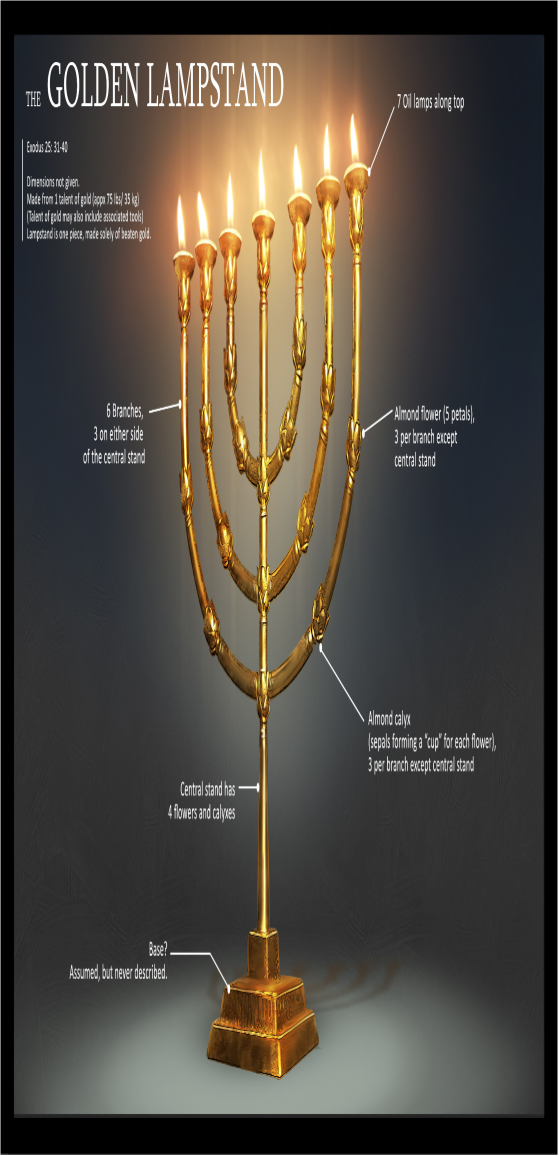
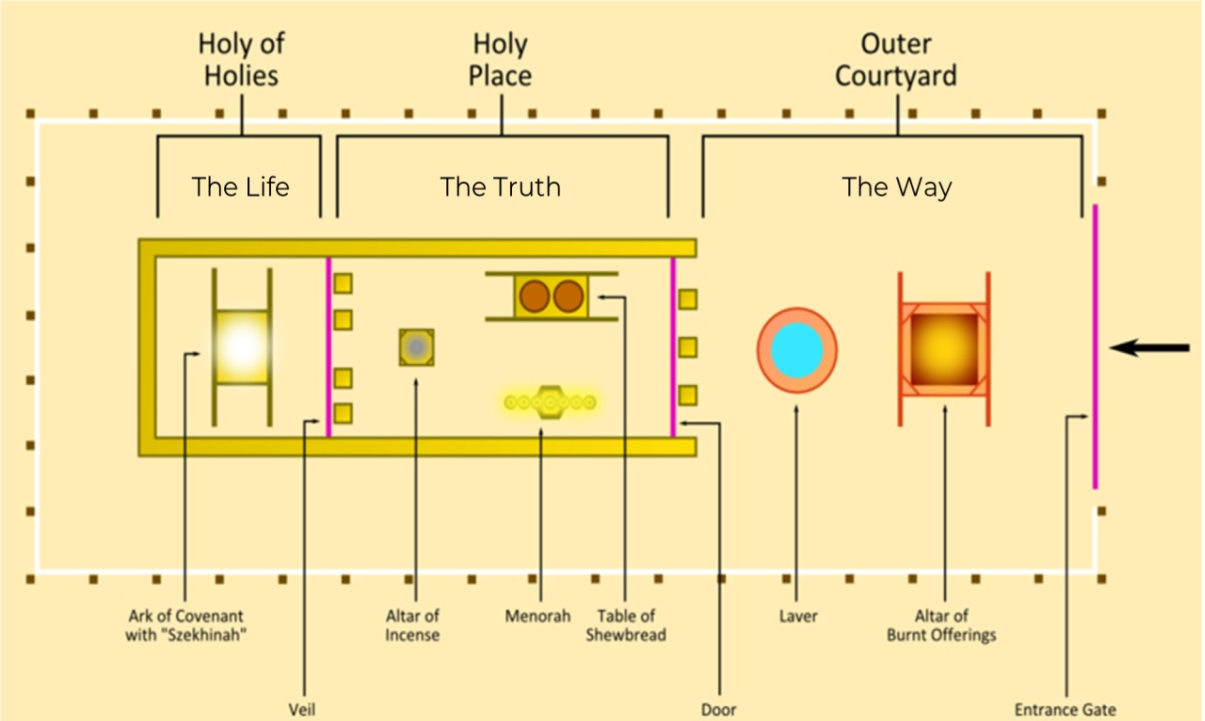
            In this message, our focus will be upon the lampstand in the tabernacle. But to show what this was like and where it was sited, consider the illustrations below:

The lampstand is also called the “Menorah.” Details of its construction can be found in Exodus 25:31-40. The lampstand was found in the Holy Place where the priests did their work. The Holy of Holies was separated from the Holy Place by a thick veil and could only be entered once a year on the Day of Atonement by the High Priest alone.

We shall consider this part of the tabernacle furniture using the following details of its structure and function:

[1] Pure gold.
[2] Of one piece.
[3] The only light.

[1] Pure gold.

            The ‘Menorah’ or the golden lampstand had seven branches in all. It was made of pure gold. In Scripture gold is put to illustrate divinity. The ark of the covenant was made of acacia wood overlain in gold and it housed the two tablets upon which were written the ten commandments. The wood aspect points to the human nature of the Lord Jesus and the gold to His divine nature. Gold was used in many other parts of the temple built later by Solomon. You may recall that the wise men who visited Christ in the manger brought gold, frankincense, and myrrh. Gold is a bright precious metal that is generally inert and so used mainly to represent the divine nature. Other precious substances such as pearls or other gems and precious stones are made from a combination of things that have undergone some form of transformation, but gold is elemental. Gold is considered a pure substance of great worth and largely uncorrupted. It is found as the native metal in the earth. So in the Old Testament economy (which is much more visual and earth-based), gold is put to point us towards the divine.

            But gold can in fact react if it is mixed with a mixture of nitric acid and hydrochloric acid. It serves well as a temporal picture to illustrate divinity in the tabernacle and temple because by-and-large it is pure, unreactive, very shiny, and highly prized. But in the New Testament we find that there are some precious things which are greater than gold. For example, true faith in Christ (that is, a faith which is genuine) is “much more precious than gold that perishes,” and it is even so “though it is tested by fire,” that it “may be found to praise, honour, and glory at the revelation of Jesus Christ” (1Peter 1:7).  Then further, our very redemption was purchased with something of much greater value than mere gold. Peter goes on to state in his first letter that we “were not redeemed with corruptible things, like silver or gold” but rather “with the precious blood of Christ, as of a lamb without blemish and without spot” (1Peter 1:18,19). Gold will perish, for it is simply a part of this creation. Even though it is a precious metal and high in value, Christ’s blood is of infinitely greater worth.

            The gold of the Menorah points us towards this thought that God in His incredible wisdom and grace has provided us with “precious faith,” towards Christ, and “precious blood” of Christ for our redemption which are of infinitely more value and worth than earthly gold.

[2] Of one piece.

            In Exodus 25:31 we are told expressly that the lampstand of gold was made from one piece. It was hammered into shape but from a single lump of the precious metal. We are also told that it was made from “one talent” in weight of pure gold (Exodus 25:39). There is some debate about the exact measure but it is somewhere around 32 to 35 kg. Apparently the average new-born baby weighs around 3.2 kg, so this lampstand is equivalent in mass to ten newborn babies! Quite a substantial size. It was no mere ornamental lamp on a sideboard!

            Why this emphasis on it being made from one piece and not being welded or joined in any way? This surely shows us the unique nature of the Lord Jesus. He is described in such unique ways in the New Testament as the following few examples show:

The Holy One and the Just. (Acts 3:14).
The Head of the church. (Colossians 1:18).
The Apostle and High Priest. (Hebrews 3:1).
The Mediator of the new covenant. (Hebrews 9:15; 12:24).
The Man, Christ Jesus. (1Timothy 2:5).
The Bright and Morning Star. (Revelation 22:16).

But then also He is One with the Father: “I and My Father are one” (John 10:30). When we think of the Lord Jesus Christ we are also to think of the Father too, for as our Lord Himself said: “He who has seen Me has seen the Father” (John 14:9). And we dare not exclude the Holy Spirit who Himself is God too. These three divine persons, Father, Son, and Holy Spirit, are united in the trinity. One God but three distinct Persons. All work in concert and harmony. Where One is there are the others in perfect union.

            Now our union with Christ is also apparent too. You will notice that there are six branches to the lampstand, three on either side. In the middle is the main or central branch. The number six is the number which represents man. Our Lord Jesus was the God-man. Fully human (although sinless) and fully God. Here in this menorah (lampstand) we see mankind reflected in perfection for the number seven stands for perfection, or that which is complete. Paul in Colossians tells us that in Christ “dwells all the fullness of the Godhead bodily” (Colossians 2:9), and because of our faith in Him we are united with Him and so Paul continues “and you are complete in Him” (Colossians 2:10). Wonder of wonders, the believer gets to share and partake of this incredible unity within the Godhead. As our Lord said in His prayer the night before He died:

20 “I do not pray for these alone, but also for those who will believe in Me through their word; 21 that they all may be one, as You, Father, are in Me, and I in You; that they also may be one in Us, that the world may believe that You sent Me. 22 And the glory which You gave Me I have given them, that they may be one just as We are one: 23 I in them, and You in Me; that they may be made perfect in one, and that the world may know that You have sent Me, and have loved them as You have loved Me. (John 17:20-23).

So we are “complete in Him,” and this is illustrated by the six branches of the lampstand and the central branch indicating perfection. The union of Christ and the believer is a theme which is spread throughout the New Testament. We have the illustration of the “true vine” and the branches in John 15. There is the illustration of believers as the one body of Christ (1Corinthians 12:13). We are “all one in Christ Jesus,” so that national and ethnic distinctions are all now gone (Galatians 3:28). For those truly saved this unity is eternal! And believers will reign forever with Christ (Revelation 5:10). The last part of Stuart Townend and Keith Getty’s song “See What A Morning” celebrating the resurrection has these words:

And we are raised with Him
Death is dead, love has won, Christ has conquered
And we shall reign with Him
For He lives, Christ is risen from the dead

Christ is risen from the dead

Or what of the hymn “All That Thrills My Soul Is Jesus”? Does the Lord thrill us so? Do we recognise that we shall indeed reign with Him in glory?

[3] The only light.

            If you look at the tabernacle again you will notice that the Holy Place and the Holy of Holies are enclosed spaces. These are separated from the outer court by means of curtains. The veil that separated the Holy of Holies from the Holy Place was much thicker than the curtains shielding the entrance into the enclosed space itself. So inside would have been very dark (the materials used to cover the tabernacle were many and quite thick). Thus the only light available within was provided by the lampstand. The priests could enter the Holy Place to carry out various functions, and the High Priest could enter the Holy of Holies once a year for atonement. But work in such enclosed spaces would have been very difficult without the light of the lampstand. Now if we have not the Lord Jesus Christ within (who is the “light of the world” John 8:12; 9:5) you cannot do anything that will bring God pleasure. You will be in darkness. Light brings the ability to function. Without this light in the tabernacle the priests would be fumbling about and unable to perform. Light, therefore, is essential. But man in sin is in darkness. The Lord Jesus Christ is our light. The tabernacle shows us how we can approach God to worship. Without the light we would be stumbled.

            Christ ought to be the centre of our very lives. He ought to be the One who guides and illuminates us. After all only in Christ can be found “all the treasures of wisdom and knowledge” (Colossians 2:3). We are therefore encouraged to “set your mind on things above, not on things on the earth” (Colossians 3:2), and we are to be “looking unto Jesus, the author and finisher of our faith, who for the joy that was set before Him endured the cross, despising the shame” (Hebrews 12:2). We are to look to Christ our light, for He is the light of the world.

            The world spends billions upon billions of pounds, dollars, and other currencies to figure out what has gone wrong with man. The Bible offers the analysis and the solution for free. The heart of man is deceitful and is full of darkness (Jeremiah 17:9,10), and man is lost in sin, but Christ is the light of the world and “in Him was life, and the life was the light of men,” and this light of Christ which has come “shines in the darkness, and the darkness” cannot overpower it (John 1:4,5). Christ Jesus has come to save us from our sin, and a key part of this is that we may see the truth, and that we see things clearly, as they are, so the light of Christ illumines us. The light of Christ is still shining through those who truly believe, for the Lord said to His disciples who truly believed “you are the light of the world” (Matthew 5:14). The light of Christ shows up our sin, and it also shows up Christ’s true and glorious life. This light is in the believer forever. The Lord has called believers to be the lights of this world. Through the apostle Paul He says that we should “shine as lights in the world” (Philippians 2:15), which we do by “holding fast the word of life” (Philippians 2:16). We were “once darkness” but on account of what the light of the world has done we are now “light in the Lord,” and so we are to “walk as children of light” (Ephesians 5:8). May the Lord shine through us the glory of His Son!

December 1st 2024: Gaius Douglas

Click on the link to watch this service on our YouTube channel: https://youtu.be/9cy-EKKPIS4?si=DgV0AKErFFaXokGx

Luke 1:26-38 God’s Interventions

God intervenes in the affairs of the world all the time. This world is upheld by Him. You and I are here this morning because we are upheld by His gracious hand. Nothing can happen without God ordaining it, without God allowing it. (Jeremiah 23:20). We are constantly surrounded by His divine interventions. He intervenes in a miraculous way. If you know the Lord Jesus Christ as your Saviour, you have made a profession of faith. God has intervened in your life, saving you from darkness into His marvellous light. We give Him the glory.

  1. Divine intervention – He speaks with authority.

We see God’s intervention and authority in the gospels. He says, ‘Go,’ ‘Come unto Me,’ ‘Go into the world,’ ‘Follow Me.’ When judged by Pilate, He says, “You could have no power at all against Me unless it had been given you from above.” (John 19:11). He has intervened in your life. God the Father sent the Son. We see the Spirit of God working and moving in this world, bringing the word of God to our soul. It reveals to us, For God so loved the world that He gave His only begotten Son, that whoever believes in Him should not perish but have everlasting life.” (John 3:16). He gave His begotten Son. Rejoice that our salvation is based on the finished work at Calvary’s cross by the Lord Jesus Christ. Rejoice every day – you have been saved.

Salvation is of the Lord. Appreciate God uses whom He will. We are called for a purpose. He has called us. God has chosen us in Christ, to take the word of God and take it to others. The Spirit of God reveals God’s word. He wants you to take this word to all around us.

  • When God speaks every human being needs to listen.

The angel Gabriel came to a house in Nazareth. He spoke to a young lady. He brought a message that would change this young woman’s life forever. Do we appreciate our lives have been changed forever? We find a wonderful verse in Isaiah 55:11,

So shall My word be that goes forth from My mouth;
It shall not return to Me void,
But it shall accomplish what I please,
And it shall prosper in the thing for which I sent it.”

It will accomplish what He pleases. It will prosper where He sends it. Regardless of what we may do, God continues to work by His Spirit, changing lives. He continues to work in your life, bringing you to a greater appreciation of who God is.

“This is the word of the Lord to Zerubbabel:
‘Not by might nor by power, but by My Spirit,’
Says the Lord of hosts.”

(Zechariah 4:6).

How wonderful!

The angel spoke to Mary. She listened. Are you listening? Mary was engaged. It was a contractual agreement. She was at home, probably thinking of the time when she would be officially married to Joseph, having a new home. Maybe she was a little anxious as well as happy. It is a life-changing situation going into something you have never experienced before. Mary was looking forward to life with Joseph, then the angel intervened. All of a sudden, her world was turned upside down. She considered the greeting from the angel. What an amazing message! All of a sudden, the almighty God was speaking and something was happening in Mary’s heart. The saving of our souls is a miracle of grace. We are bought with a price and now belong to God.

We read of the miracle of Elizabeth’s pregnancy – how she was barren and conceived in her old age. This message would have impacted Mary’s life. “For with God nothing will be impossible.” Are you challenged? Nothing will be impossible? Do you and I believe it?

On hearing this word, Mary willingly agreed and submitted to God. We hear these wonderful words, “Behold the maidservant of the Lord! Let it be to me according to your word.” (Luke 1:38). Mary’s response is an indication that the Spirit of God was at work in her life. We have in us the gift of the Holy Spirit. 1 Corinthians 6:19-20 reminds us that we are the temple of the Holy Spirit. What impact is that having on you each day?

The Holy Spirit has many functions and activities, “And when He has come, He will convict the world of sin, and of righteousness, and of judgment,” (John 16:8). God has given every human being a conscience. Every human has some knowledge of Him. The Spirit of God is moving, convicting the world of sin, of righteousness and judgement. The Spirit of God has convicted us we were sinners and needed salvation. He has called each of us to follow, to leave and follow.

Mary rejoiced. When God speaks, He expect a response from you and me. Will you follow Me? Will you go for Me?

  • When God speaks He expect me to respond.

Mary’s willingness to obey brought the blessing of God’s salvation to all human beings. His song shows a willingness to obey she willingly said, “Behold the maidservant of the Lord! Let it be to me according to your word.”(v.38).

We are called of God, individually. He has been speaking, sharing with you. Will you go for Him?

The angel said, ‘Leave the impossibilities to God.’ Mary said, “My soul [magnifies the Lord.” (v.46). She was not only rejoicing for herself but that God would bring blessings to you and me. She was going to enjoy the food of the land.

“If you are willing and obedient,
You shall eat the good of the land;

Isaiah 1:19).

For 30 years the Lord Jesus Christ lived in her home. She cared for Him and loved Him. She had the enjoyment of the very best of heaven. She and Joseph had responsibility for caring for the Son of God. She was also blessed to be an instrument in Jesus’ first act of public service (Marriage at Cana). When they ran out of wine she knew who to go to. Where do you go to? We see her faith in God, her Saviour. Led by the Spirit of God, she said to the servants, ‘Whatever He says, do.’ That’s faith! That is the authority God has given you and me. We are servants of the living God. He is the Saviour of our souls and has brought us life.

At the foot of the cross we see Mary standing next to John, the disciple Jesus loved. She looked up at God, her Saviour, the one who she nursed and cared for (Isaiah 49). This was her son. But He was more than her son, He was her God and Saviour. She felt the pain, not only as a mother but as a servant of God. She would have remembered when He said, ‘Do you not know I must be about My Father’s business.’

Has your life been changed? God has intervened in your life and mine. He has saved our souls, blessed us with eternal life. I am looking forward to sharing His glory. The same God who spoke to Mary and Joseph is speaking to you, saying, ‘Will you follow me?’ Will you be obedient to His calling? All He wants to hear is, ‘I will go for You.’ May that be your answer today. May God bless you.

November 24th 2024: Peter Robinson

Titus 2:13 – 3:7.

In this passage there is a word that crops up twice (2:13, 3:7). It is the word hope, true hope in a hopeless world. What is it you are hoping for, for the future? What do you hope for, for this world? What do you hope for yourself personally? We are living in a day of hopelessness; there is not a lot of hopeful speech going on in the public domain. Globally, we are told of the terrible effects of global warming and climate change. Internationally, there are conflicts whatever we turn – wars, fighting, potential wars. Close to home, nationally, we see a lack of hope – rising inflation, more crime. There are great moves to overthrow established truths; there is a new bill in Parliament to enable people to be killed. There are a lot of reasons to be discouraged. Perhaps, in our own lives, we have little hope for the future. There may the illness, loss, grief, unemployment. Wherever we turn, there is little to find hope.

The Christian is someone who has hope. One of the chief characteristics of a Christian is hope. Hope is built into their DNA. In spite of what is going on in our world, the Christian is someone who has a real hope, a certain yet not seen hope (Hebrews 11:1). This hope is definite, certain, real, absolute. It is very different from the way the world thinks of hope. For example, ‘I hope you feel better soon.’ This is a sincere wish, but there is nothing certain about it. Christian hope is not simply a positive mental attitude, an optimistic feeling. Everyone has a certain amount of hope for the future. The hope of the world is baseless, lacking in knowledge. It is a hope which has no certainty. The Christian hope is an inner hope which is permanent, solid, changing, empowering.

The foundation for our hope.

There are three essential cornerstones of our hope.

  1. Christian hope is in the life of the Lord Jesus Christ.

Nobody disputes a man called Jesus Christ lived about 2000 years ago in Israel. Not only do we have the accounts of the four gospel historians, but He is referred to in Jewish records and Roman records too. But the reason the Christian has hope is the life of Jesus Christ being seen in the word (John 1:14). In the life of Jesus Christ, we have God walking on the face of the earth and interacting with human beings. God has demonstrated in the life of Jesus Christ, His concern for the people of the world. The greatest evidence of there being God is the life of Jesus Christ. The life of the Lord Jesus Christ shows concern for the life of people. We see His compassion and His love for the marginalised. He was drawn to people others ignored. His compassion was seen in word and action.

We see in the life of the Lord Jesus Christ the very truth the world is searching for. His disciples testified He spoke the words of eternal life. His mind-blowing miracles transformed people as they received power, grace and healing. Everything declares to us God cares for us. Christian hope is God has made Himself known to humanity in time and space, and made known His love for the world.

  • Christian hope can be seen in the death of the Lord Jesus Christ.

Death is the very antithesis of hope, when hope has no more life in it. Death destroys hope, yet the death of Jesus Christ gives certain hope because of why He died. On the surface it appears He died because of the jealousy of religious leaders. But Jesus’ death was the proof positive that God will stop at nothing to save (Mark 10:45).

Can we trace why there is so much destruction in the world? It is not poverty or social injustice. The problems of the world are because of human sinfulness. The cause of every problem can be traced to the rejection of God, our Maker. We have all gone our own way, chosen to please ourselves. We make the rules, we do whatever we want. That’s sin. The human race is suffering from a crippling illness which has made us enemies of God. It cuts us off from God and puts us under the very judgement of Go – all because we have rejected Him.

When Christ Jesus came into the world, and suffered and died on the cross, it was to cure sin. He purposefully died to deliver us from sin and to transform us. The Christian has hope in this world in the death of Jesus Christ because we can be set free from sin.

  • Christian hope is founded on the resurrection of Jesus from the dead.

The resurrection is the guarantee. God made man, living amongst us, rose from the dead. After His resurrection, He spoke with many people. Everything stands or fails from the Resurrection (1 Corinthians 15:17). The reality is you and I must die. There will come a day when we will not be able to defeat death. But the resurrection gives hope that death is not all that there is, we can have eternal life. Our Lord Jesus Christ has conquered death for us (John 11). That is the Christian hope for the future – eternal life which is full, perfect, in the very presence of God.

This world is heading for another climatic conclusion. God designed this world not for destruction but for transformation (2 Peter 3:13). We are to look forward to a new heaven and a new earth. There is an end, but also a beginning when the Lord Jesus comes again. Our ultimate hope is the glory of our Saviour, the Lord Jesus Christ. This world is heading towards that day when Christ will come again. He will bring a new world of righteousness. Jesus comes again for those He loves. We wait for the blessed hope.

Yet, there is a serious warning. For anyone who has not built their hope in the Lord Jesus Christ, Jesus comes to bring judgement to those who have rejected Him. (1 Peter 4:1). Dear friends, it is time for you to give up your sin and receive His forgiveness. He has promised if you do that, He will give you a bright future.

What is your hope and hope for the future? Do you have this hope, this confidence and certainty in the Lord Jesus Christ? He is ready, willing, able to forgive you, to love you and save you.

November 17th 2023: David Norbury

Psalm 23

“The Lord is my shepherd, I shall not want.” This is a remarkable way to start a passage. In a world where enough is never enough, here we’re told, “The Lord is my shepherd, I shall not want.” What does it mean? Does it mean that Christians do not have any problems? No. The truth of the matter is the Bible is telling us ‘we shall not want.’ C.S. Lewis made a point; if you have a friend who dies, then part of you dies. With the Lord Jesus Christ, whatever problems we hit, He will guide us and take us through in a gentle way. We have a Shepherd, someone who meets our every need in the deepest possible way, in the things that really matter in life. He is our all sufficient One. There is nothing that we lack because of Him. Such abundance!

An angel is not our shepherd. The King of Kings and Lord of Lords is our Shepherd. It is difficult for folks outside the faith to understand the Lord is our shepherd. He is the one, there is no one else.

Where is the Shepherd?

“He makes me lie down in green pastures.
He leads me beside still waters.
(v2).

He leads me. He is ahead of me. He is taking me to places I can trust. Sheep trust their shepherd. The Lord Jesus Christ leads us. He takes us to the places He wants us to go. Where are you today? As a Christian, in a place where He has brought you to, leading you step by step, whatever difficulties you have, He is ahead of you, leading you.

Where else is He?

“Even though I walk through the valley of the shadow of death,
I will fear no evil,
for you are with me;
your rod and your staff,
they comfort me.”
(v4).

‘I fear no evil for you are with me.’ If you take the whole Bible and condense it down – it is here – ‘you are with me.’ The great Shepherd of the sheep is with me. The problems I face, the joys I have, are all because He has led me here, even in the darkest times of life. Sometimes, as He leads us into times of difficulty and challenges, in the most wonderful ways we wouldn’t be without those times. He, in His kindness, is with us. The Lord Jesus Christ is the Shepherd who cares for us. He is with us. He will never leave us all forsakes us. He is right by our side.

Throughout this passage we see it is very personal. You can see something changes in the way the psalmist, David, writes. He begins by writing about ‘He’ but then this changes to ‘you.,’ It is a personal statement of great confidence. He is personally ours and we are His.

“Surely goodness and mercy shall follow me
all the days of my life,
and I shall dwell in the house of the Lord
forever.
(v6).

Goodness and mercy. The Lord Jesus is the King of Kings and Lord of Lords. He is abundant in His mercy and kindness. He is the God who wonderfully meets our needs. His goodness and mercy follow us all of the days of our lives. They pursue us. They are for us, all the days of our lives. Isn’t that wonderful! If ever we feel alone, then the reality is we are not alone. He is leading us, pursuing us all the days of our life. What a great Shepherd we have. He loves us; He gave His life for us. What more could we want? He bore our sins. He gives His life for us.

“You prepare a table before me
in the presence of my enemies;
you anoint my head with oil;
my cup overflows.”
(v5).

This is a remarkable statement. There is a feast that the Lord Jesus, this great Shepherd, has prepared. It is a feast for our souls, our lives in heaven. Whatever challenges we face, the Shepherd is ahead of us. He provides for us, even in the presence of the enemies. In all the difficulties, there is a table prepared for you. Our God and heavenly Father, the Lord Jesus Christ, has prepared a table for us in front of our enemies. Remarkable. In our deepest and darkest times, He prepares a table, provides for our needs way beyond.

Sometimes, we can be switched off with our spiritual communication. What does the good Shepherd want me to hear now? Our hearts can be turned off. Switch on your spiritual Internet to call on Him. He is ‘my Shepherd.’ Know that He is the one to help us. He is waiting – even for you, even for me.

September 27th 2024: Harvest Service Martin Williams

Psalm 24

This is a psalm of David. Most people believe the psalm was written when David brought the Ark to Jerusalem. This song begins and ends with a harvest theme. It is a psalm that points us to the Lord Jesus Christ. We are going to focus on 4 points:

  1. God owns this world.

The earth is the Lord‘s and the fullness thereof,
    the world and those who dwell therein,
for he has founded it upon the seas
    and established it upon the rivers.

This world and everything in it is all owned by God. This is because He created it. We have a God who created all. We are not here to celebrate by accident; the seasons are a result of an almighty, all gracious God, the one true living God. These two verses teach that the world is created by God’s handiwork. All things were created by Him. The New Testament reminds us in John chapter 1, “All things were made through him, and without him was not any thing made that was made. In him was life, and the life was the light of men.” We also read in Colossians 1, “For by him all things were created, in heaven and on earth, visible and invisible, whether thrones or dominions or rulers or authorities—all things were created through him and for him.

It is wonderful to remember we live in a world created by God and sustained by God. What an almighty God we have, an all-wise God, to create such complexity. He must be a beautiful God. We live in a fallen, cursed world. But even then, we can see such beauty, especially as we look around the Pembrokeshire landscapes. He is worthy to be worshipped. It was for His pleasure all things were created (Revelation 4).

  • The Psalmist then asks, ‘Who may come before this God?’

    “Who shall ascend the hill of the Lord?
        And who shall stand in his holy place?
    He who has clean hands and a pure heart,
        who does not lift up his soul to what is false
        and does not swear deceitfully.
    He will receive blessing from the Lord
        and righteousness from the God of his salvation.
    Such is the generation of those who seek him,
        who seek the face of the God of Jacob.

It is one of the most important questions any of us can ask. How may I draw near to this God and know Him?

“Who shall ascend the hill of the Lord?
    And who shall stand in his holy place?

Why is that place called a holy place? Because God dwells there! God is a God of absolute, inflexible holiness. God is light, in Him is no darkness. Our God is an all-consuming fire. That describes His holiness. If a sinner stood before Him, His holiness would consume us. Who will stand in this holy place? We are told exactly who can come,

“He who has clean hands and a pure heart,
    who does not lift up his soul to what is false
    and does not swear deceitfully.”

God will accept those with clean hands which show outward action, outward life – a life where there is no sinful action whatsoever. But we have stained hands. Outwardly, we have not lived a life in conformity to Lord God. We don’t have a wholehearted obedience. We don’t have clean hands by nature.

But it goes deeper – “He who has a pure heart.” Our God is a God who looks upon the heart (1 Samuel 16). Our hearts by nature are sinful, vile, evil. God requires truth, “He who has not lifted up his soul to an idol.” Lifting up your soul is to trust in God, but we have lifted up our souls to false gods and idols. What occupies your thoughts? What brings you the greatest joy? Is it family, work, your bank balance, your reputation? That is lifting up your heart to vanity. God requires you to worship Him and Him alone. We come to the conclusion, none of us could stand before this God in and of ourselves.

  • The Lord Jesus Christ is able to bring us to God.
    “He will receive blessing from the Lord
        and righteousness from the God of his salvation.”
    (v.5).

He.’ There is only One who could do this. None of us could, but there is one – the Lord Jesus Christ. God’s Son came into this world and said, “I delight to do the will of God.” Look at His life and see a life of sinless perfection. Here is a man with clean hands and a pure heart. He is one who completely and wholly kept the word of God. Even His enemies spoke of Him in this way.

The remarkable truth is when Jesus Christ honoured God’s law, He honoured it for you and me, in our place. In His life and death, He died as our representative. When He was in this world, as He rendered to the Father in wholehearted obedience, He was earning righteousness for all those who believe in Him.

We have broken the law, “The wages of sin is death.” The Lord Jesus Christ, upon Calvary’s cross, honoured to the law in another way. In His death He honours the law by bearing it’s just penalty for those who have broken it. He bore our curse, our debt, the judgement of God. On Calvary’s cross the Lord Jesus Christ endured the fire of God’s holiness. When Moses stood before the burning Bush he was not consumed. On the cross of Calvary, Jesus Christ was our burning bush, raging in His holy soul. Yet, He was not consumed. In His Life and in His death, He honours the Lord God for you and me.

When we come and wholly trust in the Lord Jesus Christ, we receive pardon for our sins. God cannot demand twice. The great transaction is done. We are then clothed in righteousness divine. God sees my sin has been pardoned. He sees me righteous as Jesus is, pure as Jesus is. The robe covers me completely. God sees me in Christ, righteous. In that way, I can approach God – something no Jew could do in the Old Testament, let alone the high priest once a year. But we can enter into the holiest through the Lord Jesus Christ – not once a year but every day. By myself, I cannot stand before God, but through Christ Jesus I can.

  • The triumph of all in Christ.

“Lift up your heads, O gates!
    And be lifted up, O ancient doors,
    that the King of glory may come in.
Who is this King of glory?
    The Lord, strong and mighty,
    the Lord, mighty in battle!
Lift up your heads, O gates!
    And lift them up, O ancient doors,
    that the King of glory may come in.
10 Who is this King of glory?
    The Lord of hosts,
    he is the King of glory!” Selah

We see in these final verses the entrance of Christ into heaven. The cry goes out twice. This tells us the everlasting doors will open for Christ twice. The first time has already happened,

“Who is this King of glory?
    The Lord, strong and mighty,
    the Lord, mighty in battle!”

This took place at the Ascension. The one who has gained a victory, triumphed in the battle. A mighty battle was fought at Calvary and He gained the victory. Now the triumph begins. The King of glory returns. He comes to reign, to intercede for His people.

But then in verses 9 to 10 we read of the ‘Lord of hosts,’ the Lord with a vast army coming in His train. When will this happen? There is a day coming when our Lord shall descend, when He will come for His people. He will come to bring them home – a harvest reaped (1 Thessalonians 4).

There is a day coming when they will be a shout from heaven. The king of glory is coming with a vast host of people, so numerous no man can count them. They will come in triumph. He will be bringing His harvest home. Will you be among that throng? Will you be there? I pray that each and every one will be. But if you are not sure, if you haven’t got clean hands and a pure heart, if you haven’t truly trusted in Jesus Christ, what do you need to do? My friends, simply this – turn your eyes upon Jesus and look full in His wonderful face. Turn from the life you are living and turn and trust in Him. Trust in Him alone.

Our Lord does not play hide and seek. He is freely available. If you want Christ, you can have Him, no matter how young or old you are. You can know the certainty you will be among the harvest on that great last day.

September 15th 2024: John Mann

To watch this service, click on the link to our YouTube channel: https://youtu.be/ME3DlIYJ57A?si=KGP0pLDYEsGPSivD

1 Samuel 21:1-9 Faith in difficult times

Liars need good memories! Having lied once, the second time is easier, the third one easier still. David, God’s chosen king, is finding life difficult. Saul has become very jealous of David and has sought to take David’s life. David is finding the way hard and it is damaging his integrity. Fear is chipping away at David’s principles. His walk with God is compromised.

Sadly, lying is becoming a habit. David is seeking to escape from Saul. As he plans his escape his says to his friend Jonathan, If your father misses me at all, then say, ‘David earnestly asked leave of me to run to Bethlehem his city, for there is a yearly sacrifice there for all the clan.’” (1 Samuel 20:6). It is a blatant lie, a total fabrication. He is concocting a false alibi. In so doing, he makes Jonathan complicit in the deceit as well. The world would say, ‘The end justifies the means. Needs must, a white lie causes no harm.’ But the Bible is very clear – we are to be truthful at all times, even those times when we find the going difficult.

David escapes under rives in the town of Nob, where the Tabernacle has been established and where the priests are there to carry out their daily duties. He arrives not far short of destitute – virtually nothing and no one with him. He hopes to find some assistance in the Tabernacle. Ahimelech is a friend, but he is anxious. He knows Saul is out for David’s blood. It is also the Sabbath day. David would not normally travel alone on this day. David senses Ahimelech’s mind. He is afraid he won’t give him the help he needs so he invents a pack of lies, “The king has charged me with a matter and said to me, ‘Let no one know anything of the matter about which I send you, and with which I have charged you.’ I have made an appointment with the young men for such and such a place. Now then, what do you have on hand? Give me five loaves of bread, or whatever is here.” (v2-3). He says he is on a hush-hush mission. David comes to the priest for support and food.

Fear has lowered his standards. Desperation and deception have overcome his faith and his trust in God. On many occasions God has proved His faithfulness to David: spared him from harm, protected his life. This is the man who took on and defeated Goliath, the ten foot giant. God had appointed Samuel to anoint him to be the king of Israel. You would think David would feel untouchable, knowing that he is under the protection of the sovereign God. But he is suffering from spiritual amnesia. God’s goodness has become a dim and a distant memory. He is depending on own initiative and his own ingenuity to see him through this difficult time. He has decided to go it alone without seeking God’s help. He resorts to deception and lies.

We cannot justify David’s actions, but we are in no position to criticise. We have all felt the heat and burden of the day in our Christian lives. Do I deal with anxiety any better than David when the pressure is on? Does fear and anxiety get to me? Where is my first port of call when things get difficult? Is it the throne of grace?

We can learn from David’s failure. We go through the trials. If we turn to the Lord, we can find Him closer than ever. He is our God. He is faithful, shaping us more into the likeness of the Lord Jesus Christ. Count it all joy, my brothers, when you meet trials of various kinds, for you know that the testing of your faith produces steadfastness. And let steadfastness have its full effect, that you may be perfect and complete, lacking in nothing.” (James 1:2-4). That is God’s invitation as He takes us through difficulties. It is always for our good. When the Lord leads us down difficult paths, it is always for our own good and blessing. There may be torrents of hardship, floods of sadness, but God will always keep our heads above water and be with us. We won’t be completely consumed. If there are hardships that come your way, we need to look to Him, the Father of all mercies and the God of all comfort.

“But the Helper, the Holy Spirit, whom the Father will send in my name, he will teach you all things and bring to your remembrance all that I have said to you. Peace I leave with you; my peace I give to you. Not as the world gives do I give to you. Let not your hearts be troubled, neither let them be afraid.” (John 14:26-27). These are the promises of Jesus Himself. Every promise is a blessing to us, and we should hold onto them.

David’s circumstances were desperate and he had legitimate concerns. He fell into the trap of falling away from the Lord. Thankfully, God never took His eyes from David, or from us. David is hungry but all Ahimelech has is the holy bread of presence. The loaves were renewed every Sabbath day, but they were only to be eaten by Aaron and his sons, the priests. The bread also pointed forward to God’s great provision, that of satisfying our spiritual hunger. Jesus said to them, “I am the bread of life; whoever comes to me shall not hunger, and whoever believes in me shall never thirst. 36 But I said to you that you have seen me and yet do not believe. 37 All that the Father gives me will come to me, and whoever comes to me I will never cast out. 38 For I have come down from heaven, not to do my own will but the will of him who sent me. 39 And this is the will of him who sent me, that I should lose nothing of all that he has given me, but raise it up on the last day. 40 For this is the will of my Father, that everyone who looks on the Son and believes in him should have eternal life, and I will raise him up on the last day.” (John 6:35-40).

In Bible times bread was the staple diet of the people for physical existence and well-being. Without the bread of life, Jesus, there is no possibility of spiritual life. He is fundamental and essential to our eternal existence. If we refuse to feed on Him by faith, then we starve ourselves of life and we will be afflicted, as David was. Are you feeding upon the bread of life, the Lord Jesus Christ? Are you looking to Him for your spiritual and eternal well-being?

David’s need is legitimate; he is suffering from real hardship and is desperate. He requires assistance. God had made provision for such circumstances. Compassion and kindness is more important than the law. The law was an incentive to lead them in God’s ways, but not a set of handcuffs to bind the people. There was no allowance which permitted anyone but Aaron and his sons to eat the bread. But the spirit of the law allows love and compassion.

One Sabbath he was going through the grainfields, and as they made their way, his disciples began to pluck heads of grain. 24 And the Pharisees were saying to him, “Look, why are they doing what is not lawful on the Sabbath?” 25 And he said to them, “Have you never read what David did, when he was in need and was hungry, he and those who were with him: 26 how he entered the house of God, in the time of Abiathar the high priest, and ate the bread of the Presence, which it is not lawful for any but the priests to eat, and also gave it to those who were with him?” 27 And he said to them, “The Sabbath was made for man, not man for the Sabbath. 28 So the Son of Man is lord even of the Sabbath.” (Mark 2:23-28).

The Levitical law gave Jesus the right to pick the grain for those who were hungry and in need. God makes provision for all our needs. He provides that spiritual help and strength in times of difficulty. Jesus came to be the instigator and fulfiller of the new covenant. Praise God the Lord Jesus came and did what we could not do for ourselves. All that the Lord does is to reveal our sin and show us the need for salvation. Jesus came to obey the law for us. It frees us from the condemnation of sin. We are a privileged people. God has drawn us, opened our eyes to see the need for salvation.

For David, in his desperate situation, he was entitled to eat of the bread from the Tabernacle. But, as a result of David’s deceit, if we read on, so much grief and tragedy resulted. For us, as believers, obedience to God’s law is important. But now, it is written on our hearts. Jesus has fulfilled that law. We should have a desire and honour to please Him.

We cannot use grace as an excuse to live our lives as we please. God’s commandments show He wants us to live in accordance to His ways. He wants us to be good ambassadors for the Lord Jesus Christ. We are saved by grace, through faith in the Lord Jesus Christ. We should long to walk in God’s ways. We should have total reliance on the promises of God.

For unbelievers, failing to trust in the Lord Jesus Christ, their situation is even more desperate than David’s. They are eternal souls are in grave danger. God says you are invited, welcome to eat of the bread of life.

Satan is the father of lies. He will whisper deceit into our minds. Don’t believe this nonsense that you can get by on your own. None of us are good enough to come into the presence of a holy, righteous God, unless we are covered in the righteousness of the Lord Jesus Christ. Are you clothed in garments of salvation?

Believe on the Lord Jesus Christ and you shall be saved. Look only to the one who says, “I am the bread of life; whoever comes to me shall not hunger, and whoever believes in me shall never thirst.  If we are children of the living God we have that wonderful, eternal future that lies before us, when we will see Him, our Saviour, face to face.

August 3rd 2024: 202nd Anniversary Service – Adrian Brake

2 Corinthians 5:17-6:2

Reconciliation

The fact that Penuel, Roch is still alive and kicking in these dark days is because God still has work for you to do. What is that work, that contribution? God has a message He wants people of this area to hear. He has appointed you to deliver the message on His behalf. It is a message they must hear. The churches responsibility is to proclaim it. It is a message of reconciliation for a broken world, reconciliation through Jesus Christ.

What is the message of reconciliation God has to deliver, and how will it be delivered?
What does it mean to be reconciled? The bringing together of two parties that have previously estranged, where there is ill feeling between them, a huge gulf, where’s those two warring parties have been restored to a peaceful relationship.

In 2 Corinthians chapter 5 we see the most wonderful reconciliation between a holy, righteous God and wretched, guilty sinners. It is tragic when we read of the beginning of scriptures when God created us to have this life-giving, soul-refreshing relationship with Him. Yet, we are at war with Him, poles apart. Why? Adam, our representative, rose up against the God who created him. He wanted to live life according to his own terms. Adam had once enjoyed perfect fellowship with God, walking with Him in the cool of the evening and talking with Him. What a picture of God, Adam and Eve, walking and talking in the garden.

In next to no time they are completely shut out of the garden because of sin, because of rejection. That beautiful relationship is spoiled. That is our relationship too; we are determined to walk away from God, rising up against Him (Romans 8), going our own way. We, who were created for a relationship with God, are the children of God’s wrath. What an awful situation. We are all born into sin. Yet, against this dark background, we read in 2 Corinthians of those far from God, restored to Him and living in fellowship with Him.

  1. Reconciliation: something God has done for us.

Reconciliation on a human level is when 2 individuals fall out, two nations fallout. Someone outside the conflict seeks to bring them back together, or the person who has caused the estrangement sees what happened and recognises what they have done, then approaches the person, asking for forgiveness.

Here, in 2 Corinthians chapter 5, this is not what has happened. The one who has been sinned against, the one who is utterly blameless, He is the one who has made a glorious decision to settle the dispute. He has come down and reached out to His enemies who deserve nothing. He has come down to bring peace. This is an act of God. Astonishingly, in verse 20 He comes to people and pleads with people. Amazing Grace. He is utterly blameless when the other party doesn’t care, then goes further and pleads with them. He implores us to escape His wrath and enjoy His love. Incredible! He makes the way of reconciliation.

To think we were living in sin, sinning ourselves to hell at the second coming of the Lord Jesus Christ. Then, God comes to you and to me in grace. He brings the gospel to you and reveals that before the creation of the world, God purpose to bring you to Himself. Then, astonishingly, He takes it to another level – humbling Himself and pleads for you to come to Him.

  • Reconciliation: something God has done for us in one person (v.18-19).

This is why we must preach the Lord Jesus Christ – because He is the only one who can make this reconciliation possible. Without Him, there could be no reconciliation. He is God’s gift to us so that reconciliation might take place. The son of God comes in the person of the Lord Jesus Christ to the believer. He is precious. Everything.

  • Reconciliation: a work God has done for us.

This is a work God has done for us both in His Son’s death and life. Jesus Christ had to live and die for us to be reconciled to God (v.21). There is something we have that we must get rid of, and something we don’t have that we must be given. Before we can be reconciled to God we need righteousness. God cannot fellowship with sin. He hates sin and delights in righteousness. Righteousness is when we adhere to God’s law in all its fullness. We need to be perfect, flawless law keepers. This is what God requires in a person who wants fellowship with Him. Perfection! How can we ever come to Him? We are lawbreakers.

How can we ever have a perfect record? That is where the Lord Jesus Christ comes in. He comes into the world as a real human being. He lives a perfect, utterly obedient life – the only human being to have this perfect righteousness. He lived this life for His people. Every time He obeyed God, He did it on your behalf. He loved the Father with all His heart, soul, mind and strength and did it on your behalf.

When we put our faith in the Lord Jesus Christ for salvation, all His perfection becomes ours. When God looks at you, He sees His Son and He sees perfection, and He is able to have fellowship with us, For our sake he made him to be sin who knew no sin, so that in him we might become the righteousness of God. (2 Corinthians 5:21). If you are in Christ, you have nothing to answer to before the throne of God. Everything He did is yours. We need righteousness. We have it in Jesus Christ.

We have sin. We need to get rid of it. How? We can’t just undo them. It is sin that spoiled everything. Until it is settled you can never move on. Sin separates us from God, “In Christ God was reconciling the world to himself, not counting their trespasses against them, and entrusting to us the message of reconciliation.” (2 Corinthians 5:19). God does not count the sins of His people against them. God does not hold them against us.

How can God let us escape, cancel the record against me? He does. It is the gospel. How? For our sake he made him to be sin who knew no sin, so that in him we might become the righteousness of God. (2 Corinthians 5:21). He sets us free and cleanses us of our sin because He has dealt with it through His Son. There, at the cross, Jesus Christ took responsibility for your sin. That life of stubbornness, rejection of God was placed on Jesus Christ and He was accountable for it instead of you. He died that death for you. God punished His own Son. How deep the Father’s love for us.

Will we ever understand how much the Father loved His Son? Yet, He did not spare His Son. Jesus Christ went to the cross willingly. He knew what was ahead, the horrors, the bitterness of the cup, yet He went willingly. We live. Far from God, in rebellion, God appoints His Son to spare us what we thoroughly deserve. He comes into this world, humbles Himself, lives a life of sorrow to establish a righteousness for us. He does all this so we can come to God, that we might live with Him forever in heaven. When we were enemies, we were reconciled to God through His Son, through the blood of His cross.

What is wrong with our world? People are estranged from God. True joy, life, energy, and purpose can only be found in a relationship with God. We have a message to declare to the world – God is a God of incredible love who, in love, sent His Son into the world and has made a way for us to be reconciled to God. We are the only ones, Christians, who have the answer to the world’s pain and misery. It is our privilege to bring the message.

June 23rd 2024: Gaius Douglas

Readings: Psalm 23 & John 10:1-17
Jesus, the true Shepherd, the Good Shepherd.

Psalm 23 is one of the most well-known, wonderful psalms in scripture. This psalm is known in many languages and by many people. It is repeated by many. It is read at funerals of the saved and unsaved. It is repeated in difficult situations. Every man will have to give an account to God. When you repeat this Psalm you are repeating words of scripture and you are accountable for every word that you have spoken.

David wrote this song when he was a shepherd and had sheep as a little boy. He loved them and cared for them. Samuel was sent to the House of Jesse to choose a king from that family. Jesse brought his strongest, fittest son but Samuel asked for another. David, the youngest, was on the hillside. Samuel asked for him. God says, ‘This is the one.’ When you compare David to David’s older brother in the King’s army, surely the oldest son would have been the one. But no – David, the one who cared for sheep, is chosen. This little boy stood before the strongest and mightiest God. By His Spirit, He allowed David to pen these words, ‘The Lord is my shepherd.’

Do you know this as a reality in your life? David knows his sheep, but he is taken to the Shepherd of the sheep. Sheep are very dependent on their shepherd. We live in Pembrokeshire, in Wales. There are more sheep than people. A shepherd is there to protect, to watch over and make sure that the sheep do not get into trouble. They depend on the shepherd to care for them. Now, David says, ‘My God is my Shepherd. He looks after me. He cares for me.’

In John chapter 10 Jesus says He is the Good Shepherd. What does it mean to be a Good Shepherd? ‘Good’ in Greek describes a noble, wholesome, beautiful person. The Good Shepherd is good inwardly and outwardly. The Lord Jesus Christ is the Good Shepherd. He is the only One who is good through and through, “For He made Him who knew no sin to be sin for us, that we might become the righteousness of God in Him.” (2 Corinthians 5:21).

Jesus contrasts Himself with those who had to care for His sheep. The Pharisees had responsibility to keep the law and look after the sheep of His pasture – yet they were not doing this. The Pharisees were meant to protect but allowed the wolf to come in and take the sheep. Do you realise how privileged you are? If it wasn’t for the Lord, where would you be? If He wasn’t the Door, where would you and I be? He is the Door. Regardless of who comes, He will protect us, I am the door. If anyone enters by Me, he will be saved, and will go in and out and find pasture.” (John 10:9).

Do you come to the Lord? He wants to hold you in His arms. So often we are reluctant to come to Him, but He wants you to come close to Him. The thief does not come except to steal, and to kill, and to destroy. I have come that they may have life, and that they may have it more abundantly.(John 10:10). The thief does not come except to kill and destroy – referring to the Jewish leaders of the day. Instead of loving the people, they gave others the responsibility to look after them, but they stole from them (Malachi – the priests had responsibility for looking after God’s people).

Each of us has a responsibility for the person next to us, to care each other and to look after each other and feed each other. In Malachi, the people were told to bring unblemished sacrifices, but they brought blemished sacrifices. The priests accepted the corrupt offerings, but God rejected them. We have a responsibility to bring God sacrifices of praises that are pleasing to His sight. What have you brought to Him this morning?

We need to give Him the first place – that is the place that is His. We are set apart for His glory and praise. We are holy. God sees us as holy in Christ. What are you bringing to Him everyday? You and I have a responsibility that we do not lead others astray. Are you living in Him, walking in Him? Can others see this?

Jesus is the Good Shepherd. He is saying to the religious leaders He is not like them. He is the Door. He will keep, He will guard, He will protect, He will uphold His sheep.

The hired hands ran away when the wolf came. As believers in Christ, we are held by His power. His everlasting arms hold us (Deuteronomy).

In John 10:17-18 we see Christ going to Calvary’s cross. Here is the Lamb of God who takes away the sins of the world. We see the depth of His love, the meek and lowly one who lays His life down for His sheep – defending us from the wolf, “Therefore My Father loves Me, because I lay down My life that I may take it again. 18 No one takes it from Me, but I lay it down of Myself. I have power to lay it down, and I have power to take it again. This command I have received from My Father.”

He has the power to overcome. We have been singing, rejoicing, because of Him who has redeemed us by His precious blood. He is holding us and will never let us go. He is the Good Shepherd who loves us. He will not leave or forsake us. He loves us so much He is taking us to heaven.

“But now, thus says the Lord, who created you, O Jacob,
And He who formed you, O Israel:
“Fear not, for I have redeemed you;
I have called you by your name;
You are Mine.

(Isaiah 43:1).

The blood of Jesus Christ cleanses us from all sin. We are His.