September 24th 2017 (noon): John Funnell

John Funnell - Sept 17II Kings 4:1-7

The woman had nothing left. Creditors were coming to take her boys as payment for the debt. Think about the poor woman – her husband was dead, she was in debt, her boys were about to be taken.

‘Now the wife of one of the sons of the prophets cried to Elisha, “Your servant my husband is dead, and you know that your servant feared the LORD, but the creditor has come to take my two children to be his slaves.”’ (II Kings 4:1). The woman cried out to Elisha – God’s man on the ground. Have you got an Elisha in your life you can turn to? Are you an Elisha? Can someone in the community turn to you in a crisis? As a church we are a family – bound by the love of a family, bound by the blood of Christ. Our churches need to regain the community’s home. We need to become the Elisha of Roch in our work, for our neighbours.  Also, we need to become the Elisha for each other. Have gospel love at the heart of your church. You’ll never need gimmicks, be driven by gospel-centered life, by God’s word. Be a place where people are happy to come to at all times.

The love of God will draw people in. That’s what evangelism is. We don’t offer what the world offers. As a church our priority in our community is to be an Elisha. How should we respond to people who cry out to us? The widow is in the time of greatest need. Elisha asks her what she has. Interesting. He reminds her to look back at how God has blessed her. Initially she says she has nothing, then pauses and says she has a little oil. We too have a little oil. Don’t let the stresses of life control us, cloud our view of what God has done for us. Humanly speaking, the church is dying in Wales – empty pews, people not interested. We must not forget our responsibility to thank God, to thank Him for the little oil we have.                                   

It was only God who could pay this woman’s debt. It was only when she could totally rely on Him in faith that God poured out His grace to her. When we realise we are incapable of saving ourselves, He will pour it His Spirit to you. Whatever doubts and anxieties you carry, God’s merciful Spirit will never dry out, just take your empty jars to Him. Pray in desperation, knowing that without God we have nothing. 

Do your neighbours know you go to church every week? If they don’t know, they won’t come to you in times of need. People have stopped coming to church.  We need to become the Elisha of our community. We must acknowledge the facilities we have, remain responsible for the pot of oil we have.  We must go forward in faith and He will pour out all we need.

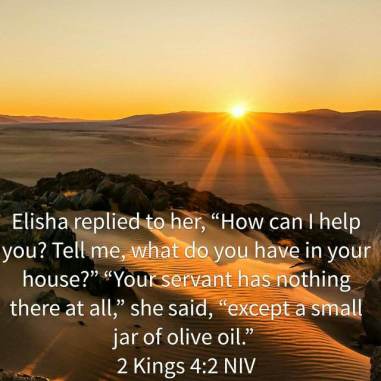
2 Kings 4-2

How do we respond when people ask us about Jesus?

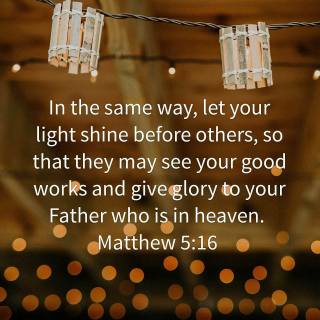
Matt5.16

What would be the first thing you would say to a friend if they came to you asking about Jesus? Would you say that Jesus is your best friend? A historical figure? A religious leader? As we become more mission-minded, it is an important question to know how to answer.

In Matthew 5:16 we see that followers of Jesus are called to shine their light before others. At the core, sharing our faith isn’t about giving someone a lesson of spiritual laws or a heavy theological explanation. It’s about introducing people to someone they can know personally, someone who loves them, someone who will change their lives forever.

The challenge for Christians is to communicate the gospel in a way people can understand. We undertake the awesome task of explaining eternal truths in different ways that will connect to our community today. Our impact in sharing Jesus in our schools, home, community or workplace is directly linked to our knowledge of those around us and our ability to engage with them. 

As we make an effort to understand the people God has placed around us, we will find better ways to engage with and respond to the difficulties and negative perceptions that many have against religion and Christianity.

When God wanted to connect with humanity once and for all, He didn’t write a sermon, He came to visit us in person. Our job is to be His witness, pointing our community to know God, to relate to Him, and to have lives changed by the power of His love and forgiveness. God is a person to know, not a theory to understand.

It is important to remember that the Holy Spirit is at work in us, He will always supply the right words to use in season.  When we are willing to pause and ask God to guide and prompt us, you never know what opportunities will appear.

When we allow the love of God to grow within us, dying to our old self and receiving new life, it flows out to everyone around us too.  Consider the incredible calling of sharing Jesus with those around us, begin to ask yourself – “What are the reasons I should share?” and you will find the love of Jesus will stir with you and completely overcome our fears and obstacle to sharing.

1Peter3.15.jpg


Children’s Club – 29th September 2017

We had a lovely time celebrating Harvest 🍓🥕🍂🌻 The children explored, with awe and wonder, the beautifully decorated chapel before singing and praying to God 🤔🙏🎵This was followed by painting cards before apple and blackberry picking 🎨🍏 Looking forward to all the exciting plans we have in the next few weeks, including a family fun afternoon on Saturday 21st October, 2 p.m. at Victoria Hall and our Light Party on Tuesday 31st at 5.00 p.m. 🎉🎈🕯️😃

September 17th 2017: Alan Davison

Alan Davison - sept 17John 7:1-24

Time, as a concept, has always fascinated humanity. We want time, yet we rush around, which doesn’t help. Blaise Pascal, the French religious philosopher, mathematician and physicist, once wrote, “I would have written a shorter letter, but I did not have the time.” In the 1800’s the theory of evolution gained credence, claiming that anything was possible in millions and millions of years. Lord Tennyson, a Christian, wrote:

            Here about the beach I wandered,
Nourishing a youth sublime,
 With the fairy tales of science
                                                 And the long result of time.

Time is very important in the Bible. In today’s popular culture there is more of a focus on time. For example, there are many television programmes featuring time travel. We often think, ‘If only we had time again we could change things, fix things.’ What’s to say by changing a mistake we wouldn’t end up making a worse mistake?

Time is a succession of moments. Biblically, time is part of creation, a possession of God. ‘Before the mountains were brought forth, or ever you had formed the earth and the world, from everlasting to everlasting you are God.’ (Psalm 90:2). Here we have a mixture of tenses; time is past but God is present because God has always been. This psalm was written by Moses, who understood God made time.

‘Behold, God is great, and we know Him not; the number of His years is unsearchable.’ (Job 36:26). We cannot measure God’s existence because He exists outside of time.

‘”I am the Alpha and the Omega,” says the Lord God, “who is and who was and who is to come, the Almighty.”’ (Revelation 1:8). Here we have God’s own words. God Himself declares He encompasses all of time. These are weighty concepts.

God acts in time. We see this most clearly in the Incarnation. Being God, Jesus knew the importance of time. Certain events had to happen at the ordained time of the Father. ‘Jesus said to them, “My time has not yet come, but your time is always here.’ (John 7:6). Jesus speaks here of the contrast of man’s use of time and his perceived perception of time.

A time to shine. Jesus’ brothers didn’t believe in Him, ‘For not even His brothers believed in Him.’ (John 7:5). The Feast of Tabernacles was so important it was mandated that the Jews attend. Jesus’ brothers may have wanted Jesus to attend out of concern that He had lost followers, ‘After this many of His disciples turned back and no longer walked with Him.’ (John 6:66). Perhaps they thought He could gain more followers, potential recruits, at the Feast. However, they may have had a more sinister motive; it was widely known that the Jews sought to kill Jesus. Perhaps His brothers were suggesting He should go, knowing that this would put Him in danger, even resulting in His death. Most Jews in Jesus’ time were looking for salvation from the Romans. Jesus turned down His brothers’ course of action. His time to shine had not yet come.

We see a contrast in Jesus’ brothers who had time to spare. They were not constrained by time. However, the way we experience time has been ordained by God. Jesus did not go to Jerusalem on a whim but when He was supposed to. He rejected his brothers’ advice. Jesus knew exactly what needed to be done, when it needed to be done and why. As others look at us, how do they see we are living our lives? it needed to be done. How do we value our time? The world says, ‘time is money.’ This is certainly true. We are paid for the time we work and pay others for their time. We talk of ‘spending time.’ This suggests we ourselves think of time as a resource to use as we see fit. ‘Look carefully then how you walk, not as unwise but as wise, making the best use of the time. Because the days are evil.’ (Ephesians 5:15-16).

‘Walk in wisdom toward those who are outside, redeeming the time’ (Colossians 4:5). To redeem something means to buy it back. The Bible tells us we should be buying time – it’s not our own personal property. In Ecclesiastes 3:1-8 we read there is a time for everything. We need to ask God for wisdom when a period of rest drifts into wastefulness.

A time to stop. We need to wait on the Lord. ‘After this Jesus went about in Galilee.’ (John 7:1). What did Jesus do as He walked in Galilee? From the other gospels we know Jesus did much, such as feeding the 5000, healing a blind man, being transfigured. However, John speaks of Jesus’ brothers being mean to Him. The Feast of Tabernacles lasted 8 days. This incident takes place midway. For four days Jesus did nothing in Jerusalem. It shows us Jesus was waiting for the Father’s timing. He would have been praying, meditating on Scriptures. There was a growing level of opposition which would have been becoming more and more stressful. People sought to seize Jesus. The Pharisees would ultimately succeed in arresting Jesus – but in God’s time.

If Jesus stopped, we certainly need to stop and evaluate. Do we take time to pray, to read the Scriptures? Do we spend time in prayer, to seek His guidance for the week ahead? If we have time to spare we ought to be putting it to use in a way that is pleasing to our Father, helping others, praying. The activities we do require an act of will.

We too will have a time to shine. Jesus rejected His brothers urging to shine in a way they required. However, Jesus would shine, hanging on a cross, suffering, dying. But in Peter’s sermon we see the Father glorified the Son by raising Him from the dead, ‘The God of Abraham, the God of Isaac, and the God of Jacob, the God of our fathers, glorified His servant Jesus, whom you delivered over and denied in the presence of Pilate, when He had decided to release Him.’ (Acts 3:13).

Each moment we spend on this earth has been gifted from God. Pray to God He will show us the way to use our time. We live in a fast-paced culture, we need to be serious about shining for Jesus. ‘You are the light of the world. A city on a hill cannot be hidden. Nor do people light a lamp and put it under a basket, but on a stand, and it gives light to all in the house. In the same way, let your light shine before others, so that they may see your good works and give glory to your Father who is in heaven.’ (Matthew 5:14-16). We are the light of the world, His followers. Our light should shine before men, it’s reflecting from Jesus Himself, pointing to the ultimate light of the world.


Contact The Elderly – 10th September 2017

We have had a blessed afternoon sharing fellowship at our monthly Contact the Elderly UK afternoon tea. It was a wonderful time to sit down and chat with senior citizens in our community, who were also delighted to receive cards made by our Women’s Fellowship. Gareth Edwards spoke of the importance of friendship, reminding us that Jesus sticks closer than a brother. Once again a huge thank you to drivers, hosts and bakers of truly delicious quiches, cakes and sandwiches. Looking forward to next month 

September 10th 2017: Ian Middlemist

Ian-September 17Hebrews 10: 23-2, Holding Fast Together

There’s a battle waging for the souls of God’s people today. Whilst our God leads His people, He calls them together to encourage each other to look to Him. It’s a team effort. A top priority of the Christian life is learning to battle against unbelief. Now we are Christians it’s a wrong notion to think the battle is over. Have we allowed our unbelief to creep in through the back door? Paul’s closing remarks to Timothy are, ‘I have fought the good fight, I have finished the race, I have kept the faith (2 Timothy 4:7). Paul had fought the good fight all his Christian life. One way he did this was to surround himself with faithful believers.

  • Holding fast together:

Hebrew 10-23
The biggest battle we face is unbelief. When we make a public confession of faith through baptism it should serve as a strong motivation to hold fast when we’re tempted to disbelief, to compromise. Holding fast implies there is some serious danger, serious difficulty. What persecutions are you facing? We are persecuted in different ways. We may yet face our greatest persecutions. We should be ready. We all face the pressure of conformity of the world; it is easier to blend in than to stand. The writer of Hebrews wants us to hold fast, not to let go. Christians have a firm grip on Jesus Christ. We are being kept, not ultimately because of our grip on Christ, but because of His grip on us. Keep on holding on to the one who will never leave or forsake you. Hold fast without wavering.

  • Keep your hope:

Hope points to the absolute certainty, but not yet realised promises of God. He who promised is faithful. We put our trust in Him. Are you trusting the faithful God, trusting Him to complete what He has already done? Hope is essential for the Christian life. It’s like a long rope that keeps us attached to the sovereign God. Hope is grounded on the historical life, death, resurrection and ascension of Jesus Christ. ‘So that by two unchangeable things, in which it is impossible for God to lie, we who have fled for refuge might have strong encouragement to hold fast to the hope set before us. We have this as a sure and steadfast anchor of the soul, a hope that enters into the inner place behind the curtain, where Jesus has gone as a forerunner on our behalf.’ (Hebrews 6:18-20).

Throughout the storms of life, the pressures to conform to this world, the anchor that holds us is Jesus, our rock. Let us pray for one another that we will continue to hold fast in faith. An incredible future awaits us. Life is tough, pray that we will be granted a clearer vision of heaven to come, see the beautiful shores that await us.

  • Encourage each other to love.

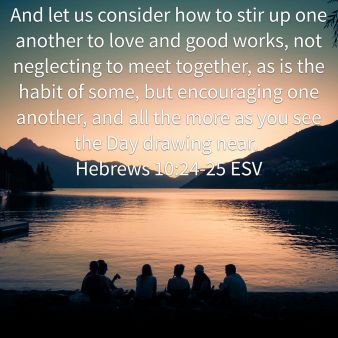
‘And let us consider how to stir up one another to love and good works, not neglecting to meet together, as is the habit of some, but encouraging one another, and all the more as you see the Day drawing near.’ (Hebrew 10: 24-25).

Continually minister to one another. ‘Shared joy is double joy, shared sorrow is half the sorrow.’ (Swedish motto). Be involved, like co-workers, team-workers, rejoicing with those who rejoice, mourning with those who mourn. ‘But woe to him who is alone when he falls and has not another to lift him up.’ (Ecclesiastes 4:10). When a person struggles spiritually that person needs those who will help him out of the ditch. Find help from others. We also need others because of their skills and their gifts. We’re a team, we do not excel each other; we depend on each other. The command here is ‘to consider’ how to stimulate one another to love and good deeds – to encourage others around you to love and good deeds. To consider is to give thought about how it is going to happen. Ask ‘What does the person need to grow to encourage them to look to Christ and to encourage them?’ How do we do this? It’s very important not to neglect to meet together. It’s so discouraging when people allow the world’s priorities to crowd in and neglect meeting together. We should encourage one another. The devil is trying hard to attack God’s people, to remove their confidence in Christ. 

Hebrew 10-23-24
We should be filled with joy because of Jesus’ return. We should meet together to have encouragement, to see a glimpse of heaven. We have three meetings here a week in Penuel which we can attend. We can see the power of Christ. He is keeping His people. Our gatherings are to be encouraging, pointing us to heaven. Are you aware Jesus is coming? These are difficult days but we need to gather together, to press on, looking in hope to Jesus’ return.


September 3rd 2017: Norman Rees

Norman Rees-Sept 17II Kings 6:1-7

Elisha was a great man of God. Jesus refers to him in the New Testament. Elisha was used by God, he had a mighty portion of God’s Spirit resting on him. He was a teacher of students. They lived in Gilga, an important place in the Bible. This was where Joshua camped, it was where men were circumcised, where Samuel preached. There was a college in Gilga where Elisha taught the students. They sat at his feet and learnt from Elisha. Elisha loved the Lord. God used him greatly. The students were greatly blessed and grew in number. As they increased, they asked Elisha if they could move and build a bigger place.


They suggested to Elisha that they moved to the Jordan and live there. They would have water (there was a drought in Gilga), and they could expand the work and live for God, then go out themselves as prophets. The young men wanted the counsel of Elisha and asked him if they could go. He said yes, but they wanted him to go with them, ‘Then one said, “Please consent to go with your servants.”’ (II Kings 6:3). They were keen for Elisha to go with them so they could learn more from him. So Elisha moved with them from Gilga, walking 35 miles to the Jordan across rough terrain to serve the Lord.

The students cut down trees to make booths. They used axes. They were poor. One of the students did not have an axe but he wanted to join in, so he borrowed an axe. However, as he hammered away at a tree the iron axe-head flew off into the water and sank. Panic set in. The River Jordan is a fast flowing river, there was no chance of rescuing the axe-head. Yet the young man was conscious that he was responsible and needed to make good, he knew he had to pay back what he had lost. He was distressed he had lost something belonging to someone else. He was poor. God chooses poor people. We should be ready to serve Him.

The young man was part of a team – he didn’t want to let the team down. We need to be careful of the way we act. The man cried out to his Elisha, “Alas, master! For it was borrowed.” (II Kings 6:5). He went to Elisha, to the right place, to the man of God. We believe God is sovereign. We may pray in the morning, ‘I’m in your hands Lord, whatever happens today is in your control.’ God is involved in all situations, even when things don’t go our way. God sends these things that can affect our reaction. We have a conscience to admit when we’re wrong. The Lord allows these things to test us. What is important is how we react. The student went to his master, Elisha. We go to a greater Master, Christ. People view our reactions, they should see Christ in us.

Elisha was concerned for the young man. He asked, “Where did it fall?” And he showed him the place. So he cut off a stick, and threw it in there; and he made the iron float.’ (II Kings 6:6). Elisha did not tell the young man off. When things in our life go wrong, Jesus asks us to tell Him about it. He knows our situation, He knows our thoughts.

Elisha lived close to God and knew the Lord. The student showed him where the axe-head fell. Elisha then threw a stick into the water and the iron axe-head floated to the surface of the water. A miracle was worked by God through Elisha. God made gravity, God can overcome gravity – as He did when Jesus ascended into heaven. God can make the impossible possible. The situation was hopeless to humans but not to God.

We pray for the axe-heads, sinners sunk in sin. Every one of us is born in sin. We pray for people, maybe for many years, who have sunken iron hearts, sunken in sin. What is your axe-head this morning? God is the God of the impossible, the God of grace, the God of Salvation. God will bring an end to the Devil, an end to sin. Christ can save you, He saved me, He can save anyone. Elisha is no longer on the earth, he’s in heaven, but his God is still here on earth.

Whatever give us anxieties, take it to God. God is a God of the impossible. He will deliver. Be sure to glorify Him and praise Him. Praise Him more.

August 27th 2017: Ian Middlemist

Ian-Aug 27th 2017Romans 5:12-21

Israel has two main bodies of water – in the North is the Sea of Galilee, 13 miles long, 7 ½ miles wide, a well-known fishing area with 22 sorts of fish, as well as lush vegetation on the side and a beautiful, fruitful shore. It is a beautiful body of water. In contrast, 60 miles south lies the Dead Sea, 47 miles long, 9 ½ miles wide, full of salt and mineral but with no life, no vegetation, even the shore is barren. This stark contrast is a portrait of spiritual humanity. One sea is full of life and fruitfulness, the other is death and uselessness. There are two classes of people – those in the person of Adam and those in the person of Christ. Adam represents death and uselessness, Christ leads to life. The two men represent the whole of humanity. It is essential we grasp the central message of the Bible. Believers used to be in Adam but now we’re in Christ.

We are all born in Adam:
Paul examines the consequences of Adam’s sin. Adam serves as our representative. He sinned and this sin was applied to every person who has lived or ever will live. Adam perfectly represents humanity. God chose Adam to be our representative. We are sinful. We should be glad God chose Adam, God always knows what He is doing. Some may say that they don’t want to be represented by Adam, they want to represent themselves. The truth is, if you and I had been in the Garden of Eden, we would have committed exactly the same sin.

Christ is our representative as well, He has acted on our behalf too. Adam sank our spiritual boat but God has thrown our life-preserver to us. Adam served as our representative; we are every bit as guilty as he was. But we’re also guilty sinners because we’ve sinned.

The results of sin:
Even before the 10 commandments, sin had exercised power over humanity. But sin is not imputed when there is no law. Imputed means to charge to one’s account. Sin is there but is not accounted as a legal matter. It cannot be punished if there is no acknowledgement. After Adam, God gave no more explicit commands until the time of Moses. Although people sinned from Adam to Moses, people died because they had sinned in Adam. They shared Adam’s punishment because he was their representative.

In Adam we can see a number of principles in Jesus:
       – Adam and Jesus were both real persons;
      – Adam and Jesus both served as representatives for the whole of humanity;
     –  They both drew the world for themselves, one for evil, one for good;
     – Both effected the course of humanity through one single act (Adam taking the                fruit, Jesus dying on the cross).

Humanity is either in Adam or in Christ, it can’t be in both. Death reigns for all mankind in Adam.

All believers are in Christ:
God’s grace is readily available to those who out their faith in Jesus Christ. The promise of eternal life is a free gift. 7 times grace is mentioned in verses 15-21. Salvation is a free gift, no strings attached.

God’s gift brought life to all who are in Him (v.15). Grace is always more powerful than sin. It is a free gift but it was purchased at infinite cost – it cost God the death of His only Son. To think we can earn grace is an insult. Salvation is freely given to you. What a great cost has been paid for you so you can be rescued from Adam’s domain.

‘For if, because of one man’s trespass, death reigned through that one man, much more will those who receive the abundance of grace and the free gift of righteousness reign in life through the one man Jesus Christ.’ (Romans 5:17). ‘Reign’ comes from the word ‘king.’ We also think of authority, of influence. All of these words are to be applied to you – for you are in Christ and you are to reign in Christ. We have no idea of the sphere of influence we have. Justification is the beginning of salvation. Sanctification is to bring heaven down to earth, to live as God has called you to live in Christ. God is equipping us to rule the world to come.

Instead of us being condemned eternally for our sins, Jesus was condemned. We don’t realise just how much we have received. It’s been given to us at a great cost. Christ brought freedom to the human race, He signed our liberty with His own blood on the cross. Having trusted the Saviour we have the power to turn from sin and live in Him, to live in righteousness. He is our great emancipator.

August 20th 2017: Gareth Edwards – Baptism Service

Reading: Colossians 2:6-15, Preaching: Acts 2

Today is not about Meg, it’s about the Lord Jesus Christ. It is all about what He has done, not what Meg has done. What Megan is doing is a response to what Jesus has done, ‘Peter said to them, “Repent and be baptised every one of you in the name of Jesus Christ for the forgiveness of your sins, and you will receive the gift of the Holy Spirit. For the promise is for you and for your children and for all who are far off, everyone whom the Lord our God calls to Himself.”’ (Act 2:38-39).

When Peter preached on the day of Pentecost there was: conviction, conversion and consolation.

Conviction:
Everybody who comes to be baptised has experienced conviction of sin. Peter is preaching about the Lord Jesus Christ and how the people had wrongfully, spitefully put Him to death. They listeners were cut to the heart, crushed under the enormity of their sin. They knew they were guilty and had no excuse. They had killed the anointed one of God, the one the nation had wanted to see for so long. Yet they rejected Him, He wasn’t the Messiah they wanted. Ultimately, they had Him killed. Now they are told by Peter that He had been raised from the dead. Perhaps they thought He wanted revenge? Crushed under the sense of their sin, perhaps they wanted to know was there forgiveness? In helplessness they cried out to Peter and the rest of the Apostles, “Brothers, what shall we do?” (Acts 2:37).

There is nothing harder to penetrate than the heart of a sinful man. When we are confronted by the wrong that we do, we suggest if there’s anything wrong in what we’ve done, surely it’s outweighed by the good we’ve done. Some refuse to acknowledge they’re sinners. It is a natural human reaction when confronted by wrong. But these people were convicted – as those of us are who have come to know Jesus. We too are convicted as we saw ourselves as we really are – sinful and broken. We were brought to grief. Have you been convicted of your sin? Has your conscience been grief-stricken at your actions and words in the sight of God?

Isaiah proclaimed, “Woe is me! For I am lost; for I am a man of unclean lips, and I dwell in the midst of a people of unclean lips; for my eyes have seen the King, the LORD of hosts!” (Isaiah 6:5). There is no hope for the self-righteous. Meg is not here because she thinks she is a good person, she is here because she knows she is a sinner, like me. There is hope only for those who are convicted of sin.

Conversion:
Peter shows the people the way of Salvation. First they repented. Repent means to make a U-turn. All of us have to complete a U-turn if we are to have the hope of forgiveness of sin. In repentance we acknowledge we have done wrong in the sight of God and nothing we can do can save us. Repentance is knowing that there is nothing we can do to impress Him. Everything about me in the sight of a holy, righteous God is an abomination. However, God Himself has come in the person of Jesus Christ into our world. He identifies Himself fully with us, He died on the cross for my sin and gives to me the perfect righteousness, so I am acceptable as He is before God. It’s nothing of me – it’s all about Jesus. Jesus, by His saving grace and power, changes me and makes me acceptable to God. Therefore, it’s important to be baptised. Being baptised doesn’t make me right with God. Praise the Lord, Meg is already right with God. Jesus has taken her to be His own. Now she’s being baptised as a witness to what Jesus had done. A sinner can only be saved by the grace of Jesus Christ. Your old sinful nature dies with Him on His death on the cross. It brings newness of life in Christ, through His resurrection. Baptism shows this. Every one of us here needs to be converted, without exception, from the youngest to the oldest. Meg wants you to know it’s not because of anything she’s done, it is all because of what Jesus has done.

Consolation:
‘So those who received his word were baptised, and there were added that day about three thousand souls.’ (Acts 2:41). The people gladly received the word, the message of salvation which convicted them of their sin. It also thrilled them.

Jesus said, ‘Blessed are those who mourn, for they shall be comforted.’ (Matthew 5:4). Receiving Jesus, they are assured their sins are forgiven, they are right with God. Their hearts are gladdened. They gladly gave themselves 100% to serving the Lord and Saviour in the life of the church. They have such great consolation, great comfort. Every believer in the Lord Jesus Christ, no matter what their troubles, have the peace of God which can never be taken away or destroyed because Jesus is the Saviour and Lord. The gospel never leaves people in the pit of despair but leads to the joy of salvation in Jesus Christ for all who repent and believe in Him. It’s available to all, free of charge, you don’t have to do anything, you don’t have to improve yourself; all you have to do is trust Jesus as your saviour. The gladness, the peace that passes all understanding, is freely available – just acknowledge your sin and trust Jesus Christ as your saviour. Then, being born-again, you can be baptised, as Meg is being baptised. Our salvation was purchased for us at such a great cost. As we witness Meg’s testimony to Jesus Christ, we should also acknowledge our debt to Him.

Meg has poignantly spoken about not so happy days, but she would never exchange the happy days, when God’s saving grace changed her life, to be free of all the unhappy days. For the happy day, when Jesus washed our sins away, is an eternal day. It’s a day that outlives beyond the grave as it will never end. It’s a day to rejoice in. So as Peter preached this sermon on the day of Pentecost, there was a mighty work of conviction, conversion and consolation. The joy of salvation happens to everyone who is truly a Christian.

August 20th 2017: Dave Norbury

John 20: 19-32

Dave-Norbury-Aug 20th 2017The Guardian states that 20,000 messages a day hit us – via email, television, radio etc. They have one single message in terms of spiritual life, ‘We live in a one floored bungalow, there is no heaven and no hell. God keep out.’ Therefore, it is not unusual that there are times when we begin to doubt. Here, in John chapter 20, we have Thomas, always associated as ‘The Doubter.’ We are labelled by the things we can’t do. This is very sad. Doubt is something we all get. Thomas had serious doubts, ‘So the other disciples told him, “We have seen the Lord.” But he said to them, “Unless I see in His hands the mark of the nails, and place my finger into the mark of the nails, and place my hands into His side, I will never believe.”’ (John 20:25). The truth be known, the disciples had doubts. There are at least three times in the book of Luke when Jesus said He would rise on the third day, yet none of them were reminded of this or understood it. Sometimes we doubt God can get us through difficult situations. Doubt can riddle us, it is real.

Doubt is a leap of faith into something else. Many doubt God’s existence when so many people say there is no God. If you don’t believe there is a God, you believe in something else. If there is no God there is no purpose in life – ultimately you become dust and that’s the end of it. We ought to help people explore what they do believe in.  

What happened to Thomas? ‘On the evening of that day, the first day of the week, the doors being locked where the disciples were for fear of the Jews, Jesus came and stood among them and said to them, “Peace be with you.” When He had said this, He showed them His hands and His side. Then the disciples were glad when they saw the Lord.’ (John 20:19-20). The disciples were in fear of the Jews. The Bible is honest about it. God understands. However, they were glad when they saw Jesus. If Jesus Christ is risen from the dead, then the truth of Christianity is real. Christ died for our sins and rose again. We have a risen Saviour!

Thomas was not with the disciples. We do not know why he wasn’t there. The disciples tell him they have seen the risen Jesus. Then Thomas makes the remarkable statement, “Unless I see in His hands the mark of the nails, and place my finger into the mark of the nails, and place my hands into His side, I will never believe.”’ (John 20:25). Thomas expresses his doubt in a very clear way. How would you react to that? The Lord Jesus did not condemn Mary, Peter and John for their doubts. If we have doubts, Jesus doesn’t condemn us, He wants to help us. That’s exactly what He did with Thomas. The disciples were with Thomas for eight day, yet he did not believe them. They may have been frustrated with Thomas. Isn’t God wonderful to give us the example of Thomas? When Jesus came, He didn’t say ‘Thomas, I’ve been waiting for you for eight days!” No, He said, ‘Peace be with you.’ The Lord Jesus is full of grace – kindness we don’t deserve. Then He went straight into the problem, giving Thomas the evidence he wanted, ‘Then He said to Thomas, “Put your finger here, and see my hands; and put out your hand, and place it in my side. Do not disbelieve, but believe.”’ (John 20: 27).

The greatest blessings are in the valleys, the storms of life. Jesus gives Thomas all the evidence he needs. ‘Thomas answered Him, “My Lord and my God!” (John 20:28). This is the greatest statement anyone can ever make. Thomas is a wonderful example of what the Bible is written for – whatever difficulties you are facing, go to His Word, meet Him personally in His Word. Absorb God’s Word day and night. ‘Blessed is the man who walks not in the counsel of the wicked, nor stands in the way of sinners, nor sits in the seat of scoffers; but his delights is in the law of the LORD, and on his law he meditates day and night.”’ (Psalm 1:1-2).

Listen to the voice of God, not the messages around you. He will meet you in your doubts, He will strengthen you. Trust Him, He will make you safe. (Psalm 3).