August 17th 2025: Ian Middlemist

Psalm 3

            This is a Psalm of the morning. It is a Psalm of David, who was, by and large, a good king. But he wasn’t perfect. He did some things wrong. He was adulterous and even though he repented of this sin, there were things that came to pass in consequence of his wrong actions. His own son Absalom took it upon himself to get into such a position by deceit so that he could usurp authority in the nation. David did not correct Absalom properly and so, little by little, Absalom rose to prominence and power so that he brought civil war upon the land and David had to flee. David recognised that he had few amongst his number that could contest with Absalom’s army and so he fled, for the odds were stacked against him. But, following this Psalm, we learn that even though he was in such a dire situation, he was enabled to have a good night’s sleep! He awoke in praise to God, for He alone is Almighty.

[1] David in trouble.

            Sometimes people find themselves between a rock and a hard place. This is where David ended up. Some today may ask the question: how can troubles come to those who have put their trust in God, who are saved, and who are seeking to follow Him? We know surely whether we are young or old, in whatever circumstance, that believers face troubles. It may be in school, or in the workplace, or wherever you live and do your normal things. But Christians have additional troubles too, apart from the normal heartaches which are as a result of the fall. Christians can be left out of things, may not be free to share in the jokes told, and are separate on account of their walk with the Lord, and so face these additional irksome troubles. There is a tension because they are not part of this world’s order and ways even though they must mingle in the world. Troubles come in all sorts of ways. It may be through sickness, or on account of finances. It may be through ill health or advancing age. Now there are two kinds of troubles we can face.

[a] Troubles we bring upon ourselves.

[b] Troubles given to us.

David brought the trouble he faced upon himself. Absalom’s behaviour ought to have been challenged and corrected. Now when we put a foot wrong and commit sin, and then repent, even though our sins are all paid for by Christ, He does allow the consequences of our sinful actions to play out as chastisements upon us.

            Now there are troubles that we do not bring upon ourselves. If we face a difficulty, and if after examining our hearts we see nothing which needs repenting of, and we are suffering, then we must realise that even though this is not consequential from a sinful act, it is nevertheless given to us. We are, and always will be, under the sovereign hand of the Lord. This trouble is not a punishment from the Lord, although He may be using it to chastise or correct us, to sanctify us. We know that all sins are fully paid for by Christ. He was judged in our place. So there is no thought of condemnation or judgement at all. Troubles come to enable the Lord to bring us into conformity to His Son. These troubles are there to bring in growth. They are brought to us to bring in our spiritual growth. Whatever the difficulty may be, do remember that the Lord knows all about them. Even those internal struggles and troubles that cannot be spoken nor shared, know for sure that He understands and knows them truly. These difficulties and troubles are not to lead us to despair. They are not hopeless, they are not random, but are necessary for our spiritual growth.

            The process of growth is often hard. When I was young my mother dressed me! She used to say: ‘vest in pants, shirt in trousers’ to ensure I got everything tucked in properly! But now I can dress myself. I do not need my wife to come in and help. I do not struggle to get my socks on! I have grown. All of these troubles are designed by God to bring about growth. They lead us not to independency but to deeper dependence upon God.

[2] David at prayer.

            David is at prayer. When he wakes in the morning his first thing is to pray. He cries out ‘O Lord.’ What is the first thing we do when faced with trouble? We ought always to cry out to the Lord. In this modern age we tend to rely on our phones, or on ‘Google’ don’t we? As youngsters perhaps we called out ‘mum!’ or ‘dad!’ when in trouble and danger. We need to call out to the Lord as David did.

            Sometimes people act in a petulant manner and slam the door or blurt out in anger when faced with trouble. Some blame God for the situation, thinking (wrongly) they are beyond reproach and should not have to face this trouble. But as David experiences this trouble he is moved to prayer and he is brought to blessings! He discovers that in the place of true prayer he notes those things which God has done and is still doing.

[a] God is a shield, (v3).

            The first thing David observes in the place of prayer is that God is a shield to him. However great the trouble may be the Lord is David’s protector. Nothing can get to him save that which the Lord uses for his sanctification and growth. God is good and only does good. So He protects David but allows some things to come which will hone him and cause him to rely more upon the Lord.

            When I was in primary school we used to play a game of imaginary fighting. One would come up and pretend that he’d shot an arrow to me claiming it had met its mark, but I would reply ‘my chain mail has saved me!’ Undeterred my friend would say ‘I have a machine gun so you must be dead,’ and I would reply ‘but I am wearing armour plating.’ This game would soon escalate to ridiculous heights involving nuclear weapons and lasers, until it came to a point in which it was impossible to carry on when one of us would say ‘I have an infinite measure of protection and the ultimate weapon against all opponents’! There was no beating that! Now the point is that as Christians we do in fact have the ultimate protection against all opposition! God is truly our protector and nothing can get through Him! Nothing can harm you, and nothing can happen to you, except that which the Lord allows, and that for our ultimate good. Satan is not all powerful. He does have some power but he is defeated and defenceless against the Lord.

            We have trouble and difficulty. These are painful and they are real. But the Lord has the victory over all. He has made us secure as we are taken through such troubles and difficulties. This shield is all around you. There is no chink or gap. We may like to think of it as a ‘force field’ in modern thought, but it encompasses us all around. As a result we are enabled to move forward, to carry on, to live through these difficulties.

[b] God is the lifter up of our head (v3).

            David knows this truth in the place of prayer. We need to lift up our heads! We need to set our hearts and minds on the things above. Many hang their heads in shame when troubles come. Maybe they have lost money through no fault of their own. Perhaps they have been made redundant or other failures have reared their ugly heads. But in the place of prayer David knows that even if the kingdom is taken from him, even if none are with him, and even if there appears to be no hope, yet still the Lord is the lifter of his head.

[c] We are never far from God (v4).

            David mentions here ‘the holy hill.’ But he has had to flee from Jerusalem where the holy hill could be found! This was the place of sacrifice and worship. It had been settled in Jerusalem in the temple. But David recognises that it is not the literal site that is vital, but what it stands for in spiritual terms. David’s security does not lie in Jerusalem where the ‘holy hill’ was to be found, but in the Lord Himself and in that which the ‘holy hill’ showed forth – the death and resurrection of the Christ. So he was never far from God, even though he was no longer in Jerusalem.

[3] David at peace.

            David knew peace because the Lord was his shield. In verse 5 we see David can sleep. If we knew that many enemies were on the horizon I do not think we would hasten to sleep. But the Lord is such a shield to David that he can sleep and be at peace.

            Peace is linked to courage. A lack of courage is linked to those who do not know peace. So in his peace, David can now arise. Peace leads to an outward, onward march to glory. It leads us through the battlefield for God is our shield. In our long-term troubles we know we can move forward because the Lord has secured us, and He has given us all the love we need alongside His peace. David calls upon the Lord to bring about salvation for him. Are you sure that God has given you salvation? Are you sure that God is now with you? If not then maybe you have yet to really pray?

            We must rely totally on Him for safety, security, and courage, all of which we find in the place of prayer unto the Lord. In verse 2 the enemies taunt and bring doubts saying that there is no help or salvation from the Lord. But in verse 8 we read that salvation belongs to God. God is with us if we are His.

Be anxious for nothing, but in everything by prayer and supplication, with thanksgiving, let your requests be made known to God; and the peace of God, which surpasses all understanding, will guard your hearts and minds through Christ Jesus. (Philippians 4:6,7).

Amen.

July 9th 2023: Dafydd Williams

To watch this service, please click on the link to our YouTube channel: https://youtu.be/pGFLzV-Bczo

Psalm 80: “Restore us, O Lord.”

Have you ever watched a tv show where there is an old house which needed heating, its glass panes windows replaced and for the rest of the house to be lovingly restored as a family home? It was not fit for purpose but was lovingly restored. What happens to old homes is similar to what can happen to us spiritually.

Psalm 80 is a community lament, written at a time when Israel was in the north and Judah in the South. Possibly, this psalm was written when the northern Kingdom had fallen and was taken into exile. Asaph laments the destruction and exile and prays this doesn’t happen to the southern Kingdom. What has this to do with us? The circumstances are not dissimilar to us; we live in a day when Biblical truths are mocked. The central prayer of Psalm 80 is what we need to hear today. This is repeated in verses 3, 7 and 19, Restore us, O God; let your face shine, that we may be saved!” The Psalmist realises this is their greatest need and our greatest need is to restore us and make His face shine upon us.

There are four truths about the character of God in this Psalm.

In verses 1-3, Asaph is praying to the Shepherd who saves,

“Give ear, O Shepherd of Israel,
    you who lead Joseph like a flock.
You who are enthroned upon the cherubim, shine forth.”

Psalm 80:1

The Lord is called our Shepherd, as he is in Psalm 23. He is concerned for His church. A good Shepherd never leaves His sheep. The Lord above is the one alone who provides and guides. He is also the God who dwells among His people. This is a prayer asking the Lord to hear them and appear in His glorious and saving power. The Psalmist knew that the Lord had great strength. Asaph wants the Lord to act and bring deliverance, He will come in power and save,

“Restore us, O God;
    let your face shine, that we may be saved!”
Psalm 80:3

This this is a simple prayer – we need the Lord to restore us. We are like sheep who have wandered far and wide and get distracted by the idols of this world. We are unfaithful to Him, therefore we do not know the favour of God in our lives. When we don’t prioritise time with the Lord, we cannot expect God’s face to shine upon us.

“The Lord bless you and keep you;
the Lord make his face to shine upon you and be gracious to you;
the Lord lift up his countenance
[c] upon you and give you peace.”

Numbers 6:24-26

When the face of the Lord shines on His people they are blessed. Do you know something of God’s face shining on you? Do you know the grace of the Lord Jesus, the one who lays down His life for his sheep? Are you walking closely with your Shepherd or are you in need of restoration?

The second truth of who God is found in verses 4 to 7,

Lord God of hosts,
    how long will you be angry with your people’s prayers?
You have fed them with the bread of tears
    and given them tears to drink in full measure.
You make us an object of contention for our neighbours,
    and our enemies laugh among themselves.

Restore us, O God of hosts;
    let your face shine, that we may be saved!

The almighty is angry.  Would God really threaten to leave His people? We might not like to think of God in that way. These verses show God is the judge of all the earth. He is angry with His people. They have prayed for His blessing but have known ridicule from their enemies. There is no leading into green pastures. The people of God are mocked.

The question of verse 4 is ‘How long will this go on for?” In verse 5 we read that their mourning is continuous, there are so many tears. The care of the Shepherd King is not felt. Don’t make the mistake that God does not care or is not in control. The anger of God is not an accident. He never does wrong. Even through evil, the Lord works and is achieving for His people. The people were living sinful lives. They left the land of blessing. The Lord’s judgement came upon them. Is not neutral with sin, it is an offence to Him. That is why we today might not be experiencing God’s love in our lives.

Verse seven says He saves. There is a growing longing for divine salvation, a cry amongst the sin, that God might show favour again. Sometimes, there is a direct link between our sin and God’s favour. In such times, the Lord might be chastising us. He knows it is only then we will come to know true blessing. The people had fallen out of favour with God. If you are in a position where you have fallen out of favour with God and your heart has grown cold, when you don’t prioritise God, our communion with the Lord can suffer. The Lord knows what is best to draw us back. We are presented with hope in this wonderful, repeated prayer. You can come back and know the reality of the sun shining on you again. Disciplining judgement blocks out warm rays of grace. Pray He might restore you – He is willing. Repent and come back to the Lord.

Thirdly, we see God is a merciful deliverer in verses 8 to 14. This is what God has revealed Himself to be, caring for us like a gardener. God is so kind, so merciful. He is so patient and provides for their daily needs. He is full of mercy and able to save from the most dire of situations. Israel is pictured as a vine which covers the whole land. The people had been mercifully delivered from Egypt. But sadly, in verses 12 to 13, things didn’t stay that way,

“Why then have you broken down its walls,
    so that all who pass along the way pluck its fruit?
13 The boar from the forest ravages it,
    and all that move in the field feed on it.”

The Lord has broken down the walls. The people have been unfaithful to Him. The Psalmist knows God has allowed it. It seems God is turning His back on His people, allowing the land to be ravaged. Isaiah prophesized what would happen to this vine – it would be fruitless. This vine of God should have been full of truthful, faithful followers, but instead it was full of fruitless, faithless disobedience. He has allowed the vineyard to decline because of the incredible descent into faithlessness in His people. It is so sad that God’s people would respond to His mercy and grace in such a way.  

How would you respond if you were in this situation? Would you pray verse 14?

“Turn again, O God of hosts!
    Look down from heaven, and see;
have regard for this vine.”

The Psalmist asks that the Lord almighty would look down in kindness. There is a recognition of sin, guilt and shame, and pleading with God to restore. We have to grasp that God is merciful. The people had been so disobedient, yet they know they can approach God in prayer. The wonderful truth is we can lift up our eyes to heaven and ask God to return to us and restore us. We can plead that God will be merciful and do a work in our heart. Come humbly to Him and He will draw near to you once more.

Because the merciful deliverer is who He is, He is a ruler who revives. Asaph Praise that the Lord would watch over this vine, His people.

“They have burned it with fire; they have cut it down;
    may they perish at the rebuke of your face!” (verse 16).

The vine is cut down and burnt. The situation is bleak. Fire will bring destruction. This is a totally just judgement. So, Asaph prays,

But let your hand be on the man of your right hand,
    the son of man whom you have made strong for yourself!
18 Then we shall not turn back from you;
    give us life, and we will call upon your name!”

In the hour of need, may the Lord sustain his people. The focus of the hope of God’s people is one of David’s line. The Lord would always be true to David. Ultimately, the hope of God’s people is the Rescuer who will come – the Lord Jesus Christ Himself. The Lord really did watch over His people. God sent His son. The Messiah came, in whom we have been given new life, and access to God.

Verse 18 points us to the hope found in the Lord Jesus Christ. We were once dead in trespasses and sin, yet He died on the cross on our behalf so we can be brought into a relationship with Him. It is only His breath of life that can refresh and renew us. We are powerless in ourselves. We need the spirit of God to come, to give us life, power, and greater awareness of our sin. We need the Lord to revive us ( verses 3, 7, 14, 19). Every time there is a little more added to each verse. The Lord is the Covenant name of God, Yahweh. He is a promise-keeping God. He is faithful in every way.

In the final plea of Psalm 80 we see the Psalmist appeals again to the Covenant, to the promise God has made. He asks God to be faithful in His promise, to forgive the people of their sins as they call upon Him and confess their sins. This conclusion is like an Old Testament conclusion of what we find in 1 John 1: 9., If we confess our sins, he is faithful and just to forgive us our sins and to cleanse us from all unrighteousness.” Brothers and sisters, do we see and feel our need? Our nation is in a mess. The church feels so powerless. We can do nothing by ourselves, but with God all things are possible, through our Lord Jesus Christ.

This is a prayer we need. We need to be awoken from individual slumber. As a church we need to know the face of God shining on us, to know His favour. Is this prayer of this Psalm your desire? Pray to restore yourself, your church, your nation, that you might know more of Him. Do you want to know more of Him? Do you want the Lord to restore the honour of His name? Can you commit to pray for this, in the coming days and weeks, that the Lord might restore us? We come as sons and daughters to Him in prayer. Will you be bold and pray this bold prayer of Asaph?

Restore us, O God of hosts;
    let your face shine, that we may be saved!

July 2nd 2023: John Funnell

To watch this service, click on the link to our YouTube channel: https://youtu.be/Cz4WW2SFNro

Luke 15:11-32: The Parable of the Lost Son

This parable was written with God’s grace and love for us. It is masterfully told by our Lord. There are three characters to think about. We read of the Father, the loving provider, who represents God. There is a son who disgraces his father by asking for his share of the inheritance early, which, in this culture was an outrageous event, and would have been seen as the son wishing his father dead. The Father obliges and the son leaves to chase the pleasures of this world. This parable reminds us that this life choice never works for anyone. When we take ourselves away from the Father, any trial that comes our way breaks us.

A famine comes, And when he had spent everything, a severe famine arose in that country, and he began to be in need. (Luke 15:14). The son, who was prospering, becomes a slave to sin. He hires himself out to a citizen of the world, “So he went and hired himself out to one of the citizens of that country, who sent him into his fields to feed pigs.” (v.15). Look how the world treats him – he ends up rock bottom, feeding pigs, which were unclean to Jews, “And he was longing to be fed with the pods that the pigs ate, and no one gave him anything.” (v.16). He was not only feeding the pigs, they were eating better than he was. The world may lead you away from God, but temptations leave you rock bottom.

The son decides to return home, coming back on his own terms, merely as a servant. To his surprise, as he repents from his worldly sin, he sees his dad waiting for him with open arms. The son is welcomed back, not merely as a servant but loved as a son, “But the father said to his servants, ‘Bring quickly the best robe, and put it on him, and put a ring on his hand, and shoes on his feet.” (v.22). Not only that, he was given a sacrifice to atone for his sin – a prize calf, a rejection of the golden calf of this world, “And bring the fattened calf and kill it, and let us eat and celebrate.” (v.23).

Such celebrations upset the third character in this story, the other son, “But he was angry and refused to go in. His father came out and entreated him,” (v.28). He is jealous of his sibling’s treatment and said, ‘Look, these many years I have served you, and I never disobeyed your command, yet you never gave me a young goat, that I might celebrate with my friends.” (v.29). He makes the mistake of seeking a similar reward, but out of obedience. Both boys have no understanding of how God works. One thought he had to reach rock bottom to receive grace, the other thought he could earn it.

Jesus makes it clear that God’s love for you is freely an offer for you right now, regardless of where you are at. Jesus loves you all so much, He has done it all for you already. You don’t have to reach rock bottom to receive God’s love because Jesus, on the cross, hit rock bottom for you. Jesus says you can turn back to him right now. You can repent of your sin right now. Whatever is weighing you down, whatever shameful secrets you hold onto, God says, ‘Come to me.’ When you do, you will find the Father is already waiting for you with open arms, running towards you to clothe you in the robe of righteousness of the Son.

The generosity of our Father doesn’t stop there. It gets better! Brilliant! The Parable of the Lost Son links it to the wider narrative, “He also said …” (v.11). This parable is linked to what has gone on previously: the Lost Coin and the Lost Sheep. Both parables end in the same way – a party in heaven, “Just so, I tell you, there will be more joy in heaven over one sinner who repents than over ninety-nine righteous persons who need no repentance.” (v.7), “Just so, I tell you, there is joy before the angels of God over one sinner who repents.” (v.10), “And bring the fattened calf and kill it, and let us eat and celebrate.” (v.23).

What is Jesus telling us here? He is reminding us that when we turn away from the ways of the world and repent, heaven has a party. When TJ gets baptised this afternoon, it will not just be the people here rejoicing, heaven has a party. Millions of angels will be rejoicing.  

I have strong links to Romania. Romania and Roch are bookends of our continent! Christians in Romania have suffered Muslim oppression, then atheist oppression and now cultural oppression from Wokeism of secular Europe. They never talk of the day they came to faith; when giving their testimony they tell of the day of their repentance and fell into the warm embrace of their loving Father. That is what we see in the parable. We see the amazing truth of God’s grace. We don’t have to earn our salvation, we don’t have to reach bottom. He will always welcome us if we turn to Him because He is gracious. Heaven has a party. The angels rejoice.

If heaven is willing to have a party, just for you, when you repent, you can know that God will never ever let you go. Jesus wants you to bask in the love of Himself. Jesus also wants you to rest in the blessed assurance He will never let you go. The precious Lamb of God was slain for each of you. In heaven, the victory party has begun. Your other option is to spend the week living in the filth of condemnation. It’s an easy choice. God has brought each of you here today to hear this. Today is the day of salvation. Turn from your guilt, turn from your lies and darkness, come to the truth, come to God. He is waiting with open arms. Come to God before this window of grace closes.

February 13th 2022: Gaius Douglas

To watch this service, click on the link to our YouTube channel: https://youtu.be/94-YJLx3iCc

11 Let us therefore be diligent to enter that rest, lest anyone fall according to the same example of disobedience. 12 For the word of God is living and powerful, and sharper than any two-edged sword, piercing even to the division of soul and spirit, and of joints and marrow, and is a discerner of the thoughts and intents of the heart. 13 And there is no creature hidden from His sight, but all things are naked and open to the eyes of Him to whom we must give account.” Hebrews 4:11-13

Hebrews was written to the Hebrew Christians who had, not long ago been saved. When Pentecost happened, when the Spirit of God came down, 3000 souls were saved. The word of God spread from place to place. God was doing a mighty work – taking His Word, by His Spirit, to men and women all over the region. The first Christians, in the main, were Jews, they were Hebrews. They had to leave behind their own religion. They were being taught something new.

In Hebrews chapters 3 and 4 we see something that was happening to them. Something had occurred in their lives which, for many of them, was a new experience. At the same time, they were being dragged back into their old religion, into Judaism. One of the things that we must remember at all times, is that scripture is given by the inspiration of God, All Scripture is breathed out by God and profitable for teaching, for reproof, for correction, and for training in righteousness,” (2 Timothy 3:16). It is given to us that we may be complete. I love that word, ‘complete.’ In Colossians we read that as believers in Christ we are complete in Him.

This was the Hebrews dilemma – should they go to go back to Judaism, go back to the synagogue, to the temple, to something that was quite safe. One of the things they were experiencing when they came to know Christ as their Saviour was persecution. They were being thrown out of their families, they were being asked to leave. This still happening today. Many who turn to Christ will be turned out of their families, will not be spoken to. The writer of the Hebrews is encouraging them to pursue the new Christian doctrine, follow Christ, but in following it, you will suffer persecution. When we stand up for Him we will suffer; we will be called names. But we take those names and we take those who call us and we give thanks to God that we are able to stand up for Him and to suffer for Him.

Paul confirms and encourages the Hebrew Christians and Christians today, ourselves. He writes in Galatians 6:17, “From now on let no one cause me trouble, for I bear on my body the marks of Jesus.If you go back to the Book of Acts chapter 9 you will read about the conversion of Paul. From day one of his conversion until the day he died, Paul suffered persecution. Being a Christian is not an easy life. The Hebrew Christians had to make a choice – safety and miss out on the joy of Christ and the blessings of eternal salvation or go back. My friends, from time to time, are you encouraged to go back? There is a lot to drag us back because it’s safe. But the writer of Hebrews is saying, ‘Go forward.’

Being in Christ is far higher, far more exalted than anything we can experience in this life. There is no greater than Christ Himself, the hope of glory. The Hebrew Christian in chapters 3 and 4 were reminded by the writer that their forefathers, when they left Egypt, went on a wilderness journey. In that journey many died because of unbelief and disobedience. They do not enter the rest God promised them. What was that rest? That rest was the Promised Land, Canaan. But that was an earthly rest. The writer in chapters 3 and 4 is gently drawing them to a rest which is far greater, far more precious. The writer of Hebrews wants them to focus on the rest of Christ, eternal rest in Christ, a heavenly rest which is something far better. He refers to what David says,

“Today, if you will hear His voice:
“Do not harden your hearts, as in the rebellion,
As in the day of trial in the wilderness,
When your fathers tested Me;
They tried Me, though they saw My work.”

Psalm 95: 7b-9

David was speaking of that eternal glorious rest, “And I shall dwell in the house of the Lord forever.” (Psalm 23). My final resting place is in Christ, in glory. Are you resting in Christ? I am resting in the finished and completed work of Christ. I am resting in all that He has promised. I belong to Him. Today may be my last day, your last day. Are you resting in Him to such an extent that nothing else matters? Eternal rest. Eternal love. To be in His presence. What greater joy, what greater blessing.

Secondly, I want to share some thoughts on the application to you and me. “God is love,” (1 John 4:8). If anyone asks you what God is like, He is love. We see in God the Son, whom He sent to become our Saviour, we see God manifest in flesh, God revealed in flesh, the love of God being shown and demonstrated. We hear His word,

For God so loved the world that He gave His only begotten Son, that whoever believes in Him should not perish but have everlasting life.” (John 3:16) Rejoice! Jump up and celebrate! Christ in us, the hope of glory. We can enjoy the rest of being in the presence of God. The writer of Hebrews was encouraging them to hold on to the truth of the word of God. My dear friends, I am encouraging you to hold on and pursue this life.

There’s a word in Scripture I love. It’s repeated time and time again. It’s the word ‘forever.’ Being in the presence of the Lord, something I’m enjoying now, something I will go on enjoying forever. “Before long, the world will not see me anymore, but you will see me. Because I live, you also will live.” (John 14:19). I will never die because Christ lives. I’m alive, alive forever more. We have a home, we have a hope that is steadfast and certain because of the One who has gone through the curtain, who died on Calvary’s cross, who has given life – a ransom for many. What a wonderful experience, what a wonderful sight it was to believers on Christ when they heard the words, “He is not here, He is risen!”

One day He is going to stand and come for His own and bring them to glory. What a glorious prospect is yours and mine. We can rest in that certain hope. How blessed. This glorious word of God, “God is living and powerful, and sharper than any two-edged sword, piercing even to the division of soul and spirit, and of joints and marrow, and is a discerner of the thoughts and intents of the heart.” (Hebrews 4:12).

Are you aware, am I aware of and appreciate the power and majesty of God? If we believe that God owns everything, the breath I breathe this morning, my children He has lent to me, they belong to Him? Where are you resting? In your home? But that’s only a temporary residence. Where is your home? Heaven! We must be diligent in the rest which is ours now. We need to work at it. “Therefore, my dear friends, as you have always obeyed—not only in my presence, but now much more in my absence—continue to work out your salvation with fear and trembling,” (Philippians 2:12). What does it mean to ’work out your own salvation with fear and trembling’? It doesn’t mean to attempt to deserve salvation on the grounds of what you do. There are many who try and work their way into heaven, trying to be a good person. Who saved you? Jesus. We’ve been saved by the grace of God, “For by grace you have been saved through faith. And this is not your own doing; it is the gift of God, (Ephesians 2:8).

It is only by the grace of God. We can’t make atonement for our past sins. the Bible says, “Their sins and their lawless deeds I will remember no more.” (Hebrews 10:17)

“I have swept away your offenses like a cloud,
    your sins like the morning mist.
Return to me,
    for I have redeemed you.”

23 Sing for joy, you heavens, for the Lord has done this;
    shout aloud, you earth beneath.
Burst into song, you mountains,
    you forests and all your trees,
for the Lord has redeemed Jacob,
    he displays his glory in Israel.”

Isaiah 44:22-23

“Fear not, for I have redeemed you;
I have called you by your name;
You are Mine.”

Isaiah 43:1b

When the writer of Hebrews says to ’work out your own salvation with fear and trembling’? he means to break off from your sins. For the Hebrew Christians, it meant don’t turn back to Judaism, don’t look back. To us it means don’t turn back to the things that were holding you from Christ. Many of the things that you and I do so often take us away from Christ. We belong to Him,

Your body is the temple of the Holy Spirit who is in you, whom you have from God, and you are not your own?” (1 Corinthians 6:19). We belong to Christ. The writer of Hebrews was saying to the Hebrew Christians, ‘I want you to enjoy the rest of Christ, the glory and the wonder, the power and the majesty of God. For the word of God is living and powerful, and sharper than any two-edged sword, piercing even to the division of soul and spirit, and of joints and marrow, and is a discerner of the thoughts and intents of the heart. (Hebrews 4:12). Trust in it.

This Word changes and transforms. It renews. It rejuvenates. It takes us out of ourselves and brings us into the very presence of God. Let us come boldly to the throne of God. This is the power, this is the wisdom, this is the majesty, this is the glory of God.

It is a life-giving word, the source of all things. It has the keys of life and death. Satan, with all his powers, cannot do anything to you without God’s permission. Death has been defeated. How blessed we are! His word gives light to the repentant sinner. This word causes the devil to tremble, it causes demons to flee. It heals the sick. It gives sight to the blind.

God alone upholds this universe. He is the one to whom you and I have to give an account to. To the believers in Christ, God will honour us for the works we have done in His Name, for His glory and praise, not the works we decide to do for a pat on our back. There are many, many, many things that men and women of God do that we never hear of, but God does. To the unrepentant sinner, to those who have turned away, we read,

“To the unrepentant sinner, “Because I have called and you refused,
I have stretched out my hand and no one regarded,
25 Because you disdained all my counsel,
And would have none of my rebuke,
26 I also will laugh at your calamity;
I will mock when your terror comes,
27 When your terror comes like a storm,
And your destruction comes like a whirlwind,
When distress and anguish come upon you.”

Proverbs 1:24-27

We read in Revelation 20 of the white throne judgement, where those who have refused God, who have rejected Him, who have refused His word, will be cast into the lake of fire.

My dear friends, heaven is my home.  Where do you stand? Do you know Him as your Saviour? Do you trust Him? Are you resting in Him? Are you rejoicing in Him? Praise the Lord!  

August 25th 2019: Gareth Edwards

Gareth Edwards - July 2019‘You shall not murder.’ Exodus 20:13

A Sunday school teacher, in the process of teaching the Ten Commandments to her class, reminded them that they had learned the commandment to honour their fathers and mothers. She then asked if there was a commandment that refers to brothers and sisters. One girl replied, ‘You shall not murder!’ We smile and enjoy the humour of the story, but if we stop for a moment, there is a disturbing truth. All of us have harboured murderous thoughts towards others. They may be hateful glances, ‘If looks could kill …’ All of us have been angry enough to throttle someone for what they have done to us. It is extremely unlikely someone here has murdered someone. However, we’ve broken this Commandment in thought, word and deed and we are in need of forgiveness.

What is murder? The modern versions of the Bible has replaced the word ‘kill’ with ‘murder.’ In certain conditions the taking of life is permitted, for example, animal life. Some argue we should not kill animals, but Genesis 9:3 gives permission to kill to eat. Equally, God ordained capital punishment, allowing the state to kill one who deliberately kills another (Leviticus 24:17, Exodus 21:12-14). The Bible allows for the pursuing of a just war, which inevitably leads to death (Deuteronomy 20). Outside of these exceptions the destruction of life is murder. Therefore the murder of another, whether a baby still in a mother’s womb, or an elderly person coming to the end of their days, is an evil act.

There are three reasons why we should not murder another person:

  1. The sanctification of human life. God made us to enjoy fellowship with Him and gave us the capacity to have fellowship with Him. That’s what distinguishes us from the animal kingdom. We proclaim all people, irrespective of lifestyle, are to be respected. This does not mean we have to agree with them or endorse their sin, but they share in the same dignity by being created in His image (Psalm 8:5-6). Each and every human being has a God-given life that is sacred and He alone brings it to a close. For man to destroy another man’s life is to usurp the authority of God. It shows utter contempt for a God-given life (Genesis 9:6). Murder is an act of evil.

  1. Committing murder is following in Satan’s footsteps. It is the way of the devil to murder (John 8:44). From the very beginning it has been Satan’s purpose is to destroy human life through sin and death. In the Garden of Eden he pretends to Adam and Eve he is on their side. His desire is to bring death into the world and upon Adam and Eve. From the very beginning Satan has been a murderer.

  1. Murder is the elevation of self. Murder is a great evil. It’s the ultimate experience of selfishness. It’s the taking over the right of someone else to life. It is out of sin-ridden selfishness (Mark 7:21-23). Murder is one of the clearest experiences of the fallen-ness of the human heart as it is gripped in its own selfish concerns.

We are living where the respect of the sanctity of human life is in decline. We have become immune to scenes of murder in television programmes. People are enthralled by blood thirstiness. We are confronted by images of people being shot, maimed or killed. When we hear of teenagers being stabbed to death we think or feel nothing. We may say it’s sad, but then just carry on. Computer games encourage people to act out violence. Every week scores of unborn children are murdered simply because it’s an inconvenience for them to be born. People are increasingly concerned for animal rights. Dear friends, life is becoming increasingly cheap as we, as a society, turn away from God and indulge our self-centredness. Oh how we need to pray that God would have mercy on us.

Whilst we have not physically murdered anyone, the characteristics of murder are to be found in our hearts. Haven’t we refused to acknowledge the dignity of another, refused them common courtesy? It is seen in the racism of our age, where one group views another with disdain and contempt. We may despise an individual. Haven’t we taken devilish delight in bringing someone down a peg or two or been cruel in thought or action?

The Lord rightly points out the keeping of the sixth commandment includes dealing with the murderous attitudes of our hearts (Matthew 6). Inside each one of us lurks a murderer. We are all guilty of breaking the sixth commandment and all need to admit it.

But there is forgiveness. Amongst those who God forgives their sins are murderes. Even Moses, who the Commandments were given to, was a murderer (Exodus 2:11-12). Then there was King David, who arranged for Uriah to be murdered so his sin could be covered up (II Samuel 11). David was a murderer. Throughout the centuries there have been those involved in the most evil murders, including one of the closest associates of Paul Pott, yet who was saved through faith.

How can God forgive murderers? Because Jesus died in the place of a murderer (John 18). Here, this morning, no-one has picked up a knife or gun, but we are all guilty of that sin in our hearts. May be someone here has had an abortion. But there is forgiveness because the Lord Jesus Christ died, even for murderers. The good news is God forgives the sin of murder because Jesus identified Himself as responsible for the murder that lurks in your heart and mine. As we stand condemned by murderous thoughts we can rejoice the Lord Jesus Christ died for us. If we come to Him today all we have to do is repent, acknowledge our sin and no longer indulge in excuses. As your word examines me, I stand convicted. I throw myself on the mercy that is yours and can be mine. What a great God!

Finally, if you come to Jesus Christ and repent of your sin and are restored to a right relationship with God, everything changes. Instead of murder comes self-sacrifice. It leads us to make positive contributions to the life of others. Love does no harm to its neighbour. You have no difficulty in loving yourself. We are to desire to work towards our neighbours good, even more, to fellow believers (1 John 3:15-16). Anyone who hates his brother is a murderer. Dear friends, in so many churches it seems we’re more intent on murdering one another than laying down our lives for one another. The Christian should be willing to lay down his life for another. We need the mind-set of Christ (Philippians 2). We are to enter into the Saviour’s mind-set. We are to become increasingly like Him in our union. We must love one another, we must lay down our lives for each other. We must put the interests of everyone else above our own interests. When we do that we fulfil the sixth commandment.

Replace murderous thoughts and actions with true love. You cannot walk with the Lord whilst wishing harm to someone else. We are to be willing to suffer loss to secure that well-being for others, to give up everything as He gave up the glory of heaven and even His life for our salvation. Surrender all rights and privileges, then the love of God is with us.

July 28th 2019: Philip Meiring

Philip Meiring - Juy 19 -1And Elisha sent a messenger to him, saying, “Go and wash in the Jordan seven times, and your flesh shall be restored, and you shall be clean.” II Kings 5:16

Have you ever had a strange prescription from the doctor? Here, Naaman, a very important gentleman, is told to wash seven times in the Jordan, then his flesh would be completely healed. This story is an illustration of the good news we have of Jesus. God has given us a prescription which is signed off by God Himself, ‘Believe in the Lord Jesus Christ and you will be saved.’ This prescription is for us as rebellious people full of sin. The gospel prescription is wonderful!

Naaman’s reaction is a good illustration of how people react to the gospel of the Lord Jesus Christ. There is an interesting twist to this story. Naaman is not only healed but he is a man changed in his heart too. He came to know the living God that the servant girl knew.

Naaman was commander of the army of the King of Syria. His CV was long and impressive. He was a man who led from the front, a ‘valiant soldier.’ He was a brave, strong man, one of the most important people in Syria. He was even used by God in battle. He was a deeply religious guy but he had leprosy. That’s how it is with us. Naaman began to lose sensation in his fingertips. Pale white marks spread on his skin. It was about to ruin him. That’s why Mrs. Naaman was so upset, wondering where to turn. This man didn’t realise he had a deeper problem than leprosy.

We have put men on the moon, can listen to wonderful musical compositions, think about black holes on the edge of the cosmos. God has given us a wonderful world. But the Bible tells us we have a deep problem within our hearts because we are sinners. We have this disease which spoils everything. For all that we are as human beings, this disease spoils us. It’s in our hearts. It spoils the world we live in. Naaman was going to have to have his skin healed, but wonderfully, he was going to have his heart changed too.

How did God sort out Naaman? How does God sort us out? Look at verses 9-16. Naaman was used to being in control of his life. He sort of controlled the gods around him. He was deeply religious but he didn’t know the God who made the world. Everything revolved around Naaman. When he arrived at Elisha’s home, the neighbours must have been surprised to see the chariots roll up. The neighbours would have expected Elisha to come to the door but instead Elisha’s servant came out and gave instructions. It doesn’t sound like Elisha had a lot of respect for Naaman. But this was the man of God. He was giving Naaman a prescription that would change Naaman’s life and cause the pride of this man’s heart to be broken before God. The prescription was designed to humble Naaman. He would have to know his place.

Naaman’s reaction is what happens when a lot of people hear the good news about Jesus. The good news is Jesus died in your place. He took the penalty for that rebellion in your heart, that sinfulness. From the time you and I were born we were cut off from God. But Jesus died on the cross in your place and my place as a punishment from sin which has separated us from God. And if you come to Jesus and thank Him for taking the flack for your sin, if you truly believe in Him, you will be saved and have a relationship with God. It’s wonderful to know Him! Jesus lived a perfect life on my behalf. I’m so thankful. He took the penalty for my sin and I can go free. Believe and you will be saved.

The gospel is designed to make God big and us small, to give all the glory and praise to Him. You cannot pay for this good news, to be washed clean. It’s free. Jesus is the one who paid the price. You and I just have to accept the grace of God. That’s what Naaman experienced that day.

This morning, whatever you think is holding you back from a relationship with God, be assured, God can forgive. Humbly accept it, freely accept it. Believe on the Lord Jesus Christ and you will be saved. There is no other way, it’s just Jesus. He is the only way.

How was Naaman healed? He went storming off in anger. Like all of us, he rebelled. But he had some wise men around him who told him to be humble and accept the prescription. Eventually, Naaman sees sense. He repents. What is repentance? It’s a change of mind and a change of direction. He turned to God. He washed himself seven times in the Jordan – seven is the perfect number.  He was healed. That’s how it is with Jesus. All you have to do is believe in Jesus. Naaman believed the promise that had been given to him. You need to repent and change your mind about God and what He is offering you. Believe. Trust Him to be your Saviour.

October 29th 2017: Alun Johnson

Alun Johnson - Oct 17

Acts 2:14-41

Acts – the clue is in the title. It’s about the Acts of the Apostles, what the early church leaders did, about the early church being set up and spreading. It’s about Christianity on the march. Is our Christianity on the march today? Do others in the community see us as being insular? Christianity on the march suggests action – getting out there. The early Christians did not consider it an action not to march. Jesus Christ said, “Be not afraid, but speak, and hold not thy peace.” (Acts 18:9).

  • What does a Christianity that is on the march do?

We live in a society that is hostile to Christ and the gospel. How do we march? Acts 2 tells us exactly how. Acts chapter 1 links to the end of the gospels. After Jesus’ ascension the disciples are to be witnesses to the ends of the earth but they stay in Jerusalem. Why? Because they are constantly in prayer, waiting for the Holy Spirit. ‘And, while staying with them he ordered them not to depart from Jerusalem, but to wait for the promise of the Father, which, he said, “You heard from me; for John baptised with water, but you will be baptised with the Holy Spirit not many days from now.”’ (Acts 1:4-5).

Chapter 2 is the Day of Pentecost. 120 disciples were altogether in one place. Here we see the wonderful miracle of tongues of fire and the other wonder of wonders, Galileans speaking in other languages. They were filled with the Holy Spirit. There was a mixed reaction to this. Jews from all known corners of the world were there. Some utterly amazed, others made fun of them, saying they were drunk. It’s here Christianity begins its march.

‘But Peter, standing with the eleven, lifted up his voice and addressed them: “Men of Judea and all who dwell in Jerusalem, let this be known to you, and give ear to my words.’ (Acts 2:14) Peter stands up. This is a very different Peter we see to the Peter of Matthew 26:74 ‘The he began to invoke a curse on himself and to swear, “I do not know the man.” It is also a very different group of disciples compared with the disciples in this chapter of Matthew. There has been a dramatic change. This is not a Peter who is terrified of what others think of him. He shows remarkable authority. He is standing up physically and spiritually. He sought out Jews who had been mocking them and says, ‘For these people are not drunk, as you suppose, since it is only the third hour of the day.’ (Acts 2:14). It’s customary for Jews not to drink on the Sabbath or during festivals. They would fast, having not eaten or drunk. It was only 9 a.m.

What has brought about this change in Peter and the other apostles? ‘This Jesus God raised up, and of that we are all witnesses.’ (Acts 2:32). These disciples had seen Jesus being crucified on a Roman cross and being brought back to life three days later. Jesus had beaten death, proving He was really who He said He was. The disciples were transformed by the resurrection of Jesus. We serve a risen Saviour. We trust in Christ who lives forever more. As Christians we are going to be resurrected one day because of what Jesus has done. ‘But in fact Christ has been raised from the dead, the firstfruits of those who have fallen asleep. For as by a man came death, by a man has come also the resurrection of the dead.’ (1 Corinthians 15:20-21). This is also seen in 1 Thessalonians 4:16

These disciple weren’t only able to stand up for Christ in front of hostile Jews, Peter and the other disciples stood because they were all filled with the Holy Spirit (Acts 2:4). The resurrection and ascension of Jesus meant that His promise of the gift of the Holy Spirit would be fulfilled. Peter stood because he was filled with the Holy Spirit. Do we have God in us? Do we crave to be filled by the Holy Spirit in such a way that we can stand for the cause of the cross, whatever the cost?

  • Christianity that is on the march has confidence in the Bible (Acts 2:16-21)

The scriptures prophesied what was seen. Peter quotes Joel, ‘”And in the last days it shall be, God declares, that I will pour out my Spirit on all flesh.”’ (Acts 2:17). God’s plan for the world is much bigger than you or I think. It includes not just Jews but Gentiles as well. This would have been a very big deal for the crowd. Peter is showing he has confidence in the Bible. He knows he is part of the purpose and promises of God as prophesied in the Old Testament. They have God on their side. They are living out the very purpose of God. They are part of something huge – the outpouring of the Holy Spirit, as prophesied in the Old Testament.

Peter trusts the Bible. Do we have the same trust in the scriptures? Are we confident that the Bible is the inherent word of God and that we are in the Bible? ‘By grace you have been saved – and raised us up with him and seated us with him in the heavenly places in Christ Jesus.’ (Ephesians 2:6). Fantastic! See also John 17:20.

There are over 300 Old Testament prophecies about Jesus Christ, some in minute detail. Jesus fulfilled everyone to the letter. We need to tell people about them. Do we spend time meditating on it? Does it pepper our conversation? Do we live by it?

  • Christianity on the march makes much of the death, resurrection and reign of Christ (Acts 2:22-36).

Peter talks about the historical Jesus, but he is not merely giving a history lesson. There’s one pronoun repeated time and time again here. ‘You.’ Peter makes it personal to his listeners. He’s telling them ‘You saw Jesus yourselves, you put Him to death. Peter is not being subtle! He means for his listeners to see the horror of what they have done. The death of Jesus is not an awful accident. The key phrase is in verse 23, ‘This Jesus, delivered up according to the definite plan and foreknowledge of God, you crucified and killed by the hands of lawless men.’ God meant for the death of Jesus to happen. Jesus’ death was purposed by God. Christianity on the march makes much of the death of Jesus Christ; it is God’s answer to the world’s greatest problem – sin. Without sin being forgiven we can never be with God. But, the fantastic thing is sin can be forgiven because God planned for Jesus to die as an atoning sacrifice for our sins. “For God so loved the world, that He gave His only Son, that whoever believes in Him should not perish but have eternal life.” (John 3:16). Do we make much of the death of Christ?

Christianity on the march also makes much of the resurrection of Jesus. ‘God raised Him up, loosing the pangs of death, because it was not possible for Him to be held by it.’ (Acts 2:24). It is plainly obvious that Peter is at pains to prove that the resurrection of Jesus really did happen and it was also prophesied in the scriptures. Christianity is on the march because the resurrection of Jesus really did happen.

Peter also quotes Psalm 110 in which David points prophetically to Jesus’ resurrection, ‘The Lord says to my Lord: “Sit at my right hand until I make your enemies your footstool.”’ (Psalm 110:1) The climax can be seen in Acts 2:26, ‘Let all the house of Israel therefore known for certain that God has made him both Lord and Christ, this Jesus whom you crucified.’ Christianity is on the march here because God’s plan goes beyond the resurrection of His Son. Peter answers the question of verse 12, ‘What does this mean?’ by showing that Jesus of Nazareth is God’s own answer to the problem of sin and death.

Jesus ascended and poured out His Holy Spirit. Do we have the same confidence? Do we believe in the reign of Jesus Christ? ‘Therefore God has highly exalted Him and bestowed on Him the name that is above every name, so that at the name of Jesus every knee should bow, in heaven and on earth and under the sun, and every tongue confess that Jesus Christ is Lord, to the glory of God the Father.’ (Philippians 2:9-10).

  • Christianity is on the march because it tells the world to repent (Acts 2:37-41).

Peter, filled with the Holy Spirit, convicts His listeners of their sin and need for righteousness. Peter had just called the listeners murderers. They were not offended. By the Holy Spirit they feel the need of an answer, asking “Brothers, what shall we do?” (Acts 2:37). They know they are in trouble. In order for us to be saved from our sin we need to see our sin and need. The answer is not popular. Our message is the same as Peter’s, “Repent and be baptised every one of you in the name of Jesus Christ for the forgiveness of your sins, and you will receive the gift of the Holy Spirit.” (Acts 2:38).The people needed to repent. Nobody wants to be told they are wrong, they are sinners. Repentance shows a change of heart. From the mess of our lives we can receive forgiveness of sins and the gift of the Holy Spirit.

Acts 2-38

Do we ache for the lost to be saved? Do we warn people and plead with them? ‘Save yourselves from this crooked generation.’ (Acts 2:40).

What is the result? ‘So for those who received his word were baptised, and there were added that day about three thousand souls.’ (Acts 2:41). Isn’t that what we want – 3,000 added to our number this day!


Good Friday 2017: Rev. Dr. Gareth Edwards

Isaiah 53. Mark 15:15-20

Easter - crosses

In the past few weeks we have seen again the suffering of the people of Syria. We’re moved to sadness seeing the plight of men, women and children as evil men inflict untold misery. It moves Donald Trump into action, it moves the world to condemn. Yet when it comes to watching the suffering of our Saviour, the world, even perhaps you and I, remain unmoved. Why? Because we are responsible for this suffering. To be moved would be to acknowledge our guilt. It is right that the world is moved to tears by the people of Syria, but, oh how we should be moved by the tears of Christ.

The verses in Mark 15:15-20 fulfil the prophecy of Isaiah 53. We must consider the awful reality of the Saviour’s sufferings and repent.

Isaiah 53-5

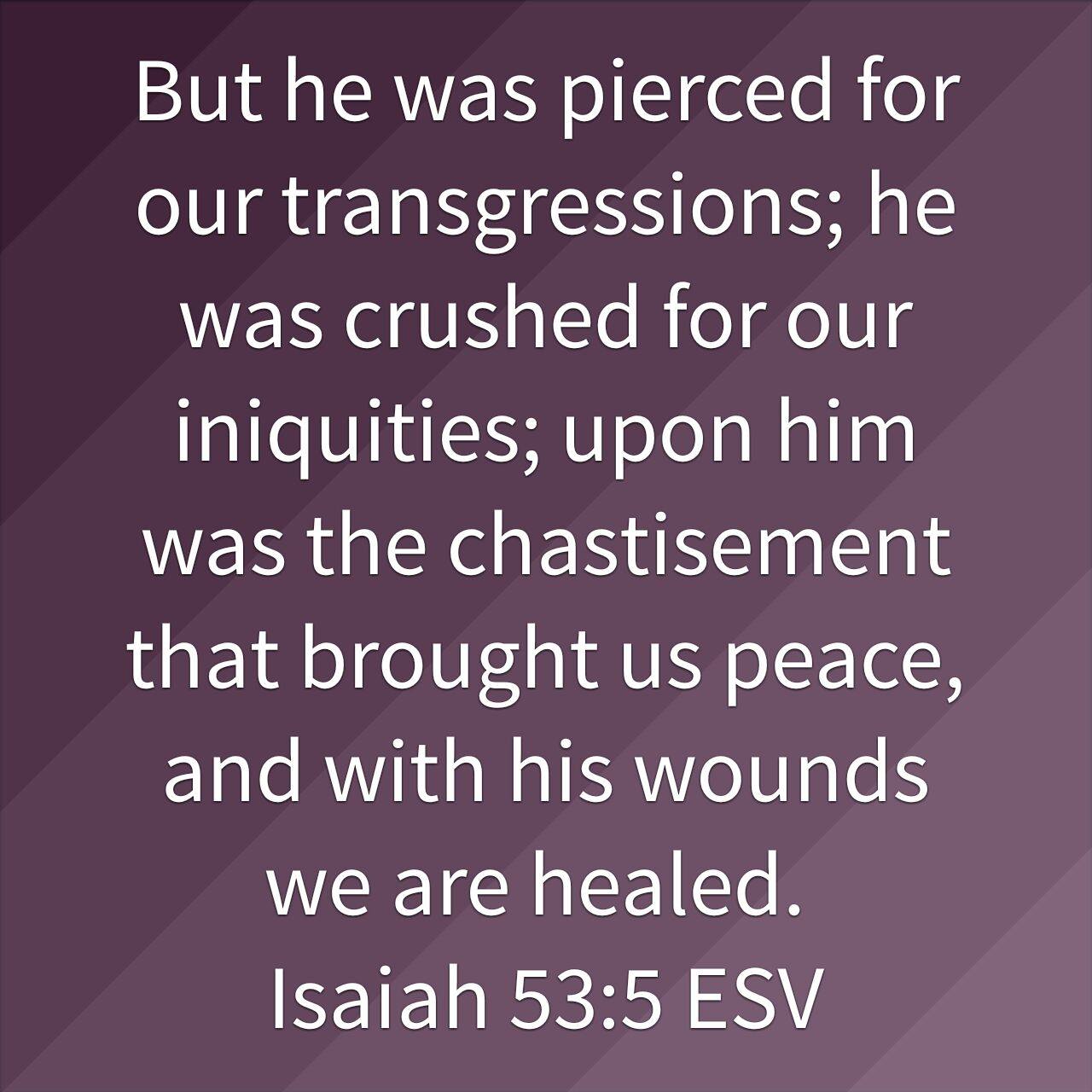
Isaiah tells us, ‘by His stripes we are healed.’ (Isaiah 53:5). The Saviour had already suffered; His face had been beaten beyond recognition ‘And some began to spit on Him and to cover His face and to strike Him, saying to Him, “Prophesy!” And the guards received Him with blows.’ (Mark 14:65). Now He is scourged. This was common practice so the person being crucified was weakened before the crucifixion. Many died at this stage. Jesus would have been stripped and forced to bend over and flogged with a whip of thongs, to which were attached metal and bone. In Jewish law a man could only receive 40 lashes, but in Roman law there was no limitation. Jesus would have been whipped until the flesh was removed from His back. Unimaginable pain and suffering.

What was the purpose? The Romans weren’t concerned with God’s purpose. Jesus was so brutally beaten and whipped as punishment for your sin and mine. ‘Then I will punish their transgression with the rod and their iniquity with stripes.’ (Psalm 89:32). By His suffering our sin is forgiven. As horrendous as this description of the Lord’s suffering is, it doesn’t tell us of the depth and anguish of His soul as He bears the wrath of God against your sin and mine. Each stroke was blow from God for a punishment for my sin. The healing was only made possible because of the great sufferings of Christ, ‘by His stripes we are healed.’

This picture of Christ’s mutilated body should cause us great sorrow. We take sin so lightly, we excuse it. We see its true significance here. Sin is an affront to God’s nature, the most sickening sight. It must be punished. Every fibre cries out justice for your sin and mine. It demands the sufferings of hell. The Lord Jesus Christ suffered hell for your sin and mine. We must despise sin and repent of it. Trust in Christ and receive the forgiveness His sufferings alone can bring.

Isaiah also says Christ was, like a lamb that is led to the slaughter.’ (Isaiah 53:7). The Lord had been bound and led around all night, dragged from one place to another. Here again, in Mark 15, we see Him being dragged around by the soldiers, first led to the barracks, ‘And the soldiers led Him away inside the palace (that is the governor’s headquarters), and they called together the whole battalion.’ (Mark 15:16). They spitefully abused, mocked and spat at as they degraded Him. Then they dragged Him out to be crucified, ‘And when they had mocked Him, they stripped Him of the purple cloak and put His own clothes on Him. And they led Him out to crucify Him.’ (Mark 15:20). This glorious Lord subjected Himself to be led about like a common criminal. He willingly submits. Why? Because He willingly agreed to do His Father’s will, to submit to God’s punishment for your sin and mine, ‘like a lamb that is led to the slaughter.’

Isaiah 53-7

Jesus did not resist or reject because, in love, He was going to die for me and you. What great love Christ has for us that He could endure such treatment. It’s impossible for us to see our Saviour’s willingness to die for us not to render ourselves completely to Him. He loved me so shouldn’t I love Him with all my heart, all my being, all my life? Should I not worship Him, praise Him, serve Him and love Him?

The Saviour’s experience reflects the reality of sin in hell. There is no freedom in hell, no possible escape. The opportunity for freedom lies this side of the grave. It is Good Friday because it’s the day in which the hope of Salvation came to those in bondage and set them free to serve Him. The Lord was bound so that we might go free.

‘He was despised and rejected by men.’ (Isaiah 53:3). We have already seen in Mark 14:65 that Jesus had already been mocked by the soldiers of Herod, He was now treated with contempt by the Roman soldiers. This was prophesied in Mark 10: 33-34, ‘See, we are going to Jerusalem, and the Son of Man will be delivered over to the chief priests and the scribes, and they will condemn Him to death and deliver Him over to the Gentiles. And they will mock Him and spit on Him, and flog Him and kill Him. And after three days He will rise.’ The Romans despised the Jews, so when the Roman soldiers had the opportunity they took great delight in ridiculing them. Now, even though Jesus was innocent, they call out the whole cohort, about 600 men, to mock Jesus. They dress Him as an emperor and mock Him as if He is a king. Mixed in with this sport was further cruelty as they force a crown of thorns on His head. They spit their revulsion in His face, then they put His own clothes back on Him and take Him to be crucified. ‘He was despised and rejected by men.’

The young Campbell Morgan, after passing his doctrinal exams to become a minister, then had to preach a trial sermon. After being told he was not successful, he wrote to his father one word, ‘Rejected.’ His father’s immediate response: ‘Rejected on earth. Accepted in heaven.’ Campbell Morgan went on to become a great evangelist. We are only accepted in heaven because Christ was rejected on earth. Those who mocked Jesus as the King of the Jews will have to face Him as the King of Glory. One day they will bow the knee and be filled with awe and fear at His appearance. And so it will be for all those who mock Christ today. What degradation that Jesus endured – not only physically assaulted but psychologically abused as well. He emptied Himself of all majestic glory in paying the price for our sin. Again we see that the penalty of sin is extreme – because sin is extreme. It’s the extreme rejection of the goodness of God. It justly deserves the wrath of God. The terrifying thing is those who despise and reject Christ today will be despised and rejected by God for all eternity. What a terrible fate! If men would just humble themselves before the Lord they will know the love and acceptance of God for eternity.

Romans 10-9 KJV

In Christ’s suffering we see how real our sins are, for His punishment is the punishment of our sin. We see in Christ’s suffering the greatness of His love for us. He willingly bore the torture of punishment that we might be forgiven.

Gaze upon Him and marvel that for us, He died. ‘Truly, truly I say to you, whoever hears my word and believes Him who sent me has eternal life. He does not come into judgement, but has passed from death to life.’ (John 5:24).

John 6-47

Sunday 26th June – Morning Service

Aaron

Character & Conduct

This morning’s worship was led by Aaron Davies-Whitfield who continued his study of Philippians, preaching from chapter 2 verses 14-16 – such a relevant scripture after what has happened in our nation.  The Word of God challenges us and changes us. Often the Word of God, which is ‘sharper than a two-edged sword’ (Hebrews 4:12), challenges us. It shows us things about us which do not line up with the Word of God. We must humble ourselves and acknowledges our shortcomings and confess. We need to repent and turn to someone we are in great need of, turning away from sin to Christ, asking for forgiveness and grace. The process of taking out sin in our lives is painful but necessary. This Word is a challenge to us all, it’s a good challenge.  Character is our reputation, conduct is our behaviour, and how we conduct ourselves. Paul is talking about a Christian character and conduct. He covers three areas:

  • Our relationship with God – This always comes first. Before we do wrong to anyone, we have first done wrong to God.
  • Our relationship with others
  • Ourselves

When Paul says, ‘Do all things’, this shows us that nothing is left out. God asks that our Christian life is one of affecting every area. We are born again, we are a new creation in Christ Jesus. Our life is to be different in every single aspect.

‘Because it is written, be ye holy; for I am Holy’ (1 Peter 1:15-17). Paul here is talking to believers. Our holiness first comes with Salvation, it is not just about morals, it is about being the people of God. We are set apart. Because we are His people, we are to be different. We belong to Christ, so we have to live as the people of God.

Verse 15 – we are the sons and daughter of God. The pulpit is not a place of politics. It’s the place of God. Whatever our views of the Referendum we must not fight. The body of Christ goes far deeper than our political views. Whatever we voted, we must love one another. We are one body, inextricably bought with the blood of Christ, we all belong to the same Father. We must come together as a Church.  If the people of God cannot come together, how can we be an example to others?

There is a greater ‘in or out’. Are people in the Kingdom? There is a greater cross to put by your name – the cross of Jesus Christ. The gospel still carries on, it is the greatest need, the greatest light and the greatest message. It travels throughout divisions. It has travelled throughout history. This gospel must carry on. It should be the most important thing in a Christian life. Glorifying Christ is the greatest work, the gospel is the greatest campaign.

‘Do all things, without murmurings and disputings’. Our delight is to please God.  The children of Israel were on a journey and murmured. Don’t murmur to God, He loves us, He is the sovereign. Remember the character of God and let it change you.

Our conduct should be ‘Blameless and harmless’ to others. We need to be different and love one another, serve and help one another. This is the beauty of the church. Manifest His love, care and compassion.

‘Love your enemies, bless those who curse you, do good to those who hate you’ (Matt 5:44). We can be one thing in church and something different behind closed doors.  In your whole life, in your very thought life and deeds, in private places, strive towards the Saviour. Don’t settle for remaining to be the same people, strive to be more like Jesus, wanting to be more and more a holy people. Strive for a closer walk with God, this is the path to glory. We are to be ever more increasing in our life to Christ. There is always a need to confess our sins, to grow in grace. What is on the outside should be the same all the way through, displaying Jesus on the inside and outside.

‘Crooked and perverse generation’ – we live in a fallen corrupt world. It is dark, it is evil. As the Church, as the people of God, in a nation that is split down the middle, we need to be an example. We need our light to shine before men, to show the light in a very dark time. God knows we live in a dark, evil world and this is why He asks us to shine. We are the light, we are different, we are changed, and we are the people of God. Our love is for God not the world. Our desire is not for ourselves but for God. We need to shine. The church must set the example, we must hold first to the Bible – the light. It is the truth in the midst of corruption and lies, it is the testimony we are to hold. We need to practice what we preach otherwise we are empty. Let people see unity and love in us, see something different in us.

‘I may rejoice in the day of Christ.’ Live this life for Jesus, whatever the cost, whatever the price, whatever the mockery and scorn. Be a light shining continually in the storm, in calm, but always shinning for the Lord. Let this message change us.