
Exodus 27:20-21.
Introduction
We have been singing about the presence of God being among us. The Lord Jesus promised the disciples that He would be with them always, even to the end of the age (Matthew 28:20). The Lord is wherever His people are, and He will never leave nor forsake them. Do we appreciate this fact that the Lord is here now and present among us? Do we give Him the reverence due His name?
In the Old Testament there are many ‘types’ and ‘shadows’ which show forth truths about the Lord Jesus (Romans 5:14; Colossians 2;17; Hebrews 8:5;10:1). All of these point towards the Lord Jesus Christ. They each tell us something about His person and/or His work. In this message we shall focus upon the lampstand, but all of the elements of the tabernacle point towards Christ Jesus in some way. We should remember that the entire Bible is a testimony to the Lord Jesus. He said as much to the disciples when He rose from the dead (Luke 24:25-27,44-46). In Revelation 19:10 we read these words: “for the testimony of Jesus is the spirit of prophecy.” Such a statement shows us that the essence of all prophecy is actually a testimony of (or about) Christ. No prophecy has come by the will of man but through the action of the Holy Spirit (2Peter 1:20,21), and no man can come to the Father except through Christ Jesus who is “the way, the truth, and the life” (John 14:6). Thus to know God we must come and approach through the Lord Jesus Christ.
But in the Old Testament during the time after the Exodus, approach was made through the tabernacle. In the book of Hebrews we read that: “Christ came as High Priest of the good things to come, with the greater and more perfect tabernacle not made with hands, that is, not of this creation” (Hebrews 9:5). The tabernacle that Moses had built was, in fact, designed by God and He (alone) enabled certain gifted men and women with their God-given abilities and talents to construct the various parts of the tabernacle structure. The Lord gave these select people the wisdom and knowledge in skill to follow the pattern that God revealed to Moses (Hebrews 8:5). The Lord could have given the tabernacle to the congregation ready-made. After all He provided them with the manna in the wilderness. But instead the Lord raised up certain men and women, giving them wisdom by His Spirit, so that they could craft and build the tabernacle. But they had to do it precisely as it was revealed (Exodus 25:40; Hebrews 8:5).
The Lord used people in the construction of the meeting place that He had revealed whereby people could meet with Him. It was His design and His work, but He used people in its formation. In the same way the church, the body of Christ, is His work, but still He uses people in its formation. The church is grounded in Christ who is the foundation stone, and it is overseen and surrounded by God’s care and watchful eye. In 1 Peter 2:9 we read these amazing words:
But you are a chosen generation, a royal priesthood, a holy nation, His own special people, that you may proclaim the praises of Him who called you out of darkness into His marvellous light. (1Peter 2:9).
Even if we think we cannot be of use, that we cannot preach or lead a fellowship, we can be His people and “proclaim the praises of Him who called” us from this world of sin and darkness into His wonderful kingdom of light. No building upon this earth, however incredible its structure and design, can ever surpass nor be as good and as beautiful as the building of the Lord’s church!
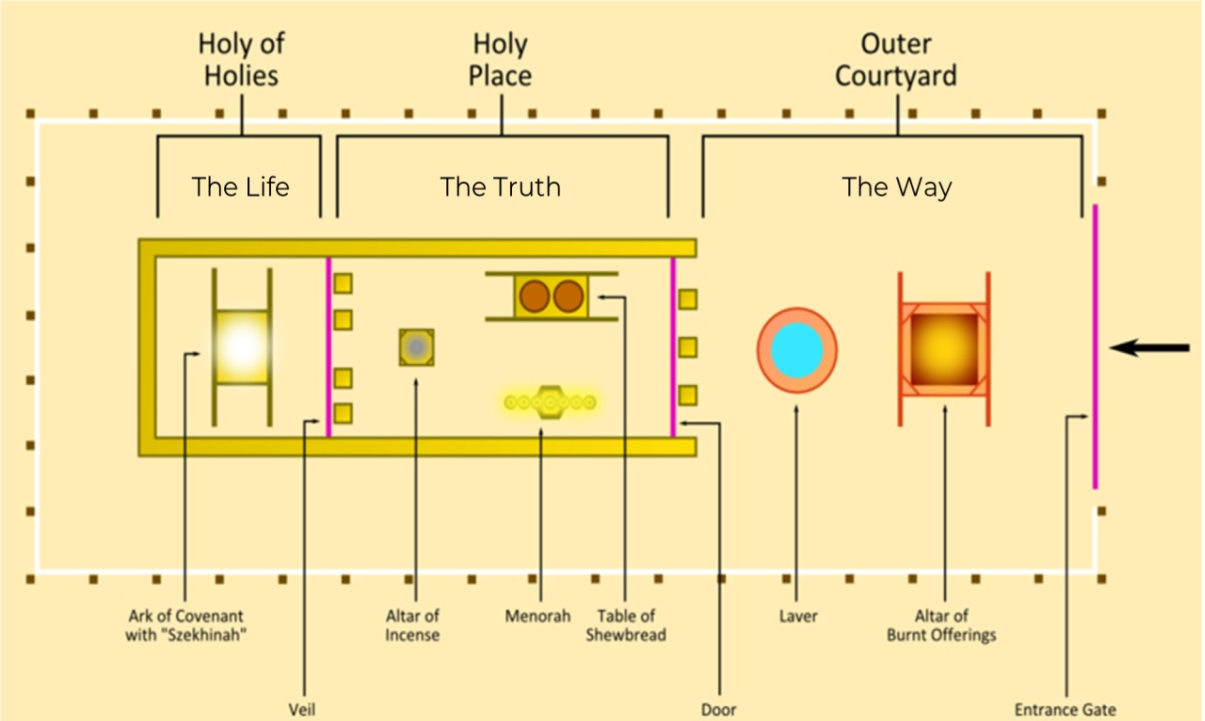
In this message, our focus will be upon the lampstand in the tabernacle. But to show what this was like and where it was sited, consider the illustrations below:
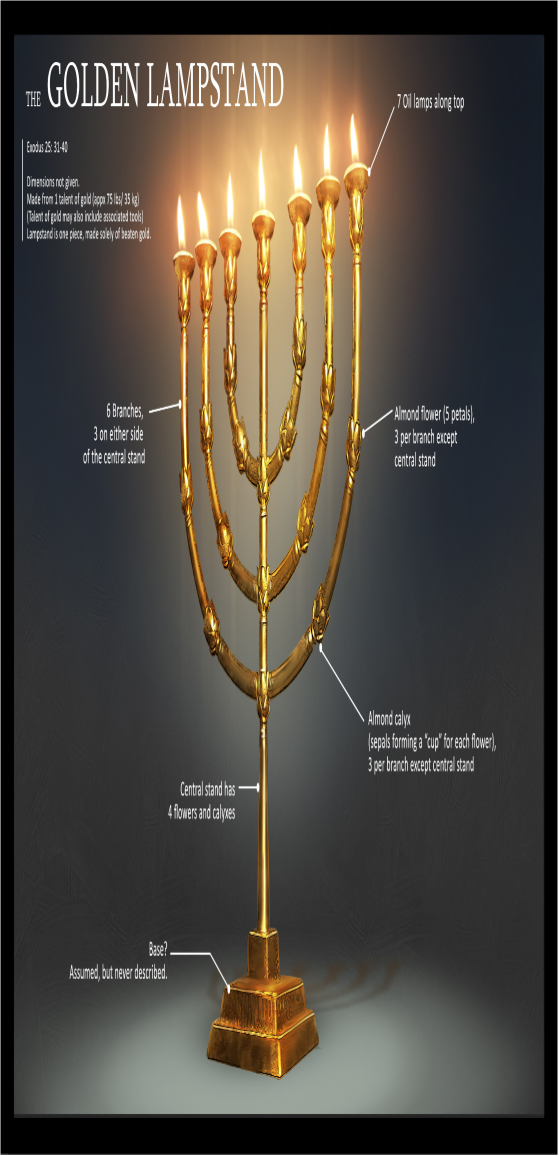
The lampstand is also called the “Menorah.” Details of its construction can be found in Exodus 25:31-40. The lampstand was found in the Holy Place where the priests did their work. The Holy of Holies was separated from the Holy Place by a thick veil and could only be entered once a year on the Day of Atonement by the High Priest alone.
We shall consider this part of the tabernacle furniture using the following details of its structure and function:
[1] Pure gold.
[2] Of one piece.
[3] The only light.
[1] Pure gold.
The ‘Menorah’ or the golden lampstand had seven branches in all. It was made of pure gold. In Scripture gold is put to illustrate divinity. The ark of the covenant was made of acacia wood overlain in gold and it housed the two tablets upon which were written the ten commandments. The wood aspect points to the human nature of the Lord Jesus and the gold to His divine nature. Gold was used in many other parts of the temple built later by Solomon. You may recall that the wise men who visited Christ in the manger brought gold, frankincense, and myrrh. Gold is a bright precious metal that is generally inert and so used mainly to represent the divine nature. Other precious substances such as pearls or other gems and precious stones are made from a combination of things that have undergone some form of transformation, but gold is elemental. Gold is considered a pure substance of great worth and largely uncorrupted. It is found as the native metal in the earth. So in the Old Testament economy (which is much more visual and earth-based), gold is put to point us towards the divine.
But gold can in fact react if it is mixed with a mixture of nitric acid and hydrochloric acid. It serves well as a temporal picture to illustrate divinity in the tabernacle and temple because by-and-large it is pure, unreactive, very shiny, and highly prized. But in the New Testament we find that there are some precious things which are greater than gold. For example, true faith in Christ (that is, a faith which is genuine) is “much more precious than gold that perishes,” and it is even so “though it is tested by fire,” that it “may be found to praise, honour, and glory at the revelation of Jesus Christ” (1Peter 1:7). Then further, our very redemption was purchased with something of much greater value than mere gold. Peter goes on to state in his first letter that we “were not redeemed with corruptible things, like silver or gold” but rather “with the precious blood of Christ, as of a lamb without blemish and without spot” (1Peter 1:18,19). Gold will perish, for it is simply a part of this creation. Even though it is a precious metal and high in value, Christ’s blood is of infinitely greater worth.
The gold of the Menorah points us towards this thought that God in His incredible wisdom and grace has provided us with “precious faith,” towards Christ, and “precious blood” of Christ for our redemption which are of infinitely more value and worth than earthly gold.
[2] Of one piece.
In Exodus 25:31 we are told expressly that the lampstand of gold was made from one piece. It was hammered into shape but from a single lump of the precious metal. We are also told that it was made from “one talent” in weight of pure gold (Exodus 25:39). There is some debate about the exact measure but it is somewhere around 32 to 35 kg. Apparently the average new-born baby weighs around 3.2 kg, so this lampstand is equivalent in mass to ten newborn babies! Quite a substantial size. It was no mere ornamental lamp on a sideboard!
Why this emphasis on it being made from one piece and not being welded or joined in any way? This surely shows us the unique nature of the Lord Jesus. He is described in such unique ways in the New Testament as the following few examples show:
The Holy One and the Just. (Acts 3:14).
The Head of the church. (Colossians 1:18).
The Apostle and High Priest. (Hebrews 3:1).
The Mediator of the new covenant. (Hebrews 9:15; 12:24).
The Man, Christ Jesus. (1Timothy 2:5).
The Bright and Morning Star. (Revelation 22:16).
But then also He is One with the Father: “I and My Father are one” (John 10:30). When we think of the Lord Jesus Christ we are also to think of the Father too, for as our Lord Himself said: “He who has seen Me has seen the Father” (John 14:9). And we dare not exclude the Holy Spirit who Himself is God too. These three divine persons, Father, Son, and Holy Spirit, are united in the trinity. One God but three distinct Persons. All work in concert and harmony. Where One is there are the others in perfect union.
Now our union with Christ is also apparent too. You will notice that there are six branches to the lampstand, three on either side. In the middle is the main or central branch. The number six is the number which represents man. Our Lord Jesus was the God-man. Fully human (although sinless) and fully God. Here in this menorah (lampstand) we see mankind reflected in perfection for the number seven stands for perfection, or that which is complete. Paul in Colossians tells us that in Christ “dwells all the fullness of the Godhead bodily” (Colossians 2:9), and because of our faith in Him we are united with Him and so Paul continues “and you are complete in Him” (Colossians 2:10). Wonder of wonders, the believer gets to share and partake of this incredible unity within the Godhead. As our Lord said in His prayer the night before He died:
20 “I do not pray for these alone, but also for those who will believe in Me through their word; 21 that they all may be one, as You, Father, are in Me, and I in You; that they also may be one in Us, that the world may believe that You sent Me. 22 And the glory which You gave Me I have given them, that they may be one just as We are one: 23 I in them, and You in Me; that they may be made perfect in one, and that the world may know that You have sent Me, and have loved them as You have loved Me. (John 17:20-23).
So we are “complete in Him,” and this is illustrated by the six branches of the lampstand and the central branch indicating perfection. The union of Christ and the believer is a theme which is spread throughout the New Testament. We have the illustration of the “true vine” and the branches in John 15. There is the illustration of believers as the one body of Christ (1Corinthians 12:13). We are “all one in Christ Jesus,” so that national and ethnic distinctions are all now gone (Galatians 3:28). For those truly saved this unity is eternal! And believers will reign forever with Christ (Revelation 5:10). The last part of Stuart Townend and Keith Getty’s song “See What A Morning” celebrating the resurrection has these words:
And we are raised with Him
Death is dead, love has won, Christ has conquered
And we shall reign with Him
For He lives, Christ is risen from the dead
Christ is risen from the dead
Or what of the hymn “All That Thrills My Soul Is Jesus”? Does the Lord thrill us so? Do we recognise that we shall indeed reign with Him in glory?
[3] The only light.
If you look at the tabernacle again you will notice that the Holy Place and the Holy of Holies are enclosed spaces. These are separated from the outer court by means of curtains. The veil that separated the Holy of Holies from the Holy Place was much thicker than the curtains shielding the entrance into the enclosed space itself. So inside would have been very dark (the materials used to cover the tabernacle were many and quite thick). Thus the only light available within was provided by the lampstand. The priests could enter the Holy Place to carry out various functions, and the High Priest could enter the Holy of Holies once a year for atonement. But work in such enclosed spaces would have been very difficult without the light of the lampstand. Now if we have not the Lord Jesus Christ within (who is the “light of the world” John 8:12; 9:5) you cannot do anything that will bring God pleasure. You will be in darkness. Light brings the ability to function. Without this light in the tabernacle the priests would be fumbling about and unable to perform. Light, therefore, is essential. But man in sin is in darkness. The Lord Jesus Christ is our light. The tabernacle shows us how we can approach God to worship. Without the light we would be stumbled.
Christ ought to be the centre of our very lives. He ought to be the One who guides and illuminates us. After all only in Christ can be found “all the treasures of wisdom and knowledge” (Colossians 2:3). We are therefore encouraged to “set your mind on things above, not on things on the earth” (Colossians 3:2), and we are to be “looking unto Jesus, the author and finisher of our faith, who for the joy that was set before Him endured the cross, despising the shame” (Hebrews 12:2). We are to look to Christ our light, for He is the light of the world.
The world spends billions upon billions of pounds, dollars, and other currencies to figure out what has gone wrong with man. The Bible offers the analysis and the solution for free. The heart of man is deceitful and is full of darkness (Jeremiah 17:9,10), and man is lost in sin, but Christ is the light of the world and “in Him was life, and the life was the light of men,” and this light of Christ which has come “shines in the darkness, and the darkness” cannot overpower it (John 1:4,5). Christ Jesus has come to save us from our sin, and a key part of this is that we may see the truth, and that we see things clearly, as they are, so the light of Christ illumines us. The light of Christ is still shining through those who truly believe, for the Lord said to His disciples who truly believed “you are the light of the world” (Matthew 5:14). The light of Christ shows up our sin, and it also shows up Christ’s true and glorious life. This light is in the believer forever. The Lord has called believers to be the lights of this world. Through the apostle Paul He says that we should “shine as lights in the world” (Philippians 2:15), which we do by “holding fast the word of life” (Philippians 2:16). We were “once darkness” but on account of what the light of the world has done we are now “light in the Lord,” and so we are to “walk as children of light” (Ephesians 5:8). May the Lord shine through us the glory of His Son!

 John 7:1-24
 Penuel Baptist Chapel, Roch