March 28th Good Friday 2024: John Scanlon

To watch this service, please click on the link to our YouTube channel: https://youtu.be/Ib4jpsGuwb0?si=6D6x2dnFIhe00bTv

Matthew 27: 29-42
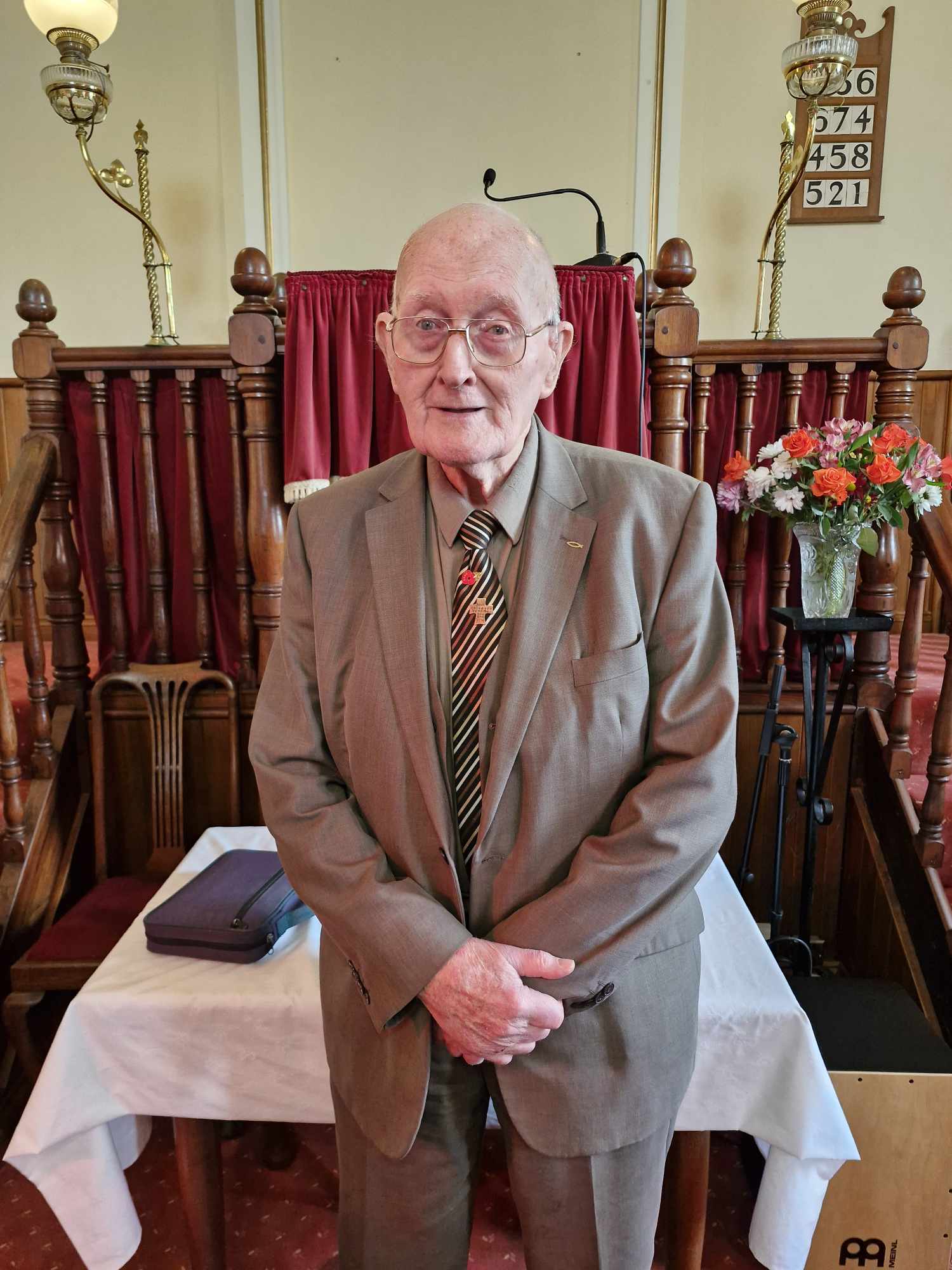
We ponder on the word of God and how it describes this great event that took place so long ago. We picture it in our minds, different people in different ways. You can imagine the big crowd there, watching. In those days, it was probably the only entertainment they had. Attending this execution of the Lord Jesus Christ we have the curious, the crowd followers, the passers-by – so hardened to the suffering of others. Crucifixion was entertainment. They were guilty of saying things amongst the crowd they would not say otherwise. They were guilty of being one of the gang. Passers-by became a mob.

What had changed peaceful citizens into a mob crying for blood? A week earlier they had cried out ‘Hosanna,’ now ‘Crucify Him!’ These people may have had nothing against Christianity, but joined in with the crowd so they didn’t feel left out. We see crowds like this today, for example, at football matches. Were these passers-by responsible for the death of an innocent man? Yes! As we all are. On judgement day you will need to give a personal account, not be part of a crowd.

In His agony Jesus cried out, “My God, my God, why have you forsaken me?” Forsaken by God! Who on earth can understand that? Jesus was crucified at 9:00 a.m., the third hour, the hour of the morning sacrifice. At noon, when the sun burnt so brightly, darkness fell until the 9th hour, 3 p.m. This was the time of the evening sacrifice when the lamb was offered as a daily sacrifice in the temple. This was a foreshadowing of the sacrifice of the Lamb of God, the Lamb slain for the world. During that time of darkness, no sound came from Jesus on the cross. There was absolute silence. When the darkness had passed, that was when Jesus cried out, “My God, my God, why have you forsaken me?”

How can we understand that dramatic scene? How can we express its meaning? We can grasp some of it by examining the following:

  1. The desperation of the cross.

Was there ever a cry so filled with desolation? Many people misunderstood and thought He was calling for Elijah. From childhood He had been misunderstood (Luke 2, John 2:19). The crowd laughed, they mocked and jeered. The religious leaders were quite correct when they said, He saved others; Himself He cannot save. If He is the King of Israel, let Him now come down from the cross, and we will believe Him.” (Matthew 27:42). He saved others but He could not save Himself because He set His heart on saving others. “And according to the law almost all things are purified with blood, and without shedding of blood there is no remission.”(Hebrews 9:22). He came to this world to save you and me, to obtain forgiveness for sinners.

  • Separation from the Father.

This is a mystery. Forsaken – heart rendering. Being forsaken was no new experience for Jesus; all His life He had been forsaken. His own family turned away from Him, His own nation rejected Him, the disciples forsake Him and fled. He knew what it was to be forsaken, yet He was always conscious that He was not alone, for the Father was always with Him.

He told His disciples at the Last Supper in the Upper Room, “Behold the hour cometh, yea, is now come, that ye shall be scattered, every man to his own, and shall leave me alone: and yet I am not alone, because the Father is with me.” (John 16:32).

Yet, now on the cross He cries out, “My God, my God, why have you forsaken me?” Nobody stood by Him. There is no opening of the heavens. There is no voice of God. There was no strengthening angel by His side as it was in Gethsemane. He is completely alone, forsaken by God. But does God ever forsake His own? All history, all human experience, all scripture indicates not. God has promised, ‘I will never leave you or forsake you.’ Yet He forsook Christ at Calvary. What can it mean?

The answer is to be found in the significance of the death of Christ. It wasn’t an eternal separation from God. The divine nature cannot be separated from the human nature. Jesus was eternally God.  The Father couldn’t be separated from the Son in the Godhead. It could not mean that the Father had forsaken the Son in the sense that He no longer loved Him, because God truly was well-pleased with Jesus for sacrificing Himself on the cross on behalf of others, and carrying out God’s will even unto the point of death. It was because all the sin of humanity was placed on Jesus. Therefore, God abandoned His Son; in His holiness He could not look upon sin. Jesus was obedient unto death.

The sins of the world separated the Father from the Son. Sin separates us from God. Jesus was the substitute for our sin, taking our place on the cross. All of the sin and iniquities of the whole world was placed on Him. Think upon on that – all the greed, all the hate, all the lust – Christ bore the sins of the world. Isaiah 53 foretold it. Consequently, all the wrath of God was poured out on Christ. Every nail driven into His body, every stripe on His back, every thorn – all this He endured for us, for our sin.

He stood between a sinful world and a righteous God. He suffered in our place. Christ still said, in spite of His suffering, “My God, my God.” He held strongly to His faith in God. God always stands near to those who can cry out, ‘My God. my God.’ Our Lord Jesus Christ, like Job, was saying, ‘Thou He slay me, yet I will trust in Him.’

It was a cry of victory. Here, Jesus was completing the work He came to carry out. He was accomplishing the will of the Father. This was His supreme moment of triumph. God authenticated it by accepting the sacrifice that was offered. The veil of the temple was torn from top to bottom, as if God was reaching down from heaven to tear it apart and say to mankind, ‘Come to me now through the sacrifice of My Son. You have no need anymore of an earthly priest to intercede for you. Instead, you have an advocate with the Father, Jesus Christ the righteous.

We are told salvation is found in no-one else, for these is no other name under heaven given about men whereby we must be saved. Jesus Christ was born as Saviour. He has accepted the penalty on your behalf. He has suffered for us. We can look to Him and no other, for salvation. Turn to God in repentance and confess your sins and you can be numbered among those for whom Christ died.

A closing thought. On that day there were three men on three different crosses: one not caring about the damage he had caused by his awful life, defiant to the end. One next to him whose death was intended to repair the damage caused by centuries of sin. And one who regretted the life he led and, although he was at the point of death, truly felt sorrow for the sins of his life and wishing he could atone for those sins. He turned to the one who hung next to him, who was truly the Son of God, who was able to tell him not only where he was going, but when, ‘This day thou shalt be with me in paradise.’

That promise is also for us if we truly repent of our sins. We too need to turn to the Saviour, to seek the forgiveness that was purchased for us at such a high price.

September 18th 2016: Gareth Edwards

Reverend Doctor Gareth Edwards, of Hill Park Baptist Church, preached on John 1:26, “Behold! The Lamb of God who takes away the sin of the world!” John 1:26

You may have had a hectic week and look back and feel exhausted by all you were required to do. All that takes place in here in John 1:19- 34 took place in a week. It begins with John the Baptist being quizzed by a deputation of Pharisees and ends with Jesus’ first miracle – turning water into wine. It was a week full of testimony to who Jesus Christ is. The question at the beginning is ‘Who is John the Baptist?’ but the question that is answered is ‘Who is Jesus Christ?’ John the Baptist plays a central role in that testimony, which can clearly be seen in verses 32-34. He has already baptised Jesus and come to realise that Jesus is the Messiah. John humbly points the deputation from Jerusalem away from himself and to the Messiah – the one who was in the midst but of whom they were ignorant. The next day John immediately identifies him as the Messiah.

In order to grasp John’s message we need to examine the key words and unpack the statement, “Behold! The Lamb of God who takes away the sin of the world!”  This will be done in reverse order: Sin, Lamb of God, Behold.

Sin:
It has been said that the heart of the human problem is the problem of the human heart. Jesus came into the world to address this problem – sin. Jesus came in order to take sin away. Today, sin is considered to be irrelevant. We may believe they are accountable to no-one but ourselves. If we believe God exists at all, then we may believe that He doesn’t have a right to condemn us because His role is to love and care for us. If we do acknowledge we have done wrong, we blame others for leading us astray or we blame our circumstances; we’re not guilty but victims.

The Bible doesn’t excuse our sin, it doesn’t allow us to escape the fact that we are accountable to God for our actions and our words. Romans 3:23 states, “For all have sinned and fall short of the glory of God.” In Romans 6:23 we read, “For the wages of sin is death, but the gift of God is eternal life in Christ Jesus our Lord.” This rebellion against God brings upon us the just sentence of death. This is the root of the whole problem of our world. All are sinners. As sinners we are justly condemned by God, subject to His holy wrath. John the Baptist tells us Jesus came to deal with the problem, to take away our sin. Do you recognise that you are a sinner? You may be someone of integrity, yet our sin is desperately wicked. The reality is that in what we do and what we say there is rebellion against God. It is no use burying our heads in the sand; we are sinners! Consequently, the Word of God tells us that the greatest priority is that our sin be taken away. Family problems, health problems, financial problems – they all pale into insignificance. We need our sin to be taken away, to know His forgiveness. We need to cry out for a Saviour to come, to rescue us. You desperately need a Saviour.

Lamb of God:
The people of Jesus’ day were steeped in the Old Testament and knew very well how lambs were used as sacrifices for sin. After sin came into the world we were alienated from God. It was God’s will that a lamb was as a sacrifice. In Genesis 4:4 and Hebrews 11:4 we read how Abel was considered righteous after offering a sacrificial lamb – the shedding of blood for life. Cain offered fruits of the soil, labours of his own hand, which God rejects. No amount of human effort had effect. Later, under the Law of Moses, a lamb was offered. We read in Leviticus 4:32 that a sinner brings a lamb and places his hands on the animal’s head to symbolise the transference for guilt.

In Hebrews 10 we learn that no amount of shedding of blood could take away sin. Only the Lamb of God truly cleanses us, the Messiah. Those who offered sacrifices in the temple looked forward to the one Lamb of God, whose death would take away their sins.

The people would have remembered how Abraham was commanded to sacrifice his much loved son Isaac. Abraham obeyed and took Isaac, who was probably in his late teens or early twenties. Isaac submits. They reach Moriah where they leave their servant behind. When Isaac asks where is the lamb Abraham replies that God will provide. Abraham was about to plunge the knife when God intervened. Abraham proved his faithfulness to God, or rather proved to himself his faithfulness to God. There, nearby, God provided a lamb caught in brambles – a substitute for Isaac. Now John describes Jesus as the Lamb of God – a substitute for you and me, for Isaac, for Abraham. ‘God demonstrates His own love toward us, in that while we were still sinners, Christ died for us’ (Romans 5:8).

In Exodus 12 God is going to send an angel of death to pass through Egypt. But the Israelites sacrificed a lamb and smeared its blood on doorposts as a sign to spare the Israelites and protect them. The lamb had to be perfect. So it is that Jesus Christ came, the real Passover, the perfect Lamb, who sacrificed His blood for us. Through the blood of the Lamb we are spared.

‘You were not redeemed with corruptible things, like silver or gold, from your aimless conduct received by tradition from your fathers, but with the precious blood of Christ, as of a lamb without blemish and without spot’ (1 Peter 1:18-19).

In Isaiah 53:5-7 the prophet foresaw the coming of the Lamb, a suffering servant, a sacrificial Lamb who will take away the sins of the people, ‘like a lamb led to the slaughter.’ Jesus was both innocent of the charges laid against Him, completely innocent of any wrong doing. Yet He goes to the cross like a man who endures what He deserves. Why? Because He has accepted the responsibility for your sin and mine. He stands in my place and yours. So in describing Jesus as the Lamb of God, John is saying Jesus is the fulfilment of the Old Testament passages of scripture.

In Egypt on Passover night there was death in every house. Can you think of what that would be like – if in every house in Roch someone had died? On Passover night there was either the death of a lamb or death of a first born babe. In payment for our sins there has to be death. Either our death or Jesus’ shed blood so we might be forgiven and have eternal life, an eternal relationship with God. It is amazing to think God provided His only Son to suffer in our place when we are so unworthy. It is amazing!

Look / Behold!
John the Baptist issues an invitation to all around him not simply to gaze on Jesus but to trust Him. John is saying,’ Here is the Saviour who can provide all your needs. Don’t look to me or yourselves for salvation, look to Him and Him alone. ’ It is only those who look to Jesus with believing eyes who will be saved.

The New Testament uses the term ‘all’ for inviting people to come. This means all types – male, female, rich, poor – Jesus offers salvation to all types of people. But it only has effect for those who repent of their sins and know that there is nothing they can do to help themselves. Have mercy upon me as a sinner. I take Jesus to be my Saviour. I hide in His death because He died for me and I trust in Him. Your wrath, Oh God, fell on Him at Calvary and as I trust in this I am hidden from that wrath. I will follow Him and serve Him.

‘Look!’ John says. He pleads for you to take Him as your Saviour. John has baptised Jesus in the Jordan. Jesus didn’t have any sin so why was He baptised? Just as He didn’t have to die for His sins, He died for ours. He was saying, ‘I am one of them, I am them.’ He carries those sins of ours throughout His perfect life. We watched as His sins were sealed behind the rock of death. He rose on the third day, minus sins, which are never to be seen again.

Have you looked to Him? Not just a passing glance. Have you looked and seen in Him the only hope of Salvation?