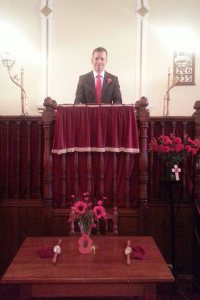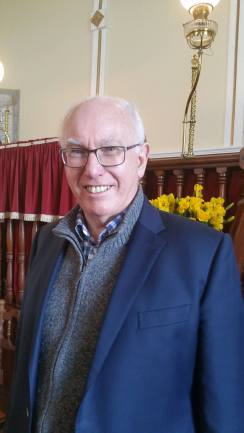
5th February 2017: Dave Norbury

david-norbury-feb-17What is so wonderful about the gospel we believe?

  • It is rooted in history.

Many of the people who stood under the cross of Jesus rubbed their hands – they had captured the troublemaker. Yet in Isaiah 53, written 700 years before, this event is predicted and described in detail. Our message is rooted in history, in an event that really happened. ‘And they made his grave with the wicked and with a rich man in his death, although he had done no violence, and there was no deceit in his mouth. Yet it was the will of the LORD to crush him; he has put him to grief; when his soul makes an offering for guilt, he shall see his offering; he shall prolong his days; the will of the LORD shall prosper in his hand. Out of the anguish of his soul he shall see and be satisfied; by his knowledge shall the righteous one, my servant, make many to be accounted righteous, and he shall bear their iniquities. Therefore I will divide him a portion with the many, and he shall divide the spoil with the strong, because he poured out his soul to death and was numbered with the transgressors; yet he bore the sin of many, and makes intercession for the transgressors.’ (Isaiah 53:9-12).

The gospel is for the very worst of people. The two robbers crucified on either side of our Lord were genuinely the sort of people you should fear, the very worst of people. They too, reviled Jesus, mocking and humiliating Him. ‘And the robbers who were crucified with him also reviled him in the same way.’ (Matthew 27:44). Yet what we find Jesus tells one, ‘Truly, I say to you, today you will be with me in Paradise.’ (Luke 23:43). Amazing!

Jesus Christ takes the very worst of people and makes them secure in heaven. He came into the world to save sinners. Hypocrisy sets you above people to look down, but you and I have wickedness within our hearts which is equally detestable. ‘For all have sinned and fall short of the glory of God.’ (Romans 3:23). This gospel isn’t restricted to the kind and good, it’s for everyone who is a sinner, everyone – the worst of the worst. And Jesus demonstrates it in His last moments of His life on the cross.

  • The gospel is about miraculous change.

During the crucifixion there was darkness between 9 and 12, but at 12 one of the robbers had changed completely. ‘One of the criminals who were hanged railed at him, saying, “Are you not the Christ? Save yourself and us!” (Luke 23:39). God has changed him. It’s almost beyond belief. Suddenly he has come to believe there’s a God. So many people think there is no God. Every single one of us during our lives, has a consciousness of God. Suddenly this man believes there’s a presence so much greater than his own. He had no conscience, but now he has God. He realises he is guilty. This is true of everyone who becomes a Christian; we become conscious of our own sin and failure. We have to believe that this message we have is about miraculous change.

  • The gospel call people to personal faith.

Not only does the gospel take someone who mocks Jesus at 9 o’clock but at 12 o’clock he worships Jesus Christ. Suddenly the man is speaking to the Lord Jesus Christ in a very personal way. He speaks to the Lord Jesus who has a kingdom. He saw, when they were carrying the crosses to the execution, Jesus spoke to the women on the road, he heard how Jesus didn’t respond to the taunts of others, how Jesus spoke to His Father. His heart moved right towards the Lord Jesus Christ. We can’t do it ourselves, but as we cry out to God, then our wonderful God draws near to us. This gospel calls us to personal faith in Jesus Christ. What a great message!

  • The gospel proclaims wonderful promises to the worst of sinners.

The Lord Jesus replies and says to the robber, ‘Truly, I say to you, today you will be with me in Paradise.’ (Luke 23:43). We have wonderful promises we can rely on for eternity. We are told, ‘Call unto me, and I will answer thee.’ (Jeremiah 33:3). ‘He shall call upon me and I will answer him.’ (Psalm 91:15). There is a death, there is judgement, but this robber will be in Paradise. What a place!

  • The gospel is filled with encouragement but there are also warnings.

We have the encouragement of heaven. Sadly, there is a great warning. One of the thieves refused to trust Jesus Christ. There is judgement. God will deal with our sin and failure. Jesus died on the cross to save sinners, but for those who reject Jesus, they will be rejected themselves.

In summary, the gospel is rooted in history, it is about miraculous change, it calls people to personal faith, it proclaims wonderful promises and filled with encouragement, but there are warnings too.


Contentment in Christ – whatever our situation

Do you ever think ‘What if’, ‘if only’ or ‘why me?’ I know I ask these questions and all too often! It is so easy to fall into the trap of thinking we ourselves can alter and shape the future. We evaluate our situation and if we are not completely satisfied the questions begin. As someone who is far too familiar with the ‘valleys’ in life, the doubts and questions can become burdensome. We’ve been taught that contentment is linked to our accomplishments or accumulation of satisfaction from the world. These questions can never be fully answered and since there is no end to our desires to acquire or do more, the horizon is always moving. We will never experience contentment following this line of thinking.

The true meaning of contentment is being satisfied with what you have and with who you are – right now, always being content that the Lord provides everything you need. Despite the many trials Paul went through he understood how to be content. In Philippians 4:11-13 he wrote,

Not that I am speaking of being in need, for I have learned in whatever situation I am to be content. 12 I know how to be brought low, and I know how to abound. In any and every circumstance, I have learned the secret of facing plenty and hunger, abundance and need. 13 I can do all things through him who strengthens me.

Contentment doesn’t have anything to do with external influences; rather it has everything to do with God and how He is moulding us and refining us all for His glory. The good news is that we all can learn how to become fully content with who we are, what we are, and what we’re doing.  Through our relationship with Jesus Christ, we can learn how to be content by thanking God for what we do have instead of focusing on what we don’t have.

“Always be joyful. Never stop praying. Give thanks no matter what happens. God wants you to thank him because you believe in Christ Jesus.”  (1 Thessalonians 5:16-18)

The key is to be confident in the knowledge you can do all things through Him who gives you strength. This only occurs by faith, moment by moment.

The apostle Paul highlighted the importance of living life as we are called to do. 1 Corinthians 7 verse 17 states ‘Only let each person lead the life that the Lord has assigned to him, and to which God has called him.’  Paul emphatically states that God has sovereignty over all things and He has assigned each believer with a place in life, and it is from where we are situated now that the Lord will use us. Every day, God places us where we need to be in order to serve Him. Our ‘place’ in this world is not determined by chance, but has been carefully crafted and weaved into a grand design.

So what happens when we reach the valley and all looks bleak? In our own strength we crumble and cannot cope with the burdens of life, but with God everything is possible. We may feel unable to carry on, but the God of the mountaintop is still the same God in the valley.  He is able to remove us from the difficult situation, but that isn’t always helpful. There is always a reason for our circumstances – whether to learn something new or to remold us in Christ. But the most important thing, above all else, our circumstances are given to us to glorify the Lord and become trophies of His grace. God is Sovereign over all things – good and the not so good. The difficulties we experience don’t happen to us by chance, but we know that there is good in every situation. We may not see it immediately and we may ask. ‘Why is this happening?’ but during these times we need to thank God and trust in Him.

For I know the plans I have for you, declares the Lord, plans for welfare and not for evil, to give you a future and a hope.  – Jeremiah 29:11

And we know that for those who love God all things work together for good, for those who are called according to his purpose. – Romans 8:28

September 11th 2016: Aaron Davies-Whitfield

Worship was led by Aaron Davies-Whitfield who preached from Philippians 2: 19-24, which he entitled “Not my will, but Thy will be done.’ We find Paul is in a place of uncertainty. His letter is written from Rome when he was under house arrest, which can be likened to the bonds and chains of the gospel. Paul is facing possible execution. He truly was an incredible man of God, a giant in the faith. It is staggering how God changed this man, who was out to destroy the church but now he is willing to lay down his life for the church and Christ.

In verse 19 we read, ‘But I trust the Lord Jesus.’ Paul was so captivated by Christ, his every thought and deed were always attached to Christ. He was under house arrest by the wicked Emperor Nero, who prosecuted and martyred Christians in the most horrific ways. Paul does not say, ‘I trust – if the Emperor allows.’ No, he states, ‘I trust in the Lord Jesus.’ Our future must fall into that place, like Paul. When you come to acknowledge Him as Saviour, He is not only your Saviour, He is your Lord. You give your life to Him. Paul faces possible execution, yet Jesus is the one who holds Paul’s future. Notice, in verse 24, Paul write, ‘But I trust the Lord.’ His future was not bleak but wonderfully glorious because of Christ. Whatever comes our way, our future is glorious in Jesus.

Paul was a spiritual giant but he also had feelings. This mighty man of God needed to be encouraged. He says he hoped to ‘send Timothy shortly unto you, that I also may be of good comfort’ (verse 19). Paul was anxious for the Philippian Church. Notice his feelings were all encompassed in Christ. He was concerned but that didn’t waiver him, his trust was in Christ. We are reminded, ‘Trust in the Lord with all thine heart, and lean not unto thine own understanding. In all ways acknowledge Him, and He shall direct thy paths.’ (Proverbs 3:5-6). Paul was trusting in the Lord. Trust in Him, lean on Him when you don’t understand and He will direct your path.

I wonder how many people visited Paul when he was under house arrest? It’s a challenge to us. How do we feel about those who minister the gospel to us? Do we love and care for them? It’s not always easy to sit under preaching – sometimes it will rebuke and chasten. We don’t pick and choose, it’s His Word. There can be that in us that doesn’t receive the Word. Let the Spirit of God work in us. We need to humble ourselves. Love those, even in their faults.

Paul found no-one like-minded but Timothy, his son in the gospel. In verse 21 we read, ‘For they all seek their own interests, not those of Jesus Christ.’ Where is your heart today? What is your greatest ambition? What are your motives and desires? Where is Jesus in all these things? How sad Paul was surrounded by Christians but none of them sought Christ’s Will. When Christ came to this earth He thought nothing of His own will, He sacrificed everything for the gospel. He laid aside everything.

In the parable of the Good Samaritan the priest and the Pharisee walked passed the man who was beaten and left for dead. It was the Samaritan who stopped and helped. It’s a challenge but one to take on board.

As Christians we can be more mindful of seeking salary not a Saviour. If Paul came to the church this morning, what would he say of us? Everything in this world will fade away – our job, salary, even our families – but all done for Christ will last. Make His name great in our life and your name full of insignificance. ‘Seek first the kingdom of God and His righteousness.’

Looking at the churches around I see an absence of men in the gospel work. God is calling men to the work. The harvest is ripe but the labourers are so few. One of the reasons is we have too glamourous minds – certain things have to be in place before we consider God’s work. The ultimate questions is, ‘Has God called you?’ If God has called you, then He will provide. Men and women look to salaries and locations. In the New Testament, being a gospel church meant being in prison. Where is Christ in your life? We may not be called to preach the gospel but we are all called to live for the glory of God and make disciples, to follow Him whatever that means. Salary, reputation and comfort will all fall aside. We need to go wherever and to whoever if the Lord is calling. Jesus called the disciples – they did not know where they were going and they would lose their lives but they went willingly. ‘All seek their own interests, not those of Jesus Christ.’ We live in a world of ‘My, my, my, me, me, me’ but what about Jesus? In light of all He has done for you, He asks you to be willing to serve Him, He will do everything else. All Jesus is asking is for you to say, ‘I’ll go Lord.’ God is calling.

‘And I heard the voice of the Lord saying, “Whom shall I send, and who will go for us?” Then I said, “Here I am! Send me.” (Isaiah 6:8) God is calling you to something. He wants you to be a faithful witness to family and friends or even to the other side of the world. Seek Christ. Seek His will in your life. Surrender your will into His hands.

In verse 22 we read of Timothy, who we know was not a well man; he was a weak and fragile young man but he was willing to go, whatever the cost. When it came to conscription in the Great War men had to leave everything and go to war. We need to serve Christ, to take up the banner of the cross.

The church must go on, the gospel must carry on. But it needs labourers, people willing to forsake their wants for God’s wants.

‘So I will go wherever He is calling me
I lose my life to find life in Him
I give my all to gain the hope that never dies
I bow my heart, take up my cross, and follow Him.’

(From the hymn, ‘What Grace is Mine.’)

You may also like to listen to the hymn, “Here I am Lord’
which is based on Isaiah 6:8
https://youtu.be/EcxOkht8w7c

Sunday 17th January 2016 – Morning Service

Aaron-Jan16

Our guest speaker on Sunday was Aaron Whitfield Davies of Calvary Church, Haverfordwest. He continued the study of Philippians, preaching from the first five verses of chapter 2.

He reminded us that Paul was encouraging the believers in how the Gospel had powerfully worked in their lives and how they needed to stand for the marvellous  good news and ultimately how they were to live by this good news.

Paul wants us to live out the Gospel, this amazing good news about Jesus. Let our life look more and more like Jesus. Christianity, in the true Biblical way, is a Christ of knowledge, a Christ of experience and a Christ of evidence. Christianity has to be known, felt and seen. It must be experienced in our hearts. We have minds to know the truth, it must be seen. We must know the truths, experience the truths and live the truths out. Romans 12.

Jesus said people will know we are His disciples by the love we have for others, the evidence of a changed life, the evidence that has changed the sinner into a child of God. It is not easy, it’s challenging. The unity of the trinity is described here. Our God is the mystery of three persons – Father, Son and Holy Spirit. There is unity in the Godhead, a perfect love, one for another. If there wasn’t unity in the Godhead we wouldn’t have Salvation. The love is so rich, so perfect, a marvellous mystery. This is the example we follow. He is the highest, the greatest, most glorious. Because there is the glorious unity in the Godhead we need to be like-minded, of one accord, of one mind. The true church is united. As God’s people we must put aside our differences. If we do not find it easy to love someone we must ask God’s help. We are all sinners saved by Grace. The very beginning of the church came in unity, The Holy Spirit always comes in unity; unity in truth, unity in Christ.

True Christianity is the whole man. It changes us into a new creation in Christ Jesus. It is born by the Spirit of God, changed on the inside and seen as different on the outside. God changes our hearts and minds. We can’t do this ourselves.

The life of love is a miracle of new birth. God works in us (v.13). It is the veins of the church.

Jesus was love itself. He is the altogether Holy One. No-one could have lived such a pure, glorious life, full of love, unless they were God. His life outshines all. Because His life was the perfect life He was the only one who could cover our unworthy life. His righteousness is the only righteousness. Jesus was absolutely perfect.

Sunday 8th November – Sunday Morning

AaronNovOur visiting speaker today was Aaron Daview-Whitfield, who has been studying the book of Philippians with us. As we came to the end of chapter 1 today, it aptly tied in with Rememnbrance Sunday as he preached from chapter 1 verses 27-30, which he entitled “Christian soldiers in the fight of faith.”

We were reminded that the Gospel is Good News, God’s Good News, God’s message of Salvation. The message centres on the cross, Christ crucified, Christ risen, Christ ascended, Christ coming again. Paul says we are citizens of heaven who no longer belong to this world and its principles if we have come to the cross. We belong to the lord, to the kingdom of heaven, therefore, we should act and live our lives in a changed way. We must live different lives.

The Philippians were to shine out the Gospel by their conduct and manner. Before we come to Christian conduct we must first realise Christian doctrine. Paul always emphasied in every epistle we must know what the Gospel is before we start living out that life, otherwise we become a church of moral conduct. We are the Church of Christ, washed in the blood of the Lamb, we belong to the Lord, we are a new creation. The Christian faith is not just a rule book, it is living out the Gospel that has transformed us. We must know this faith in order to share the faith. We must bear fruit in our lives. James writes, ‘Faith without works is dead.”

The Christian life is about standing strong. There will be conflict, people seeking to attack the church and the Bible. As troops have fought for king and country, standing together, moving forward together against the enemy, we too must come together and bear one another in love. The church must know commitment. We must all support the work of the church. We need not be afraid, for we are on the winning side. We must stand with the sword of the Spirit. The enemy’s work is to divide and conquer, but God is love and peace. Do not be afraid (Psalm 21).
One of the greatest problems today is there is no fear of God, a watering down of the doctrine. The wrath of God will be revealed to those reject Him. Hell is a reality.

Suffering and affliction was marked by the Saviour’s feet. We must all suffer in various degrees. We should not be surprised by this. When afflictions come our way we may feel hurt, offended, grieved. Jesus suffered infinitely more. If we suffer for Christ we do not suffer alone. Christ is with us, all around us. There will be blessings and great joy, times of great advancement in the Gospel, but there will be times of suffering too. Fight the good fight of faith, looking unto Jesus, our victory.

Sunday 1st November – Morning Service

DafyddMorrisVerse

The message this morning came from Dafydd Morris who preached from Genesis chapter 28 verse 12. He spoke about Jacob, who was born into the most important family on earth. Although a privileged man, prior to his dream of the ladder, Jacob was a godless man. Until the Lord comes into our lives we are ungodly. At this point in Jacob’s life he was spending his first night away from home in the darkness. The darkness outside is the reflection of the darkness inside – until we are saved. Jacob put his head to rest upon a stone, he sought comfort where there was none. He lay down alone, illustrating his vulnerability.

Yet whilst he was asleep Jacob saw a ladder going from earth to heaven. This ladder illustrates that Jesus perfectly spans the gulf between heaven and earth. At Calvary he brought reconciliation. The bottom of the ladder was on earth – it came right to where Jacob was, just as the Gospel comes to us where we are, not where we should be. We are dead in sins and trespasses, we can’t take the first step, it is all of Grace.

The top of the ladder is in heaven. Christ died to bring us to God. The salvation brings us to the place where we need to be, to be in fellowship with God, in the presence of God in prayer.


Jacob learnt by looking at the angels ascending and descending the ladder, that Jesus is the only way to come to God. We don’t come in our own merit, we come through Christ. The angels came down to serve, we also need to serve. Whatever we do we need to ask for the Lord’s help.

Sunday 4th October – Morning Service

Ian2

Our morning service was led by Ian Middlemist, evangelist at Hill Park Church, who preached from Acts chapter 1 verses 1-10, Peter healing the crippled beggar. We learnt that as Christians we all have something to give, something perfectly relevant to whatever situation we find ourselves in. The beggar held out his hands hoping for silver and gold, but he received so much more. As the world holds out its hands, waiting for riches – for what it thinks it needs, we have the greatest message to give, what the world needs – the life-changing message of Jesus Christ. Those who are spiritually dead can be raised to a new life, to walk with God, to praise God. We need to bring the message to a needy people, to a crippled world, to let them hear about Jesus Christ.

Sunday 2nd August – Morning Service

Isaiah53.1

This morning at our 10.30 am service we were blessed with ministry from Matthew Maxwell-Carr. who spoke on Isiah 53 verse 1.

‘Who has believed our message?
And to whom has the arm of the LORD been revealed?’

Below are some thoughts from Matthew regarding this verse.

What kind of belief is Isaiah talking about? He’s talking about saving faith. Faith which saves. A faith which produces a changed life. A life which desires and thirsts for and longs for God and to know more of God’s Son Jesus. This is saving faith. Nothing less.

Look at the next part of this verse: ‘And to whom has the arm of the LORD been revealed?’ Isaiah is saying one thing and then saying it again, in a different way. The Bible often does this. Says something, then says it again using other words to press the point home, to help us grasp what’s being said.

The prophet says, in effect: ‘Who has believed this gospel message? Indeed: who has the LORD revealed His arm to? Who has the LORD worked upon? Whose heart has the LORD touched? Who has really believed my gospel message?’ This is what Isaiah means. He is speaking about the kind of faith which is only produced by the miraculous power of God touching a human soul, changing that soul, changing that person for good and forever. Someone who now walks in resurrection power. Someone who would rather die than deny that Jesus Christ rules and owns all things.

Is that the kind of faith you have? No other faith will do. This is the only way to respond to this gospel message. With that kind of belief. It’s the only way to respond to this message. ‘Who has believed our message’ – believed. Have you believed? Really believed? Do you really believe? Really have faith, really trust in this gospel message as if your life depended on it?

As you think about these words, why not listen to the hymn ‘Amazing Grace’. Think how you will take these thoughts on board and respond to the message.

Amazing grace, How sweet the sound
That saved a wretch like me.
I once was lost, but now am found,
Was blind, but now I see.

‘Twas grace that taught my heart to fear,
And grace my fears relieved.
How precious did that grace appear
The hour I first believed.

We hope these thoughts have blessed you as much as we were during the service.