
 Hebrew 11:8-12:12, focusing on 12:1-3
This epistle, or letter, to the Hebrews was possibly written by the apostle Paul. We don’t know for certain. However, it is the word of God. It was probably written by a Jew who was writing to Christian Jews. The writer says, ‘Look, I know you’re going through a tough time, but I need you not to look back to the Old Testament sacrifices, but to live by faith.’ This is what every Christian in the New Testament did – live by faith. If this was Paul, he would have seen Christ on the road to Damascus. Others lived by faith without seeing Christ. They struggled. They were used to seeing sacrifices. The devil is saying, ‘You don’t believe just faith will get you into heaven, do you? Why not sacrifice again? Why not be apostate?’ (Hebrews 6). This is a test for them and for us. Is our faith in what Christ has done for us on the cross and His resurrection?
We started the race when we were born again. We have to keep our eyes on Jesus. Our Christian life is not a sprint, it is a marathon. It’s a long, hard struggle. Satan will see to that! The ‘cloud of witnesses’ are people cheering on.
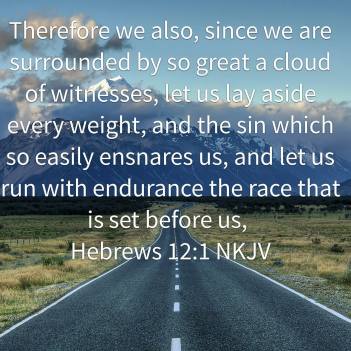
We are not told who the witnesses are – angels, the Spirit of God? Whoever they are, they encourage us to keep going. God is with us and encouraging us.
Before these people were in the race, in the marathon, there had to be preparation. When people run they are stripped down to the bare minimum, setting aside every weight. Paul says then that the things which hinder us need to be set aside. These things are sins which hinder us – things which take up too much time in our lives and detract from our Christian life. The ‘sin which so easily ensnares us,’ are things we know are not right. We need to set aside such sins.
We need to run with patience, with endurance. God has set the race, Christ has endured for us. It’s a privilege and a blessing to be chosen unto salvation, to have a seal. We have to endure and make sure things do not get in the way.
The Christian life is not an easy life. The devil will see to it we will have a hard time. Don’t despair. Rejoice! Christ has endured before us. We want to see ourselves bearing fruit. Christians in Galatia were getting discouraged. Paul wrote to them, ‘’Don’t faint, don’t get weary – it’s the devil’s work, he’s playing mind games with you.’ God is a God of the impossible. Abraham never thought he would have children in old age. His wife Sarah laughed at the thought. Yet with God all things are possible.
People have prayed for you that you might be saved. God is a great God. Pray for others. The devil attacks our thoughts. He did it with Elijah; Jezebel was going to kill him so he ran. The devil plays mind games.
In Pilgrims Progress Passion wanted everything now. Patience is willing to wait for God to work things out, to patiently endure. Sometimes we want God to get a move on. He is in control.
The people in the marathon are running for a prize. We are still running in the Christina life. Running is the grace of God. In 2 Corinthians Paul says people run for an earthly crown but this will pass away. Focus our minds on the eternal race. Our prize is in heaven, in glory with Jesus Christ.
Keep our minds focused. Look to Jesus. The moment we take our eyes off Him we’re in big trouble. When we take our minds off spiritual things, look to Jesus. Don’t look to yourselves. We’re all tainted in some measure. We have to look to our Lord Jesus Christ, our Saviour. Consider the Lord Jesus Christ, look what He has done. He started us on our race, He knows the state of our race. He knew the state of man was in a damnable position. He gave us hope. We deserved death but Christ was made sin – not a sinner. When He endured the cross, those three darkened hours, separated from the Father, we see one who was willing to suffer because before Him was the Resurrection, accomplishing the work of salvation for you and me. Look to Jesus who endured the cross.

Jesus never became weary. He kept going. We are on a great race of life. Do not look back. Sometimes there’s a temptation to take an easier path. There’s no easy way to heaven. When you’re a backslider, repent, come back to God’s word. God can still use you. Rely on God’s promises. Perhaps there’s a person in your Christian life who has hindered you. In Revelation, when writing to the churches in chapters 2 and 3, John finishes each letter with blessed words to each one, ‘To him who overcomes.’
When you feel like giving up, persevere. Jesus will use you. You will have the morning star, Jesus Himself. Jesus will be waiting with the crown of life. He will give us zeal and energy to carry on. God has saved us. ‘I give to them eternal life, and they shall never perish; neither shall anyone snatch them out of my hand. My Father, who has given them to Me, is greater than all; and no one is able to snatch them out of My Father’s and.’ (John 10: 28-29). We are in His hands. No-one can pluck us from death. We are as safe as those who have gone before us. Where we are, God has put us to live and run the race for Him. Lay aside sin and weights that hinder us. He’s the author and finisher. He started our race. Keep looking to Jesus. The devil gives us much to be discouraged about but, as we sang earlier,
O to grace how great a debtor
Daily I’m constrained to be!
Let that grace, Lord, like a fetter,
Bind my wandering heart to thee.
Prone to wander, Lord, I fell it,
Prone to leave the God I love;
Take my heart, O take and seal it,
Seal it from Thy courts above!
(Come thou Fount of every blessing – verse 3)
 Sadly, Thomas has been called ‘Doubting Thomas.’ He had seen Jesus die and knew He’d been buried but he didn’t know the whole story,






 Joshua 6: The ‘Battle’ of Jericho
 The miracle of the feeding of the 5,000 is in all four gospels. Here, in John 6, we read of three miracles: Jesus feeds the 5,000, Jesus walks on water and is verse 21 the disciples were teleported to their destination. The disciples had rowed for hours, making little progress, then Jesus teleports their boat,
 In our culture family trees are very popular. The Bible uses genealogies a lot. They were very important to the Jews; even in the time of Jesus, Salvation was thought to be dependent on being a Jew.
 Penuel Baptist Chapel, Roch