Contentment in Christ – whatever our situation

Do you ever think ‘What if’, ‘if only’ or ‘why me?’ I know I ask these questions and all too often! It is so easy to fall into the trap of thinking we ourselves can alter and shape the future. We evaluate our situation and if we are not completely satisfied the questions begin. As someone who is far too familiar with the ‘valleys’ in life, the doubts and questions can become burdensome. We’ve been taught that contentment is linked to our accomplishments or accumulation of satisfaction from the world. These questions can never be fully answered and since there is no end to our desires to acquire or do more, the horizon is always moving. We will never experience contentment following this line of thinking.

The true meaning of contentment is being satisfied with what you have and with who you are – right now, always being content that the Lord provides everything you need. Despite the many trials Paul went through he understood how to be content. In Philippians 4:11-13 he wrote,

Not that I am speaking of being in need, for I have learned in whatever situation I am to be content. 12 I know how to be brought low, and I know how to abound. In any and every circumstance, I have learned the secret of facing plenty and hunger, abundance and need. 13 I can do all things through him who strengthens me.

Contentment doesn’t have anything to do with external influences; rather it has everything to do with God and how He is moulding us and refining us all for His glory. The good news is that we all can learn how to become fully content with who we are, what we are, and what we’re doing.  Through our relationship with Jesus Christ, we can learn how to be content by thanking God for what we do have instead of focusing on what we don’t have.

“Always be joyful. Never stop praying. Give thanks no matter what happens. God wants you to thank him because you believe in Christ Jesus.”  (1 Thessalonians 5:16-18)

The key is to be confident in the knowledge you can do all things through Him who gives you strength. This only occurs by faith, moment by moment.

The apostle Paul highlighted the importance of living life as we are called to do. 1 Corinthians 7 verse 17 states ‘Only let each person lead the life that the Lord has assigned to him, and to which God has called him.’  Paul emphatically states that God has sovereignty over all things and He has assigned each believer with a place in life, and it is from where we are situated now that the Lord will use us. Every day, God places us where we need to be in order to serve Him. Our ‘place’ in this world is not determined by chance, but has been carefully crafted and weaved into a grand design.

So what happens when we reach the valley and all looks bleak? In our own strength we crumble and cannot cope with the burdens of life, but with God everything is possible. We may feel unable to carry on, but the God of the mountaintop is still the same God in the valley.  He is able to remove us from the difficult situation, but that isn’t always helpful. There is always a reason for our circumstances – whether to learn something new or to remold us in Christ. But the most important thing, above all else, our circumstances are given to us to glorify the Lord and become trophies of His grace. God is Sovereign over all things – good and the not so good. The difficulties we experience don’t happen to us by chance, but we know that there is good in every situation. We may not see it immediately and we may ask. ‘Why is this happening?’ but during these times we need to thank God and trust in Him.

For I know the plans I have for you, declares the Lord, plans for welfare and not for evil, to give you a future and a hope.  – Jeremiah 29:11

And we know that for those who love God all things work together for good, for those who are called according to his purpose. – Romans 8:28

September 18th 2016: Gareth Edwards

Reverend Doctor Gareth Edwards, of Hill Park Baptist Church, preached on John 1:26, “Behold! The Lamb of God who takes away the sin of the world!” John 1:26

You may have had a hectic week and look back and feel exhausted by all you were required to do. All that takes place in here in John 1:19- 34 took place in a week. It begins with John the Baptist being quizzed by a deputation of Pharisees and ends with Jesus’ first miracle – turning water into wine. It was a week full of testimony to who Jesus Christ is. The question at the beginning is ‘Who is John the Baptist?’ but the question that is answered is ‘Who is Jesus Christ?’ John the Baptist plays a central role in that testimony, which can clearly be seen in verses 32-34. He has already baptised Jesus and come to realise that Jesus is the Messiah. John humbly points the deputation from Jerusalem away from himself and to the Messiah – the one who was in the midst but of whom they were ignorant. The next day John immediately identifies him as the Messiah.

In order to grasp John’s message we need to examine the key words and unpack the statement, “Behold! The Lamb of God who takes away the sin of the world!”  This will be done in reverse order: Sin, Lamb of God, Behold.

Sin:
It has been said that the heart of the human problem is the problem of the human heart. Jesus came into the world to address this problem – sin. Jesus came in order to take sin away. Today, sin is considered to be irrelevant. We may believe they are accountable to no-one but ourselves. If we believe God exists at all, then we may believe that He doesn’t have a right to condemn us because His role is to love and care for us. If we do acknowledge we have done wrong, we blame others for leading us astray or we blame our circumstances; we’re not guilty but victims.

The Bible doesn’t excuse our sin, it doesn’t allow us to escape the fact that we are accountable to God for our actions and our words. Romans 3:23 states, “For all have sinned and fall short of the glory of God.” In Romans 6:23 we read, “For the wages of sin is death, but the gift of God is eternal life in Christ Jesus our Lord.” This rebellion against God brings upon us the just sentence of death. This is the root of the whole problem of our world. All are sinners. As sinners we are justly condemned by God, subject to His holy wrath. John the Baptist tells us Jesus came to deal with the problem, to take away our sin. Do you recognise that you are a sinner? You may be someone of integrity, yet our sin is desperately wicked. The reality is that in what we do and what we say there is rebellion against God. It is no use burying our heads in the sand; we are sinners! Consequently, the Word of God tells us that the greatest priority is that our sin be taken away. Family problems, health problems, financial problems – they all pale into insignificance. We need our sin to be taken away, to know His forgiveness. We need to cry out for a Saviour to come, to rescue us. You desperately need a Saviour.

Lamb of God:
The people of Jesus’ day were steeped in the Old Testament and knew very well how lambs were used as sacrifices for sin. After sin came into the world we were alienated from God. It was God’s will that a lamb was as a sacrifice. In Genesis 4:4 and Hebrews 11:4 we read how Abel was considered righteous after offering a sacrificial lamb – the shedding of blood for life. Cain offered fruits of the soil, labours of his own hand, which God rejects. No amount of human effort had effect. Later, under the Law of Moses, a lamb was offered. We read in Leviticus 4:32 that a sinner brings a lamb and places his hands on the animal’s head to symbolise the transference for guilt.

In Hebrews 10 we learn that no amount of shedding of blood could take away sin. Only the Lamb of God truly cleanses us, the Messiah. Those who offered sacrifices in the temple looked forward to the one Lamb of God, whose death would take away their sins.

The people would have remembered how Abraham was commanded to sacrifice his much loved son Isaac. Abraham obeyed and took Isaac, who was probably in his late teens or early twenties. Isaac submits. They reach Moriah where they leave their servant behind. When Isaac asks where is the lamb Abraham replies that God will provide. Abraham was about to plunge the knife when God intervened. Abraham proved his faithfulness to God, or rather proved to himself his faithfulness to God. There, nearby, God provided a lamb caught in brambles – a substitute for Isaac. Now John describes Jesus as the Lamb of God – a substitute for you and me, for Isaac, for Abraham. ‘God demonstrates His own love toward us, in that while we were still sinners, Christ died for us’ (Romans 5:8).

In Exodus 12 God is going to send an angel of death to pass through Egypt. But the Israelites sacrificed a lamb and smeared its blood on doorposts as a sign to spare the Israelites and protect them. The lamb had to be perfect. So it is that Jesus Christ came, the real Passover, the perfect Lamb, who sacrificed His blood for us. Through the blood of the Lamb we are spared.

‘You were not redeemed with corruptible things, like silver or gold, from your aimless conduct received by tradition from your fathers, but with the precious blood of Christ, as of a lamb without blemish and without spot’ (1 Peter 1:18-19).

In Isaiah 53:5-7 the prophet foresaw the coming of the Lamb, a suffering servant, a sacrificial Lamb who will take away the sins of the people, ‘like a lamb led to the slaughter.’ Jesus was both innocent of the charges laid against Him, completely innocent of any wrong doing. Yet He goes to the cross like a man who endures what He deserves. Why? Because He has accepted the responsibility for your sin and mine. He stands in my place and yours. So in describing Jesus as the Lamb of God, John is saying Jesus is the fulfilment of the Old Testament passages of scripture.

In Egypt on Passover night there was death in every house. Can you think of what that would be like – if in every house in Roch someone had died? On Passover night there was either the death of a lamb or death of a first born babe. In payment for our sins there has to be death. Either our death or Jesus’ shed blood so we might be forgiven and have eternal life, an eternal relationship with God. It is amazing to think God provided His only Son to suffer in our place when we are so unworthy. It is amazing!

Look / Behold!
John the Baptist issues an invitation to all around him not simply to gaze on Jesus but to trust Him. John is saying,’ Here is the Saviour who can provide all your needs. Don’t look to me or yourselves for salvation, look to Him and Him alone. ’ It is only those who look to Jesus with believing eyes who will be saved.

The New Testament uses the term ‘all’ for inviting people to come. This means all types – male, female, rich, poor – Jesus offers salvation to all types of people. But it only has effect for those who repent of their sins and know that there is nothing they can do to help themselves. Have mercy upon me as a sinner. I take Jesus to be my Saviour. I hide in His death because He died for me and I trust in Him. Your wrath, Oh God, fell on Him at Calvary and as I trust in this I am hidden from that wrath. I will follow Him and serve Him.

‘Look!’ John says. He pleads for you to take Him as your Saviour. John has baptised Jesus in the Jordan. Jesus didn’t have any sin so why was He baptised? Just as He didn’t have to die for His sins, He died for ours. He was saying, ‘I am one of them, I am them.’ He carries those sins of ours throughout His perfect life. We watched as His sins were sealed behind the rock of death. He rose on the third day, minus sins, which are never to be seen again.

Have you looked to Him? Not just a passing glance. Have you looked and seen in Him the only hope of Salvation?

September 11th 2016: Aaron Davies-Whitfield

Worship was led by Aaron Davies-Whitfield who preached from Philippians 2: 19-24, which he entitled “Not my will, but Thy will be done.’ We find Paul is in a place of uncertainty. His letter is written from Rome when he was under house arrest, which can be likened to the bonds and chains of the gospel. Paul is facing possible execution. He truly was an incredible man of God, a giant in the faith. It is staggering how God changed this man, who was out to destroy the church but now he is willing to lay down his life for the church and Christ.

In verse 19 we read, ‘But I trust the Lord Jesus.’ Paul was so captivated by Christ, his every thought and deed were always attached to Christ. He was under house arrest by the wicked Emperor Nero, who prosecuted and martyred Christians in the most horrific ways. Paul does not say, ‘I trust – if the Emperor allows.’ No, he states, ‘I trust in the Lord Jesus.’ Our future must fall into that place, like Paul. When you come to acknowledge Him as Saviour, He is not only your Saviour, He is your Lord. You give your life to Him. Paul faces possible execution, yet Jesus is the one who holds Paul’s future. Notice, in verse 24, Paul write, ‘But I trust the Lord.’ His future was not bleak but wonderfully glorious because of Christ. Whatever comes our way, our future is glorious in Jesus.

Paul was a spiritual giant but he also had feelings. This mighty man of God needed to be encouraged. He says he hoped to ‘send Timothy shortly unto you, that I also may be of good comfort’ (verse 19). Paul was anxious for the Philippian Church. Notice his feelings were all encompassed in Christ. He was concerned but that didn’t waiver him, his trust was in Christ. We are reminded, ‘Trust in the Lord with all thine heart, and lean not unto thine own understanding. In all ways acknowledge Him, and He shall direct thy paths.’ (Proverbs 3:5-6). Paul was trusting in the Lord. Trust in Him, lean on Him when you don’t understand and He will direct your path.

I wonder how many people visited Paul when he was under house arrest? It’s a challenge to us. How do we feel about those who minister the gospel to us? Do we love and care for them? It’s not always easy to sit under preaching – sometimes it will rebuke and chasten. We don’t pick and choose, it’s His Word. There can be that in us that doesn’t receive the Word. Let the Spirit of God work in us. We need to humble ourselves. Love those, even in their faults.

Paul found no-one like-minded but Timothy, his son in the gospel. In verse 21 we read, ‘For they all seek their own interests, not those of Jesus Christ.’ Where is your heart today? What is your greatest ambition? What are your motives and desires? Where is Jesus in all these things? How sad Paul was surrounded by Christians but none of them sought Christ’s Will. When Christ came to this earth He thought nothing of His own will, He sacrificed everything for the gospel. He laid aside everything.

In the parable of the Good Samaritan the priest and the Pharisee walked passed the man who was beaten and left for dead. It was the Samaritan who stopped and helped. It’s a challenge but one to take on board.

As Christians we can be more mindful of seeking salary not a Saviour. If Paul came to the church this morning, what would he say of us? Everything in this world will fade away – our job, salary, even our families – but all done for Christ will last. Make His name great in our life and your name full of insignificance. ‘Seek first the kingdom of God and His righteousness.’

Looking at the churches around I see an absence of men in the gospel work. God is calling men to the work. The harvest is ripe but the labourers are so few. One of the reasons is we have too glamourous minds – certain things have to be in place before we consider God’s work. The ultimate questions is, ‘Has God called you?’ If God has called you, then He will provide. Men and women look to salaries and locations. In the New Testament, being a gospel church meant being in prison. Where is Christ in your life? We may not be called to preach the gospel but we are all called to live for the glory of God and make disciples, to follow Him whatever that means. Salary, reputation and comfort will all fall aside. We need to go wherever and to whoever if the Lord is calling. Jesus called the disciples – they did not know where they were going and they would lose their lives but they went willingly. ‘All seek their own interests, not those of Jesus Christ.’ We live in a world of ‘My, my, my, me, me, me’ but what about Jesus? In light of all He has done for you, He asks you to be willing to serve Him, He will do everything else. All Jesus is asking is for you to say, ‘I’ll go Lord.’ God is calling.

‘And I heard the voice of the Lord saying, “Whom shall I send, and who will go for us?” Then I said, “Here I am! Send me.” (Isaiah 6:8) God is calling you to something. He wants you to be a faithful witness to family and friends or even to the other side of the world. Seek Christ. Seek His will in your life. Surrender your will into His hands.

In verse 22 we read of Timothy, who we know was not a well man; he was a weak and fragile young man but he was willing to go, whatever the cost. When it came to conscription in the Great War men had to leave everything and go to war. We need to serve Christ, to take up the banner of the cross.

The church must go on, the gospel must carry on. But it needs labourers, people willing to forsake their wants for God’s wants.

‘So I will go wherever He is calling me
I lose my life to find life in Him
I give my all to gain the hope that never dies
I bow my heart, take up my cross, and follow Him.’

(From the hymn, ‘What Grace is Mine.’)

You may also like to listen to the hymn, “Here I am Lord’
which is based on Isaiah 6:8
https://youtu.be/EcxOkht8w7c

September 4th 2016: Paul David

Our service this morning was led by Paul David of Cosheston Mission Church who preached from Psalm 90. As this is a prayer of Moses, it is probably the oldest psalm. You can find a summary of the life of Moses in Acts chapter 7. He lived to what we would call today a great age – 120 years old. His life was conveniently split into 3 forty year periods. The first forty years he spent in Egypt, but his life changed dramatically in the next forty years when he fled from the palace to the desert of Midian to look after his father’s flock. At the age of eighty God sent a reluctant shepherd to deliver the Hebrews from slavery. Moses saw and did miracles. He struggled with people who rebelled against God. Moses was a man of God, a meek man who knew God face to face. He was a sinner, along with his generation, who were condemned never to enter Canaan.

We live in a culture which values positive attitudes, which likes to portray positive images. In bookshops you can find many self-help books which tell us that the solution to all our problems is inside us; if we think positive things it will turn out all right. It’s always great to meet people with a sunny disposition. However, in verses 3-11 Moses gives us a serious dose of realism. Our life is short, we live under God’s anger because we are sinners. When we are here on earth life is hard. We may begin with hope and optimism but this turns to disappointment. God is fully aware of our sin, it is no secret from God.

Life may be more comfortable for some than others. There will be trouble. Christians will suffer for their faith: John 15 “If they persecuted me, they will also persecute you.”

In this psalm we see a series of requests:

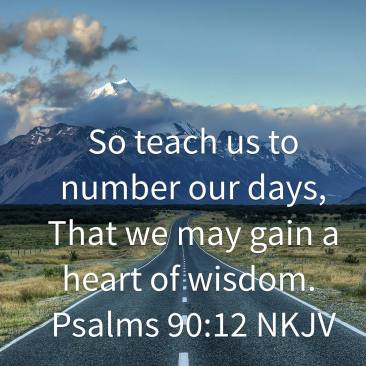
  • “So teach us to number our days,” (Verse 12). Moses considers the brevity of life. We all think we will lead a long life, we put off serious thoughts about the end of our lives, yet we are told, “But Beloved, do not forget this one thing, that with the Lord one day is as a thousand years, and a thousand years as one day. (2 Peter 3:8).

Moses asks for wisdom to see life as God sees it. Wisdom is seeing ourselves as we really are – sinners heading for a meeting with God. We need to see our sinfulness set against God’s purity.

  • “Make me glad” (verse 15). Why? Because there is more to life than can be seen. Moses knew there is spiritual life where spiritual prosperity can live alongside certain hope. This short journey on earth will end in paradise.
  • “Let your work appear to Your servants, And you glory to their children, And let the beauty of the Lord our God be upon us, And establish the work of our hands for us; Yes, establish the work of our hands” (verses 16-17). Moses wants us to work, just as we are encouraged to do so in Philippians 2. God working is us involves us working. He begins the work by saving us and continues the work by sanctifying us. A Christian’s nature is changed. As we grow in grace our lives should reflect Jesus Christ.

Moses never really had a true home, yet he learned an important lesson, “Lord, You have been our dwelling place in all generations.” (verse 1). Our permanent home is where the Lord is.

Paul David - sept 2016.jpg         psalm 90-12

August 28th 2016: Lawrence Mitchell

lawrence mitchell - august 2016Our Sunday morning service was taken by Lawrence Mitchell who preached from John 17 which he referred to as ‘The Heavenly Look’. Jesus lifted up His eyes to heaven. It is good to look up! When life is difficult you may look to Psalms such as Psalm 34: ‘They looked to Him and were radiant’ (Psalm 34:5).  Through the power of God and the spirit of God we are people who have been redeemed and can rejoice in Him.
The great prophet Isaiah said, ‘Lift up your eyes on high, And see who has created these things, Who brings out their host by number; He calls them all by name, By the greatness of His might And the strength of His power; Not one is missing.’ (Isaiah 40:26). Jesus lifted His eyes and spoke of these words. Isaiah says look to the creator, He wants us to look up and see the wonderful things God has done.

In the New Testament the disciples looked up to the Lord. In the Acts of the Apostles as they looked up to heaven they heard a message from God. We have a God who cares, a Saviour who loves. We need to look away from our circumstances and look to the Lord. The way is Christ alone. False religion changes the teaching of the Bible, changes direction. Look to the Lord. God said to the disciples He would come again. What a message, what a hope. No wonder Peter and Paul could teach on the Resurrection. They lifted up their eyes and saw the Saviour.

There was another occasion where Jesus lifted up His eyes – when Lazarus died. (John 11:41). Jesus told them to lift the stone. When the stone was removed Lazarus came forth. We have to move something out of the way to come to the Lord. Jesus then prayed to the Father, it was a prayer that others might follow. He made a personal call to Lazarus.

Stephen also lifted his eyes to heaven. He saw God and Jesus at the right hand of the Father. What a wonderful welcome into heaven.

In this great chapter, called ‘The High Priestly prayer of the Saviour’, we see the glory of Christ, the glory of God and the glory of believers. The glory of the Lord filled the tabernacle, the upper room and our lives today. Thank God for His glory and the fullness of His spirit. It was a happy day when we met the Saviour.  

August 21st 2016: Matthew Maxwell-Carr (afternoon)

14087366_1740074836265878_270299574_oDuring our Sunday afternoon meeting Matthew Maxwell-Carr asked us to consider a fresh understanding of God’s sovereignty. We can be quick to say God is in control of everything. However, being a sovereign implies being a ruler. God is the supreme ruler and only monarch of the universe.

‘Wherefore David blessed the Lord before all the congregation: and David said, ‘Blessed be thou, Lord God of Israel our father, for ever and ever. Thine, O Lord, is the greatness, and the power, and the glory, and the victory, and the majesty: for all that is in the heaven and in the earth is thine; thine is the kingdom, O Lord, thou art exalted as head above all. Both riches and honour come of thee, and thou reignest over all; and in thine hand is power and might; and in thine hand it is to make great, and to give strength unto all.’ 1 Chronicles 29:10-12

God is the supreme and only monarch of heaven and earth. Everything is under His authority. He lifts some up, He sets others down. Anyone in a position of authority should rule in God’s heart, everything belongs to God by right. In the New Testament He is called the King of Kings and Lord or Lords. There is only one King of Kings, one Lord of Lords, one God who is Father, Son and Holy Spirit.

Being the supreme ruler, God is sovereign over everything that happens in this kingdom. He rules over all that happens. It is amazing how many people do not understand this. God created everything so He rules over everything. He is involved in everything.

‘He watereth the hills from His chambers, the earth is satisfied with the fruit of thy works. He causeth the grass to grow for the cattle, and herb for the service of man: that he may bring forth food out of the earth.’ Psalm 104:13-14. We see it is God who brings forth the food for us.

Psalm 104: 27 reads ’These wait all upon thee; that thou mayest give them their meat in due season. Thou givest them they gather; thou openest thine hand, they are filled with good.’ All the animals of the world wait, it is God who provides for them, the Lord opens His hand and even those in the deepest depths of the sea have food. In verse 29 we are told all are thoroughly dependent on Him.

 Genesis 45 shows when Joseph reveals himself to his brothers who had sold him into slavery. We see Joseph’s love for his brothers. Verse 5 shows how Joseph attributes going into Egypt not to his brothers, but to God. ‘Now therefore be not grieved, nor angry with yourselves, that ye sold me hither: for God did send me before you to preserve life.’ And in verse 8, ‘So now it was not you that sent me thither, but God.’ This can be further illustrated in Genesis 50:18-20. God is in control of all aspects of our life. We must adopt a God-centred attitude to life. This is what Joseph did.

We read in Exodus 4 that Moses had been called by God to save the Israelites. Moses makes every excuse possible (verses 10-11). However, God is not having any of it! He’s the one who is in control and involved in everything.

2 Samuel 16 shows how God commanded David to be cursed. We don’t understand false accusations, but God allows it.

God is in control of everything, in every detail. Jesus ended up on the Cross because it was prophesied, ‘They pierced my hands and my feet.’ (Psalm 22:16). God created the greatest evil in humanity and turned it into good.

Ephesians 1:11 ‘In whom also we have obtained an inheritance, being predestined according to the purpose of Him who worketh all things after the counsel of His own will.’ Paul’s theology is God uses everything in the universe so it conforms to the counsel of His own will.

Romans 8:28 ‘And we know that all things work together for good to them that love God, to them who are the called according to His purpose.’ We have a confident knowledge!

Matthew 10:29-31 ‘Are not two sparrows sold for a farthing? And one of them shall not fall on the ground without your Father. But the very hairs of your head are all numbered. Fear ye not therefore, ye are of more value than many sparrows.’ Here Jesus picks something we see as worthless, insignificant – a sparrow. Yet not one sparrow moves outside of our Father. God is so involved in the life of every bird in this world but He cares for us so much more. Don’t be afraid, we are far more valuable. God is ultimately involved in even the most insignificant details in this world.

August 21st 2016: Matthew Maxwell-Carr (Morning)

 ‘I, even I, am He who blots out your transgressions for My own sake;
and I will not remember your sins.’
Isaiah 43:25

We were blessed to sit under the ministry of Matthew Maxwell-Carr from Hill Park Church, who preached on the theme of forgiveness.

God offers forgiveness to the world through Jesus Christ. It is the message of salvation, the message of the righteousness of God.

  • Who forgives sins?
  • What is the forgiveness of sin?
  • Why does God forgive sin?

Evidently sin can be forgiven. At the end of the day it doesn’t matter how much sin we’ve accumulated or what the world thinks of us, there is forgiveness, there is hope.

The judgement of God is upon us, sin needs to be forgiven. God promises He will never remember our sins. This is the message of the gospel, of forgiveness.

Who forgives sin?

The Lord God, ‘I, even I’. Have you put your trust in other ways? Some people can’t forgive themselves – they may go to a psychiatrist or psychologist who says, ‘Don’t feel guilty!’ But they have no power or authority to forgive sin. People march themselves down to the River Ganges to cleanse themselves, but that doesn’t work. A guilty conscience will hunt you down but thanks be to God, He can forgive you, heal you.

The only one with authority to forgive sin is God. ‘I am the first, I am the last; and beside me there is no God.’  (Isaiah 44:6) He alone has the power. This is why, when Jesus came into this world, they called Him a blasphemer. Even the whole Old Testament sacrificial system didn’t do away with sin. The author of Hebrews tells us those animal sacrifices had to be repeated again and again, year in, year out. Sin was never dealt with properly. Then Christ came. Once. For all. He has offered the final sacrifice. This alone can deal with sin, deal with a guilty conscience.

Some people just come before God and forget the cross. They forget God is a righteous judge; sin has to be dealt with and paid for otherwise God would be unjust. The only way is the way of the cross, He is the propitiation of our sins. Jesus is the propitiation; upon the cross God poured out His wrath on His only begotten Son, sin has been paid for. Justice has been paid for. So now, when you come to God through the cross, there is forgiveness. Apart from this, apart from the cross, there is no forgiveness. This is why the Apostle Paul can say, ‘Who shall lay any thing to the charge of God’s elect? It is God that justifieth.’ (Romans 8:33)

Heaven holds nothing against you, you have every right as a forgiven person to go in peace. He will watch over you and protect you. You are forgiven by the only one who has the authority to do the impossible thing, by way of the cross.

What is the forgiveness of sin?

According to God, forgiveness is a blotting out, a wiping away.

‘As far as the east is from the west, so far hath He removed our transgressions from us.’ Psalm 103:12

‘Who is a God like unto thee, that pardoneth iniquity, and passeth by the transgression of the remnant of his heritage? He retaineth not His anger forever, because He delighteth in mercy. He will turn again, He will have compassions upon us; He will subdue our iniquities; and thou wilt cast all their sins into the depths of the sea.’ Micah 7:18-19
‘And from Jesus Christ, who is the faithful witness, and the first begotten of the dead, and the prince of the kings of the earth, unto Him that loved us and washed us from our sins in His own blood, and hath made us kings and priests unto God His Father, to Him be glory and dominion forever and ever. Amen.’ Revelation 1:5-6

Christ blots out our iniquities and washes them away. People must realise they’ve broken God’s law and hang over the gates of Hell. Every moment of our life has never been anything but sin. When have you ever loved your neighbour as yourself? Every single one of us has dishonoured God’s authority. The shed blood of Christ completely blots out all your sin. ‘I will not remember your sins.’ He extinguishes your sins from His memory.

What happens when your conscience is cleared? The guilt is gone and taken away forever. If God has wiped away your sins, no matter how bad they were, then you ought to forget them too. You ought to believe the Word of God. The biggest sin is the sin of unbelief, it remains in our hearts and minds. You must not allow the Devil to set you on a guilt trip. Refuse to condemn yourselves. 

‘There is therefore now no condemnation to them which are in Christ Jesus, who walk not after the flesh, but after the Spirit.’ Romans 8:1

God holds nothing against you, so you have no right to condemn yourself. You are not the judge! Strive, by the spirit of God, to forget our past and move on. Get on with life and live for God’s glory. He has called us to peace and we ought to live in peace. The Lord completely justifies and vindicates you. You have received the righteousness of God by faith. You are absolutely blameless in the sight of God, that’s the forgiveness of sin.

Why does God forgive sin?

He doesn’t do it primarily for our sake. That will help unburden your soul!  ‘I, even I, am He who blots out your transgressions for My own sake;
and I will not remember your sins.’ He does it for His own sake, for His glory, the revealing of His kindness. Our forgiveness is a means to an end. We are forgiven to glorify God and reveal how tremendous He is. A forgiven sinner knows how wonderful God is. Because God forgives primarily for His sake, in as much as you live in the light of His forgiveness, that is how much you glorify Him. We’re a washed people, you’ve been set apart as Holy. Don’t hold things against others, or yourself, this dishonours God. When you condemn yourself or others you make it all about you. It’s not about you, it’s all about Him. He forgives you, be at peace. Instead of spending your life in bitterness and worry, spend it in praise and glory to His name.  


August 14th 2016: Ian Middlemist

John 4-29 Come see a man

Our service was led by Ian Middlemist, evangelist at Hill Park, who preached from John chapter 4, verse 27-42.

Jesus has shown a love for the Samaritan woman who has faced social barriers. He wants to bridge those barriers. As the Father seeks her she has been offered a spring of water welling up to eternal life. Jesus is more concerned about her heart and the direction of her worship. Ian spoke on three points:


‘Come see a man, which told me all things that ever I did: is not this the Christ? (verse 29).

We can see two contrasting responses here. The Samaritan woman exclaimed to the people she met in her community, ‘Come see a man, which told me all things that ever I did: is not this the Christ? (verse 29). Jesus reveals Himself.

The second response, from the disciples, was one of surprise that Jesus was talking with a woman. John 2:19 The Saviour is revealing a tremendous truth, ‘Destroy this temple, and in three days I will raise it up.’ It is a strange comment, but amazing. How do the disciples respond?  Jesus was speaking of the temple of His body, but they did not understand.

John 3:3 ‘Verily, verily, I say unto thee, except a man be born again, he cannot see the kingdom of God.’ Here Jesus reveals spiritual truths, but Nicodemus cannot understand.

John 4:10 ‘If you knew the gift of God, and who it is that is saying to you, ‘Give me a drink,’ you would have asked him, and he would have given you living water.’

In John 4:31 we read the response of the disciples, ‘Rabbi, eat.’ They were concerned for His physical welfare. This was a pathetic response to the glory of the Saviour in revealing Himself. Why do scriptures show us this information? There are two or three possible reasons: one may be to show us that without the mighty, powerful work of the Holy Spirit in our lives, we will not see such truths. Our response should be, ‘Come and see.’ It reveals a sense to us that this woman has seen that Christ is the omniscient one who knows all things; He knows the secret details of our lives. Behold Him in faith and you too will be amazed.

The overriding priority:

We read in verses 31-34 that although Jesus is hungry, he takes the opportunity to teach the disciples – serving God by doing His will is the sustenance of His life. Oh that that might be true of you and I, to find ultimate priority in doing the Father’s Will. We can get lost in other exhilarations, caught up in the moment, certain things that become the passion in our lives. Serve God in every duty. The overriding priority for Christ was His work in accomplishing the Father’s will, His last word breathed on the cross. He went all the way to the cross for you and me. Praise Him that the work is finished!

An overriding urgency:

In verses 35-38 Jesus tells the disciples that they are correct that there are four months between sowing and reaping. But look up! The Samaritans are coming. This is the day of harvest. There is a day of opportunity.

Jesus is sower and reaper at the same time – He is in total control. He orchestrates the entire event. Jesus is saying He has sown, but the Samaritan woman has sown to her community and told them boldly, ‘Come see a man, which told me all things that ever I did: is not this the Christ?

There is much sowing to be done. There are great opportunities today to tell others about Jesus. Whether we find ourselves sowing or reaping, there must be urgency. People need to hear about Jesus Christ from faithful people who know their Bible. The Samaritan woman’s life was changed and her community. Look afresh at the cross. Come and see the Saviour!

Mike Reeves – Aber Conference 16

Mike Reeves gave an uplifting message at the EMW Aber Conference on Wednesday 10th August. Preaching on ‘The Lord’s Desire’ from Isaiah 61:10 to 62:5 we learnt that this song sings out one of the great anthems of the Bible – of Christ the Bridegroom who comes to win and love His Bride, His most precious treasure. We were challenged to go forth as brightness into a world of darkness, rejoicing as He rejoices over us.https://youtu.be/n6LeA71OFkw

On the 11th August we listened to Mike Reeves speak on ‘God’s Transforming Glory’ as he preached from 2 Corinthians 3: 7-18. He challenged us to realise that what we look at transforms us. Look to Christ. He displays His glory in forgiving sinners. When Christians see the glory of Christ they blossom. Christ’s glory warms us, wakes us up, shines a light. Fix your gaze on Jesus, on the glory of Christ, and you will have a new passion, a desire to make Jesus known. https://youtu.be/ewKTYfL4sXg

Joel Beeke – Sermon video links

Below we have collected the links so you can view the morning sermons preached by Dr. Joel Beeke.

We had a  glorious morning at the EMW Aber Conference on Tuesday 9th August. What better way to spend a morning than listening to Joel Beeke speak on Revelation 19, ‘The Great Marriage and the Great King’d Return. Click here to watch the service: https://youtu.be/8WvcCwE69rs

Revelation 20! Such an awesome chapter. Joel Beeke packed so much in, this just has to be listened to again! https://youtu.be/JLRrjjIxdZQ You can also read notes of this sermon on our website, click the link for further reading: https://goo.gl/AOp6fu

Revelation 21! What a glorious chapter! Watch Joel Beeke preach on the live stream in an hour if you cannot be here in person. https://youtu.be/f0AMxqOgvnQ

Preaching from Revelation 22, Dr. Joel Beeke showed us how John takes us by the hand to the centre of the new Jerusalem, where God’s throne is at the heart of the city. We heard of the urgency to come to the Saviour. There’s an invitation for everyone. Come just as you are. https://youtu.be/c5cHN1PuDi8