January 11th 2026: Phil Meiring


“And who knows but that you have come to royal position for such a time as this?” Esther 4.14

To view this service, please click on the following link to our YouTube channel: https://youtu.be/dCF3QVaO2Rk?si=J1VL_5LfrI7N8tqB
The book of Esther is a remarkable story of God’s care for His people even though the name of God does not appear at all. Perhaps one key verse comes at that moment when Mordecai tells Esther that she must intervene (4:14).

We are in the Persian empire some 400 years before the coming of Christ. It was an empire that stretched across some 3,000 miles from India right across to Egypt. Esther was queen at this point in time. Despite her being an orphan Jew, and so among the minority in the empire, she had risen to the dizzy heights of the land. She was a very attractive woman both inside and in appearance. But none in the empire knew here national identity. She was a Jew. She is a ‘secret believer’ brought up by her godly uncle Mordecai.

At the start of this chapter we discover that dreadful news was afoot – there was a plan afoot to exterminate all God’s people across the whole Persian Empire. The man behind this plot was Haman, a nasty piece of work. When Mordecai heard what had been decreed, he tore his clothes (Esther 4:1). Haman had risen to power and he was a great enemy to the Jews. He had a massive ego for he wanted all those around him to worship and adore him, but Mordecai would not play along, for he worshipped God alone. So Haman came to detest the Jews with a vitriolic hatred, so planned to have them all exterminated. He was so determined in this plan that he even offered to foot the bill himself. Now he was also quite superstitious because he determined the day for this massacre by casting lots (Esther 3:7).

            The question which arises as we outline the background here is: what would God have us to do? How do we fit into this story? There are at least three things I believe that God wants us to see:

  • He wants us to see Jesus in this text (4:12-14a).
  • He would have us leave our comfort zones.
  • He would have us use our royal position to bless others.

[1] Seeing Jesus in the text.

            Whenever we come to the Old Testament we must always ask: where is Jesus? This is something the Lord taught the disciples to do after His resurrection. Now the problem is that God’s name is not once mentioned in Esther. So how can we observe the Lord Jesus here? However, even though the name of God is absent, we discover that God is clearly present everywhere in the book at every twist and turn. In the Old Testament the Lord Jesus appears in various guises, as a type, or a shadow, or in theophany, or in example, or by way of prophecy, or in seed form or through lineage. But where is He in Esther?

            To answer this first note that the entire empire stretched (as we have said) from Egypt all the way through to India. Spread throughout this vast empire there were Jews in various countries or districts of Persia. There were those in the land of Israel (although still under command of Persia), and there were those who had been scattered centuries before in the north of Assyria and in the suburbs of Babylon. And there were those too who had been taken down to Egypt when Jeremiah was taken there after the fall of Jerusalem. Genesis speaks of the “Seed” of the woman who would come and bring relief, rest, and salvation. But this wicked Haman had determined to destroy the Jews once and for all throughout the entire empire. What would happen then to the promise? Mordecai said to Esther, “If you remain completely silent at this time, relief and deliverance will arise for the Jews from another place, but you and your father’s house will perish” (Esther 4:14a). So, we see the Lord Jesus in ‘Seed’ form. He would come from somewhere among the Jews who were currently spread across Persia. But if Haman’s plan succeeded then the promise would fail. But Mordecai is convinced that if Esther failed deliverance would most assuredly come from elsewhere. So, this statement of Mordecai’s shows us Christ in ‘Seed’ form. He is hidden from view, but He is in the background in this statement made by Esther’s uncle. The promise will not fail. The “Seed” of the woman will surely come.

            Think too of Herod’s massacre of the innocents. He sought to eliminate Christ whom he thought was a rival earthly king, but his determination could never succeed. Haman did not realise that he was part of a much bigger plot engineered by Satan to stop the coming of the promised Seed. Remember that people had by this time returned to Israel and had rebuilt the temple, and, if Haman’s plan had succeeded then the line of promise would fail. So, if Esther did not seize the opportunity given to her the promised Seed might fail! And yet Mordecai is convinced that even if Esther did not act, then still deliverance and rescue would come from elsewhere because the “Seed” of the woman was most definitely coming at some time.

            It has often been noted that the book of Esther displays the great providence of God. God is active in His world preserving his interests and directing all things to His desired ending. Haman lived in a world of chance or fortune. He cast lots to determine what he thought would be the best most opportune time to carry out his wicked plan. But Esther and Mordecai lived under the providence of God. Which world are you living in?

[2] He would have us leave our ‘comfort zones.’

            It is very easy to get comfortable isn’t it in modern times? By being comfortable we mean settled and unperturbed by the moves of God’s providence. Being comfortable really has to do with self determination. We like our settled niches and places of rest. Now in truth our comfort and our rest is in Christ. The joy of the Lord is our strength and we know rest and peace only in Christ and through His great sacrifice. So we must always be aware of the danger of becoming settled into ‘comfort zones’ which are those of our own making or which we have been accustomed to over time. What is required is an awareness and a watchfulness to be ready to act and follow the Lord whenever He calls, for our true rest and strength is not in this world of things but in Christ Jesus.

            Mordecai tells Esther that she has been placed in her position just for this time so that something could be done to thwart the enemy (“Yet who knows whether you have come to the kingdom for such a time as this?” (Esther 4:14b)). Had she become comfortable being Queen of Persia? Mordecai realised that the providence of God had brought Esther to such a position that could be vital. Mordecai was calling upon Esther to no longer be a ‘secret believer’ and to show her true identity. The Lord wants us to be seen and to be seen as His light, for we are the light of the world. This call to Esther is nothing less than her granting her cooperation in His great plan for saving the people and of protecting the promised Seed.

            Now God seems to like to work in such a way as this. He could, of course, have done things in a very different way. He could have thwarted Haman immediately, after all the Lord is the One who gives and takes life, for He is Creator. Instead, God chooses to use people in situations as we read of in Esther chapter 4. Here we are being taught that obedience is the road to blessing. This is not salvation by works, for even though we do not have faith outlined clearly in this passage, Esther must heed the word of Mordecai and in faith trust that what he suggests will lead to their deliverance.

            What about Esther? She was being asked to leave her comfort zone. Mordecai told her that she should plead for mercy before the king: “command her to go in to the king to make supplication to him and plead before him for her people” (Esther 4:8). This is all well and good but there was a great problem. None were permitted to go into the presence of the king without prior permission (4:11).

Esther had not been summoned for a month. If she presented herself to the king now he could quite easily have her put to death. So, what was she to do? Mordecai made the situation plain. He “commanded” her because this was desperately needed. Esther was being asked to put her life on the line for the benefit of God’s people. Is this not like our Saviour? Esther was at the top of her ‘career,’ and she was (presumably) comfortable and set for life – but what now? She was asked to lay her life on the line and to leave her comfort zone. Is this not what the Lord asks of us too? We are commanded to take up our cross and to be dead to this world, following in the footsteps and paths of our Lord and Saviour. Are we prepared to honour God and do exactly what He says even if it means death? Think of the many persecuted brothers and sisters who are being slaughtered today simply because they stand up and identify themselves with Christ.

            Esther makes what can only be described as a confession of faith. After calling upon Mordecai and the Jews of Shushan to a fast she states her mission to go to the king even though it is “against the law” and she declares “if I perish, I perish” (Esther 4:16). Think of what she is saying here. What would happen to her if she were to die? Think too of the three Hebrews in the fiery furnace for not worshipping the statute that Nebuchadnezzar had made (Daniel 3). These men would not bow down to the image and trusted God even if they were to perish in the flames. We are taught in the New Testament by none other than the Lord Jesus Himself that to be a disciple of Christ we must bear the cross (a sentence of death): “and whoever does not bear his cross and come after Me cannot be My disciple” (Luke 14:27).

            Mordecai has said to Esther: ‘you must stand up and take a stand here.’ Now the Lord Jesus has never asked us to do anything that He Himself has not done before hand. The only thing Christ did not need to do was to repent of sin, for He had none. But the Lord Jesus in His incarnation stepped out of the comfort zone of heaven and humbled Himself. He had glorious and united fellowship with the father and the Spirit and yet he left that eternal place of bliss to take on human flesh and go to the cross. The moment He stepped out of heaven and assumed human form, He did so forever. Such commitment, for He is still God and yet is now also always human too. The commitments we may have to make are but for a time period, but the Son of God committed Himself to us forever. He was away from His true ‘home’ for thirty three years and became a humble servant and then what? He died! What do we leave to follow God?

[3] He would have us use our royal position to bless others.

            Esther’s rise to fame was a true ‘rags to riches’ story. As a true believer Esther was beautiful both inside and out. She was reliant upon God. She was the first lady of the empire. But all of this nature, status and position was granted to her by God. Everything we have too is given to us by God. Our very lives, our circumstances, our talents, our families and so on – all are gifts to us from God. Just like Esther, we are a ‘rags to riches’ story because we have been taken out of the “power of darkness” and we have been made as kings and priests unto God in “the kingdom of the Son of His love” (Colossians 1:13). We have been given tremendous privilege. We are royalty (1Peter 2:9)! We are part of God’s royal family. Now in such a position we have all the resources of God behind us. These are not at our beck and call of course for God knows how to order things and give in the wisest of ways. We are priests unto the Lord but not as Christ who was is High Priest who mediates for us, but we are to be a channel of blessing to others. The priests functioned as those who brought blessings to the people. Now we have received of the Lord freely and so we ought thence to give to others in the same manner – freely (Matthew 10:8). We each have talents and gifts both natural and supernatural. But these are given for the extension of the kingdom (Luke 14:25f). We are to forsake all and give up all in pursuit of Christ and the things He has freely given are now His for use as He sees fit. What of our house, our car, our time, our talents, our abilities and so on? Do we use these for self-advancement? Or do we use these as the Lord directs, to bless, and to help, and to glorify the Lord Jesus? Esther had royal position and now she uses this for the purpose of saving her fellow Jews and thus to extend and preserve the kingdom.
February 23rd 2025: Gaius Douglas

Exodus 27:20-21.

Introduction

            We have been singing about the presence of God being among us. The Lord Jesus promised the disciples that He would be with them always, even to the end of the age (Matthew 28:20). The Lord is wherever His people are, and He will never leave nor forsake them. Do we appreciate this fact that the Lord is here now and present among us? Do we give Him the reverence due His name?

            In the Old Testament there are many ‘types’ and ‘shadows’ which show forth truths about the Lord Jesus (Romans 5:14; Colossians 2;17; Hebrews 8:5;10:1). All of these point towards the Lord Jesus Christ. They each tell us something about His person and/or His work. In this message we shall focus upon the lampstand, but all of the elements of the tabernacle point towards Christ Jesus in some way. We should remember that the entire Bible is a testimony to the Lord Jesus. He said as much to the disciples when He rose from the dead (Luke 24:25-27,44-46). In Revelation 19:10 we read these words: “for the testimony of Jesus is the spirit of prophecy.” Such a statement shows us that the essence of all prophecy is actually a testimony of (or about) Christ. No prophecy has come by the will of man but through the action of the Holy Spirit (2Peter 1:20,21), and no man can come to the Father except through Christ Jesus who is “the way, the truth, and the life” (John 14:6). Thus to know God we must come and approach through the Lord Jesus Christ.

But in the Old Testament during the time after the Exodus, approach was made through the tabernacle. In the book of Hebrews we read that: “Christ came as High Priest of the good things to come, with the greater and more perfect tabernacle not made with hands, that is, not of this creation” (Hebrews 9:5). The tabernacle that Moses had built was, in fact, designed by God and He (alone) enabled certain gifted men and women with their God-given abilities and talents to construct the various parts of the tabernacle structure. The Lord gave these select people the wisdom and knowledge in skill to follow the pattern that God revealed to Moses (Hebrews 8:5). The Lord could have given the tabernacle to the congregation ready-made. After all He provided them with the manna in the wilderness. But instead the Lord raised up certain men and women, giving them wisdom by His Spirit, so that they could craft and build the tabernacle. But they had to do it precisely as it was revealed (Exodus 25:40; Hebrews 8:5).

The Lord used people in the construction of the meeting place that He had revealed whereby people could meet with Him. It was His design and His work, but He used people in its formation. In the same way the church, the body of Christ, is His work, but still He uses people in its formation. The church is grounded in Christ who is the foundation stone, and it is overseen and surrounded by God’s care and watchful eye. In 1 Peter 2:9 we read these amazing words:

But you are a chosen generation, a royal priesthood, a holy nation, His own special people, that you may proclaim the praises of Him who called you out of darkness into His marvellous light. (1Peter 2:9).

Even if we think we cannot be of use, that we cannot preach or lead a fellowship, we can be His people and “proclaim the praises of Him who called” us from this world of sin and darkness into His wonderful kingdom of light. No building upon this earth, however incredible its structure and design, can ever surpass nor be as good and as beautiful as the building of the Lord’s church!

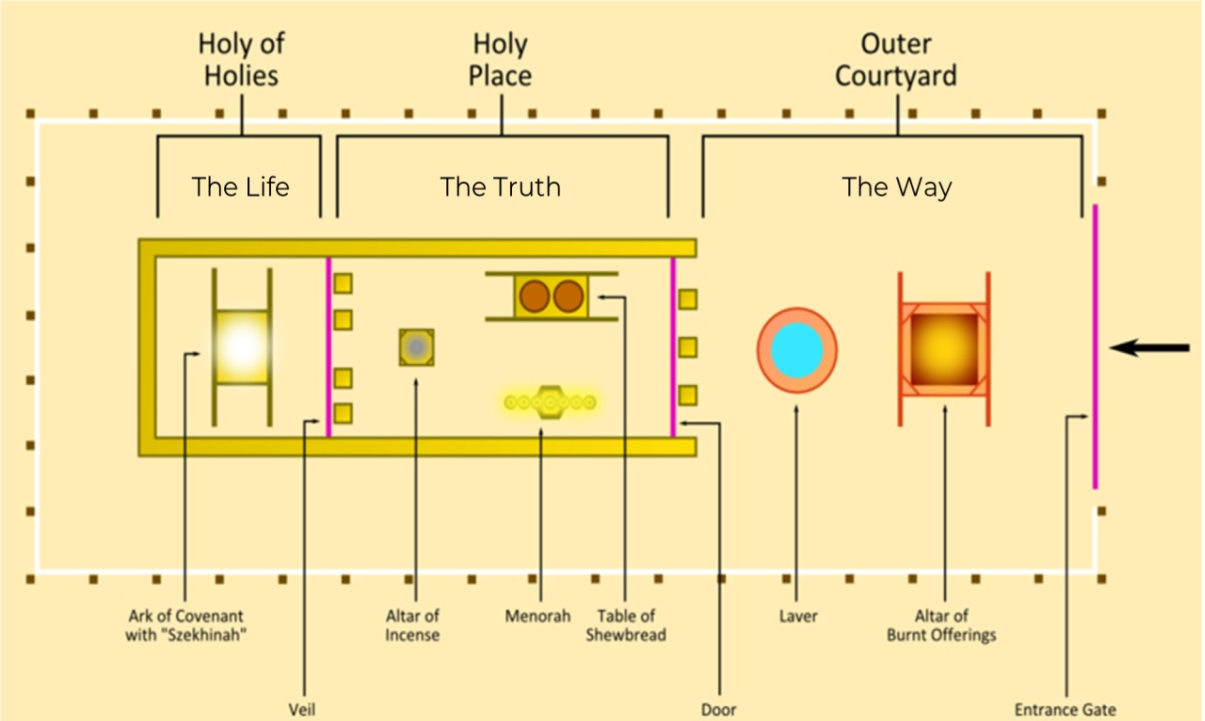
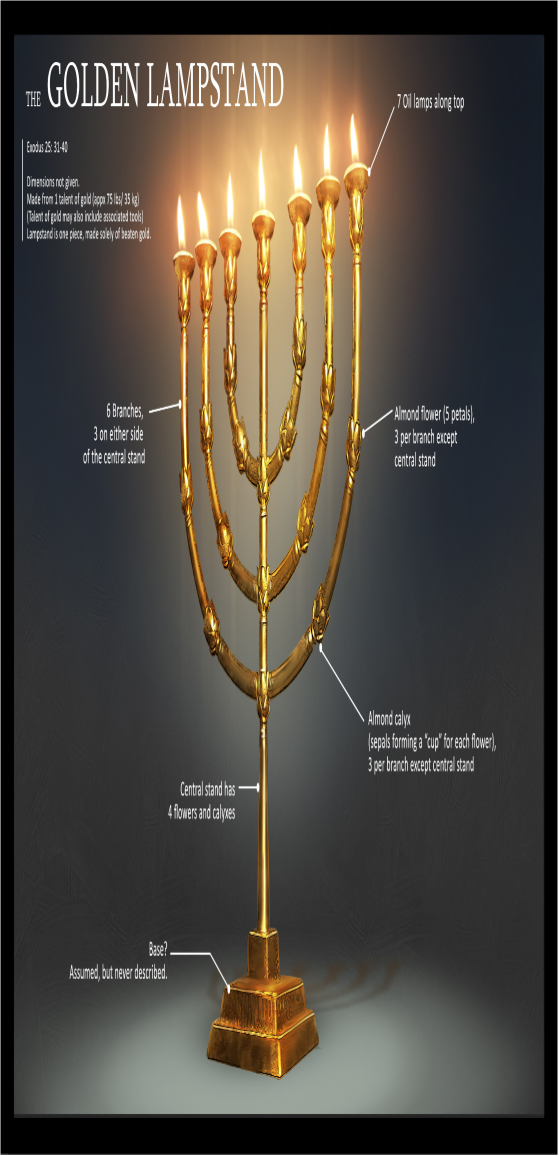
            In this message, our focus will be upon the lampstand in the tabernacle. But to show what this was like and where it was sited, consider the illustrations below:

The lampstand is also called the “Menorah.” Details of its construction can be found in Exodus 25:31-40. The lampstand was found in the Holy Place where the priests did their work. The Holy of Holies was separated from the Holy Place by a thick veil and could only be entered once a year on the Day of Atonement by the High Priest alone.

We shall consider this part of the tabernacle furniture using the following details of its structure and function:

[1] Pure gold.
[2] Of one piece.
[3] The only light.

[1] Pure gold.

            The ‘Menorah’ or the golden lampstand had seven branches in all. It was made of pure gold. In Scripture gold is put to illustrate divinity. The ark of the covenant was made of acacia wood overlain in gold and it housed the two tablets upon which were written the ten commandments. The wood aspect points to the human nature of the Lord Jesus and the gold to His divine nature. Gold was used in many other parts of the temple built later by Solomon. You may recall that the wise men who visited Christ in the manger brought gold, frankincense, and myrrh. Gold is a bright precious metal that is generally inert and so used mainly to represent the divine nature. Other precious substances such as pearls or other gems and precious stones are made from a combination of things that have undergone some form of transformation, but gold is elemental. Gold is considered a pure substance of great worth and largely uncorrupted. It is found as the native metal in the earth. So in the Old Testament economy (which is much more visual and earth-based), gold is put to point us towards the divine.

            But gold can in fact react if it is mixed with a mixture of nitric acid and hydrochloric acid. It serves well as a temporal picture to illustrate divinity in the tabernacle and temple because by-and-large it is pure, unreactive, very shiny, and highly prized. But in the New Testament we find that there are some precious things which are greater than gold. For example, true faith in Christ (that is, a faith which is genuine) is “much more precious than gold that perishes,” and it is even so “though it is tested by fire,” that it “may be found to praise, honour, and glory at the revelation of Jesus Christ” (1Peter 1:7).  Then further, our very redemption was purchased with something of much greater value than mere gold. Peter goes on to state in his first letter that we “were not redeemed with corruptible things, like silver or gold” but rather “with the precious blood of Christ, as of a lamb without blemish and without spot” (1Peter 1:18,19). Gold will perish, for it is simply a part of this creation. Even though it is a precious metal and high in value, Christ’s blood is of infinitely greater worth.

            The gold of the Menorah points us towards this thought that God in His incredible wisdom and grace has provided us with “precious faith,” towards Christ, and “precious blood” of Christ for our redemption which are of infinitely more value and worth than earthly gold.

[2] Of one piece.

            In Exodus 25:31 we are told expressly that the lampstand of gold was made from one piece. It was hammered into shape but from a single lump of the precious metal. We are also told that it was made from “one talent” in weight of pure gold (Exodus 25:39). There is some debate about the exact measure but it is somewhere around 32 to 35 kg. Apparently the average new-born baby weighs around 3.2 kg, so this lampstand is equivalent in mass to ten newborn babies! Quite a substantial size. It was no mere ornamental lamp on a sideboard!

            Why this emphasis on it being made from one piece and not being welded or joined in any way? This surely shows us the unique nature of the Lord Jesus. He is described in such unique ways in the New Testament as the following few examples show:

The Holy One and the Just. (Acts 3:14).
The Head of the church. (Colossians 1:18).
The Apostle and High Priest. (Hebrews 3:1).
The Mediator of the new covenant. (Hebrews 9:15; 12:24).
The Man, Christ Jesus. (1Timothy 2:5).
The Bright and Morning Star. (Revelation 22:16).

But then also He is One with the Father: “I and My Father are one” (John 10:30). When we think of the Lord Jesus Christ we are also to think of the Father too, for as our Lord Himself said: “He who has seen Me has seen the Father” (John 14:9). And we dare not exclude the Holy Spirit who Himself is God too. These three divine persons, Father, Son, and Holy Spirit, are united in the trinity. One God but three distinct Persons. All work in concert and harmony. Where One is there are the others in perfect union.

            Now our union with Christ is also apparent too. You will notice that there are six branches to the lampstand, three on either side. In the middle is the main or central branch. The number six is the number which represents man. Our Lord Jesus was the God-man. Fully human (although sinless) and fully God. Here in this menorah (lampstand) we see mankind reflected in perfection for the number seven stands for perfection, or that which is complete. Paul in Colossians tells us that in Christ “dwells all the fullness of the Godhead bodily” (Colossians 2:9), and because of our faith in Him we are united with Him and so Paul continues “and you are complete in Him” (Colossians 2:10). Wonder of wonders, the believer gets to share and partake of this incredible unity within the Godhead. As our Lord said in His prayer the night before He died:

20 “I do not pray for these alone, but also for those who will believe in Me through their word; 21 that they all may be one, as You, Father, are in Me, and I in You; that they also may be one in Us, that the world may believe that You sent Me. 22 And the glory which You gave Me I have given them, that they may be one just as We are one: 23 I in them, and You in Me; that they may be made perfect in one, and that the world may know that You have sent Me, and have loved them as You have loved Me. (John 17:20-23).

So we are “complete in Him,” and this is illustrated by the six branches of the lampstand and the central branch indicating perfection. The union of Christ and the believer is a theme which is spread throughout the New Testament. We have the illustration of the “true vine” and the branches in John 15. There is the illustration of believers as the one body of Christ (1Corinthians 12:13). We are “all one in Christ Jesus,” so that national and ethnic distinctions are all now gone (Galatians 3:28). For those truly saved this unity is eternal! And believers will reign forever with Christ (Revelation 5:10). The last part of Stuart Townend and Keith Getty’s song “See What A Morning” celebrating the resurrection has these words:

And we are raised with Him
Death is dead, love has won, Christ has conquered
And we shall reign with Him
For He lives, Christ is risen from the dead

Christ is risen from the dead

Or what of the hymn “All That Thrills My Soul Is Jesus”? Does the Lord thrill us so? Do we recognise that we shall indeed reign with Him in glory?

[3] The only light.

            If you look at the tabernacle again you will notice that the Holy Place and the Holy of Holies are enclosed spaces. These are separated from the outer court by means of curtains. The veil that separated the Holy of Holies from the Holy Place was much thicker than the curtains shielding the entrance into the enclosed space itself. So inside would have been very dark (the materials used to cover the tabernacle were many and quite thick). Thus the only light available within was provided by the lampstand. The priests could enter the Holy Place to carry out various functions, and the High Priest could enter the Holy of Holies once a year for atonement. But work in such enclosed spaces would have been very difficult without the light of the lampstand. Now if we have not the Lord Jesus Christ within (who is the “light of the world” John 8:12; 9:5) you cannot do anything that will bring God pleasure. You will be in darkness. Light brings the ability to function. Without this light in the tabernacle the priests would be fumbling about and unable to perform. Light, therefore, is essential. But man in sin is in darkness. The Lord Jesus Christ is our light. The tabernacle shows us how we can approach God to worship. Without the light we would be stumbled.

            Christ ought to be the centre of our very lives. He ought to be the One who guides and illuminates us. After all only in Christ can be found “all the treasures of wisdom and knowledge” (Colossians 2:3). We are therefore encouraged to “set your mind on things above, not on things on the earth” (Colossians 3:2), and we are to be “looking unto Jesus, the author and finisher of our faith, who for the joy that was set before Him endured the cross, despising the shame” (Hebrews 12:2). We are to look to Christ our light, for He is the light of the world.

            The world spends billions upon billions of pounds, dollars, and other currencies to figure out what has gone wrong with man. The Bible offers the analysis and the solution for free. The heart of man is deceitful and is full of darkness (Jeremiah 17:9,10), and man is lost in sin, but Christ is the light of the world and “in Him was life, and the life was the light of men,” and this light of Christ which has come “shines in the darkness, and the darkness” cannot overpower it (John 1:4,5). Christ Jesus has come to save us from our sin, and a key part of this is that we may see the truth, and that we see things clearly, as they are, so the light of Christ illumines us. The light of Christ is still shining through those who truly believe, for the Lord said to His disciples who truly believed “you are the light of the world” (Matthew 5:14). The light of Christ shows up our sin, and it also shows up Christ’s true and glorious life. This light is in the believer forever. The Lord has called believers to be the lights of this world. Through the apostle Paul He says that we should “shine as lights in the world” (Philippians 2:15), which we do by “holding fast the word of life” (Philippians 2:16). We were “once darkness” but on account of what the light of the world has done we are now “light in the Lord,” and so we are to “walk as children of light” (Ephesians 5:8). May the Lord shine through us the glory of His Son!

November 11th 2018: Ian Middlemist

Ian-Nov18Hebrews 4:14-15

We have a friend in a very high place. It’s good to have a friend in high places who can speak up for us, and help us when we go through personal difficulties. Things which are impossible for us to achieve are made possible with a friend in a high place.

The Hebrews obstinately ignored God in the wilderness. Many never entered God’s rest. Yet God’s rest still stands today – rest from labour, but ultimately rest from judgement – eternal rest, to enter, through the sacrifice of our high priest, Jesus Christ.

A great high priest: we have many needs which many do not know about. We have one who helps us in our times of need (Hebrews 4:16). What’s been offered to us is the offer of help. Lots of us think we don’t need help. Far too many try to cope alone. We all need help. We fool ourselves into thinking we’re fine.

There’s a specific need addressed here – the matter of belief and unbelief. This is where we need most help. It’s important for us to focus on the need of all needs, the matter of belief. All else is a distraction. Belief changes everything. Do you believe in the creator God? If you do, it changes everything. Do you believe that you can do nothing on your own? Do you believe that God sent His Son Jesus into this world as the revelation of who God is? If you do, it changes everything. Do you believe Jesus is almighty God, sinless and pure, who died at the hands of sinners? It changes everything. If you believe you should be the happiest of all because Jesus died for sinners. He chose that path. It was planned. Our God is alive, He has risen from the grace, His name is victory. It changes everything.

What gets in the way of belief? Our circumstances, career, hurt and pains that won’t go away, being fearful of the future. All of this gets in the way. Faith puts God between us and our challenges. We have a great and victorious high priest. Focus on Him, not on your circumstances.

Why is He great?
He is the priest who passed through the heavens, not an earthly temple. He blasted into space and time and is now sat down next to God in heaven. He passed through the heavens.

He has made the perfect sacrifice, the Lamb without blemish. Who would dare say no to Jesus? Heaven’s justice, the finest court from where all other courts get their ideas from.

He is filled with the fullness of God.

He is great because He is the Son of God. He is your help in time of need. His priestly work on earth was finished. In the Old Testament, animals were slaughtered; the sins of the people were laid on animals day by day, non-stop sacrifices, the priests sacrificing daily. Animal sacrifice could never be enough. Jesus sacrificed His own life, once and for all. It was finished, then Jesus could sit down next to the Father because it was finished. Do you believe in this great High Priest? Are you trusting in Him?

He is a sympathetic high priest. Our Saviour’s coming to earth means He knows what it’s like to be fallen. He knows. As Jesus returned to heaven His humanity is not diminished at all. He has experienced our weaknesses. He knows. It is important we know He is great but also that we know He is sympathetic. He was tempted. Life is a test. Jesus was tested. In order for Jesus to qualify as our Redeemer He had to be tested. He passed the test! He trusted His heavenly Father. Our High Priest is our friend who knows how hard it is for us. We need to ask for the help of the one who can help.

Our Sanctuary: our King is the polar opposite of all earthy kings. If ever there was a king we should fear it is this holy king. His requirement for our life is perfection. How can we approach Him? As sinners we should be afraid. But Jesus made the perfect priestly sacrifice for us.

The devil and his minions are fantastic videographers, capturing our words and thoughts. They love to capture footage of our sin. The devil hounds us at times, he glories in causing heartache, he is a giant over past events. We are often living in the past. Did you know Jesus takes this video footage and erases it? Everything is bank. We are sons of God. The devil has nothing against us. We can come boldly into the throne of God and claim the crown. He has done it all. You must come boldly; your guilt will hold you back from coming into His presence.

Sometimes we need more grace when facing trials. You need to know you can find help in time of need. Your greatest need is to believe in the cross, that God loves you, that God has a place for you. We’re called to come to the throne of grace. Your friend in the highest place is there waiting for you. Some Christians are surrounded by trouble. Lift up your eyes to heaven – that’s where your help will come from. Our great high priest is in heaven interceding for us. He won’t let you down. Keep looking up.