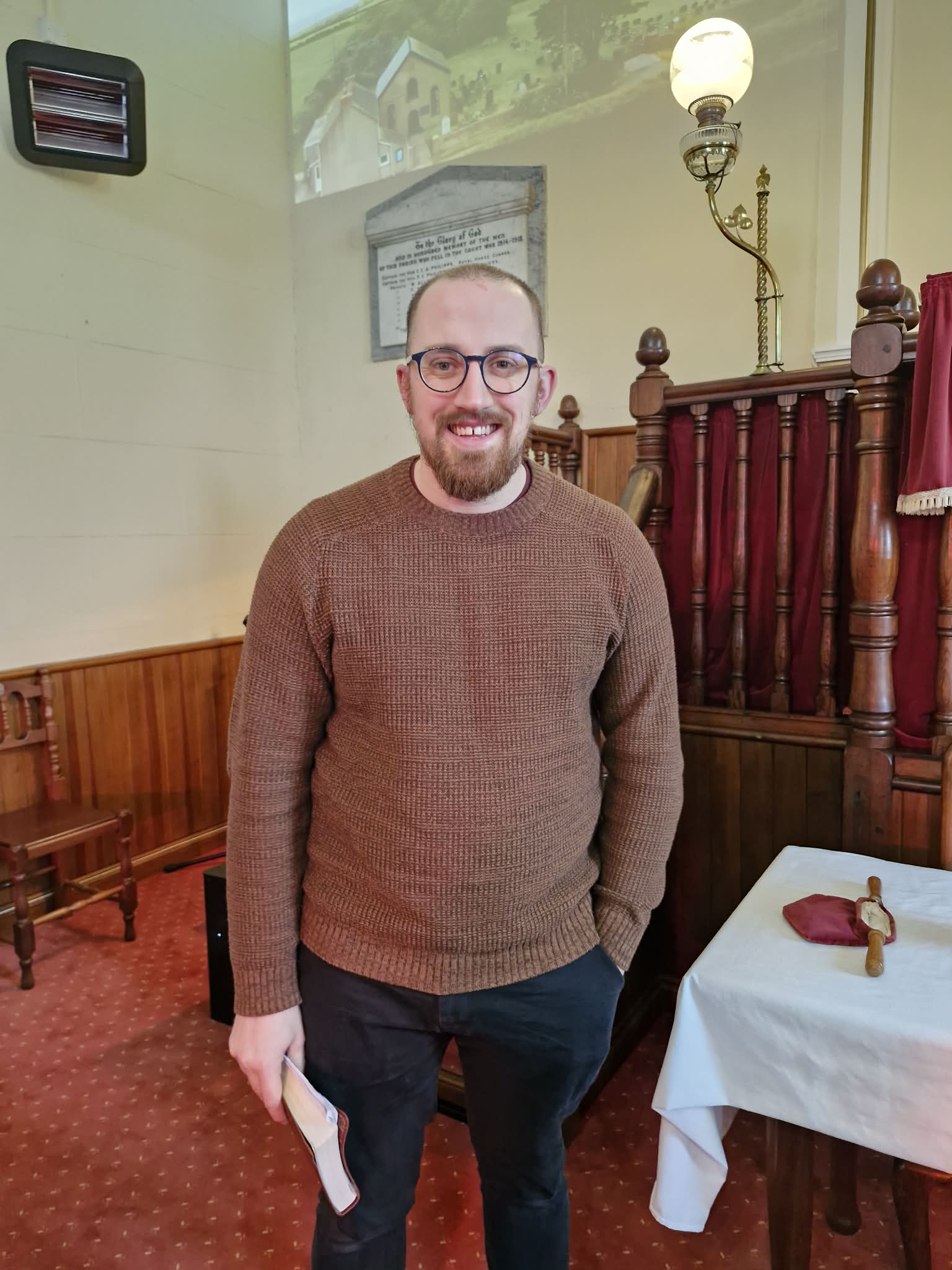
March 1st 2026: Tom Baker

To watch this service, click on the link to our YouTube channel:
https://youtu.be/CRAlVfLYMmU?si=Pn_PwqHIwLvFFAyf

Genesis 8: All things new
The days of Noah were dark days but there was a bright future. There were people reaching for forbidden fruit and everything was falling apart in the world, and yet there was also a glimmer of hope in Noah. We live in very similar times. Moses, who compiled Genesis, gives us certain clues in the text which show forth this hope amidst the horror. Our Lord Jesus spoke of Noah’s day and said that when He would return it would be just like the days of Noah. People would strive after the things of this world only, and they were grasping at things they shouldn’t have grasped at. And then Noah was called to make the way of escape, of salvation. Now we too are called to get into the ark, but this time our ark is Christ Jesus Himself. We are called to come out of the old world doomed to death and destruction, and to enter in to the ark which is Christ.

We have two graphic pictures here. First, we have our great need for salvation. There was gross wickedness which deserved judgment out of which man needed rescue. These were real historical events that we read of in Genesis but they also paint a picture of what the world is truly like in all ages. Second, we have two pictures of how this salvation from judgment was to be accomplished. Noah is placed for us in the text as a righteous man who leads others to safety. Then also we have the ark which bore the full force of the waters of judgment given to us as a type of Christ too. Now in Genesis 8 we have a new picture. Again we have real historical events that actually happened, but we are also taught something about the goal or end of salvation. Where does it all lead to? What happens when the rain stops? What comes after judgement? Well, the answer is: to a place where everything is made new. This scratches an itch we all experience doesn’t it? We often look for a fresh new start when things have gone wrong don’t we? Do we not feel like this old dead world that is destined for destruction? And do we not have this thought: ‘there must be more to life’? There is this inner desire for a fresh start, to make all things new. We don’t often get this chance to make a fresh start. Often we have to continue with the disaster we have all around us. But there is always this wish that things will be made new. Well of course the Scriptures give us the response to this longing. The Lord is making all things new.

  • How do things turn out for Noah and the ark?

The first thing we read of in Genesis 8 is that God “remembered” Noah (Genesis 8:1). At the end of Genesis 7 everything dies and was wiped off the face of the earth. But Noah was in the ark on the surface of the flood waters. Did Noah think that God had forgotten him? In relation to the entire globe covered in water, Noah and the ark were simply a tiny box floating on the surface. Even large tankers out on the Atlantic ocean are no match for the waters and seem insignificant. So was Noah worried that God had forgotten him? Well God had most certainly not forgotten him! It was impossible for God to forget Noah. After all it was God who called Noah to build the ark and gather the animals. And it was God who secured Noah and his family in the ark. Remember that Noah had found grace and so was favoured of the Lord. How could God forget the one whom He had called and instructed. This opening verse of Genesis 8 is an encouragement to us. God is mindful of His people. He thinks upon them always. It is not possible for the omniscient God to forget! What about us? Who are we? Does God forget us and abandon us? What is man that God should be mindful of him? We may be small and insignificant, just as Noah and the ark were on the water covered earth. Yet God remembers me, and you. He takes thought of you as He did of Noah and the ark.

  • What was the new world like?

In Genesis 1:2 we have an unformed and unfilled watery mass which speaks of the raw materials from which God created all things. Now here in Genesis 8 the old created order has been judged and we have another watery mass once again. Then we read that God made a “wind” to blow on the waters to make them recede (Genesis 8:1). The word for “wind” can also be rendered as “Spirit.” So we have the same situation we read of in Genesis 1. In Genesis 1 the Spirit hovers over the watery mass, and here in Genesis 8 we have the wind (the Spirit) blowing the eaters to cause them to recede. So here in Genesis 8 we have a kind of recreation. Later on we read about a dove being sent out. The dove is a symbol for the Holy Spirit. So Moses, in recounting the revealed history of the flood, gives us hints along the way to show that God is doing the same type of work – creation. The God who made the raw materials at first and then made all things from those raw materials is now re-creating this new world. See also that signs of life emerge. We have the olive branch brought back by the dove. We have the land appearing once again like it did in the original creation. We have the waters being bounded and sent to their original place once again. All these things are meant to remind us of how God created in the beginning. Note also that the dove is sent out after a seven day period. Further, that the ark rested on the mountains. The ark finally comes to its grounded resting place. The floating zoo is like a second little Eden. The world eventually dries out and then when the ark is opened an abundance of life bursts forth to spread out over the new world. Thus we have a new world. All of this is a picture pointing us towards the new heaven and the new earth to come.

Noah is presented to us as another Adam. He is the head over creation. This points us to the true second and last Adam, Christ Jesus the Lord. What does Noah do? He plays the part as-it-were of the first Adam. He leads his people out into the new earth (Genesis 8:16). As Noah obeys the Lord doing all that

He commanded, we see the blessing of his obedience is passed on to the others who follow him (Genesis 8:18). In genesis 8:17 we see that Noah is (like Adam) ruler over the animals. The animals went out according to their families over the earth (Genesis 8:19). So Noah is pictured as lord of creation and brings the animals out at the command of the Lord. Noah also leads his people (his family) straight away to the throne of God, for the first thing he does is to build an altar and offer burnt offerings (Genesis 8:20). When Noah made this offering the Lord was pleased with it (Genesis 8:21). Noah is acting like a priest. He brings people into the new world and into the presence of God through sacrifice. They find real life here. It appears that the Lord was delighted with this action. In the same way we see also the Lord Jesus Christ as our high priest whose sacrifice leads us into the new creation. It is through Christ’s sacrifice that we are granted new life. Even though we do not inhabit this new heavens and earth, through His once-for-all sacrifice we are made new creatures. The Lord was pleased to bruise our Saviour and delights in the sacrifice made. God the Father is thrilled for Christ our Pioneer leads the way to glory through His sacrificial gift.

  • A new and lasting hope.

In Genesis 1 & 2 we read of life and blessings. In Genesis 3 to 6 we read of death and the curse. In Genesis 7 we read of judgement. In Genesis 8 we read of life and blessing once more. Noah is commanded to be fruitful and to multiply (Genesis 8:17). Note that the Lord gives order in the seasons once again. For a year and ten days the world has been covered in water. But now there will be seed-time and harvest, winter and summer to order life on this new earth (Genesis 8:22). The ancient blessing of God cannot be overturned or undone. His delight in Christ never ends, so His plan and His blessings in Christ will never end. What the Lord had done in and through Noah and the ark, prefigures what He will do perfectly in Christ, so this new creation will not suffer such a judgement again and the seasons will remain true. See how this promise to continue the new world is offered despite the fact that “the imagination of man’s heart is evil from his youth” (Genesis 8:21). The everlasting covenant is not based upon the works of man. Our sin does not stop the blessing of God. He has made a way whereby the sin is once and forever judged and a new order is made.

A word of application.

How shall we respond to these thoughts? Well make sure that you are on the ark, which is Christ. Make sure that you partake of the new world to come through the once-for-all sacrifice of Christ which is pictured here wonderfully in the ark which preserved creation amidst the judgment of God by the waters of the flood. Do not remain in this old world of sin and corruption. Do not be content with this cursed world and earth. It is destined for destruction (although next time by fire). Make sure that you enter the ark which I Christ, for in Him is true salvation and safety.

September 29th 2022: Adrian Brake

Harvest Service

Texts: Acts 14:8-18; Haggai 1:1-11; Genesis 8:20-22.

            God wants us to know Him. He has made Himself known clearly and wonderfully in three important ways. First, He has made Himself known in Scripture. The Scriptures are the “word of God” in which He manifests Himself. Secondly, He has made Himself known through the coming of His Son, the Lord Jesus Christ. He is the Word made flesh (John 1:14) who declared to us the Father (John 1:18; 14:7-11). But then, thirdly, He has made Himself known through creation.

            There are three things we can learn at this harvest time by looking at what God has done in and through creation.

[1] Harvest time tells us something about God’s love.

[2] Harvest time tells us something about God’s mercy.

[3] Harvest time tells us something about God’s faithfulness.

These three things are put on display in creation by God. The Lord loves humanity. He cares deeply for mankind. He is loving, merciful, and faithful.

[1] Harvest time tells us something about God’s love.

            1 John 3:18 tells us that we must not love in word only but in action and in truth. God loves in action! God expresses His love in ways which we can experience. He gives us gifts. Most people like to give gifts. Such a thing shows that we are made in the image of God which although fallen and marred is not completely lost. In that we give gifts we know also that God gives such to a greater degree. When a person gives another a gift it is a way of saying “I love you,” or “I care.” God has given to humanity certain gifts and these declare His love.

[a] Food.

            One of these gifts is food. Where does food come from? Sadly, many youth think it comes from the supermarkets! But we know that it comes from the miracle of God’s creative works. We could speak of the soil, the sun, the rain, the warmth and so on, but all of these are provided by God. He made the systems that enable the seeds to grow in the soil. He provides the water and sunlight to enable photosynthesis to occur. It is God who brings our food to the table. In Acts 14 we hear Paul speaking of the Lord’s witness to those of Lystra:

“Nevertheless He did not leave Himself without witness, in that He did good, gave us rain from heaven and fruitful seasons, filling our hearts with food and gladness.” (Acts 14:17).

The people of Lystra did not have the law, the tabernacle, the prophets, nor the sacrifices, but they did have creation, (Psalm 19:1). God loves the cheerful or generous giver, for He is a very generous giver Himself. All of creation witnesses to this. Did He not make an abundance of creatures in the seas and on the land?

            A recent supermarket leaflet lamented the fact that in the UK we waste 6.4 million tons of food every year. This amounts to 730 lbs per household every year. There is a vast abundance of food in this land! God is a generous giver! God has provided. The problem of lack in different areas is not due to God’s lack of provision, but mankind’s greed and sinfulness.

[b] A more precious gift.

            We need food to survive and God has given this in abundance. But we need something else more desperately. Our greatest need is the forgiveness of sins. If we cannot survive bodily without food, then note that we will not survive eternally without the forgiveness of sins.

            God created us to know Him but we are unthankful and rebellious. If we do not know Him then the wrath of God abides on us (John 3:36). But God is so generous and kind that He has provided His only Son for us. Through His coming, His death, His resurrection, and His ascension we are given the gift of eternal life and the forgiveness of sins. This Person is the greatest gift that God has given to us (John 3:16).

            God has given us food that we may thrive bodily. And He has also given us the Lord Jesus Christ that we might have eternal life. Jesus referred to Himself as the “bread of life” (Genesis 6:35,48). In this manner God has loved us. The coming and sacrifice of Christ demonstrates God’s love to unholy men and women (Romans 5:8).

            In Luke’s gospel we read of the rich man and a beggar named Lazarus (Luke 16:19f). The rich man had plenty to eat in this world but in death he was cast into the torment and flames. The poor beggar, Lazarus, ate the crumbs from the rich man’s table and was taken to paradise. There is a great gulf between these two places where souls are delivered after death. If all we have in this world is an abundance of earthly food then we will end up in the same place as this rich man. If, however, we have little of this world’s fare but are rich in the knowledge of God, we have heaven to look forward to.  

            The apostle John wrote:

“In this is love, not that we loved God, but that He loved us and sent His Son to be the propitiation for our sins.” (1John 4:10).

If we trust in the Lord and in His provision through Christ Jesus, then we are highly favoured and greatly blessed. But if not then we need to see His provision of Christ afresh.

[2] Harvest time tells us something about God’s mercy.

            In Haggai 1:1-11 we read of a failed harvest. They sowed the seed but reaped little in the end. Why? Well, we read that God “blew it away” (Haggai 1:9). He did this because they had forgotten God’s house. Because they had rejected the Lord in their neglect. The exiles were those who returned from captivity and were enabled through Nehemiah and by God’s power to rebuild the walls. Having done this, they set about building themselves their “panelled houses” but they did not attend to the house of the Lord. They did not set themselves to rebuild the temple. They had no thought of the glory of God. So, God chastised is people by withholding the harvest.

            In our land the Lord has been good and gracious. We have been greatly favoured. We have a great history of God’s goodness so that by-and-large we enjoy happiness and peace in our land with an abundance of food. However, in general we do not think of God. In our rebellion and neglect are we any less guilty than the Israelites of Haggai’s day? Does not our land deserve the same chastisement? In all of this we see that God is merciful.

Mercy is when God does not give us what we deserve.

Grace is when God gives us those things we do not deserve.

What of those who have not? What of those who do in fact starve? Well in a recent supermarket magazine we are told that 29,000 tons of oranges and 6,000 tons of spring onions, all valued at £84 million, are thrown away every year. We do indeed have sufficient but we are grossly negligent in sharing this abundance. It is due to our sin and greed that some starve, not because God does not provide. Psalm 145 tells us something of God’s great provision:


“9 
The Lord is good to all, and His tender mercies are over all His works. … 15 The eyes of all look expectantly to You, and You give them their food in due season. 16 You open Your hand and satisfy the desire of every living thing.” (Psalm 145:9,15,16).

God gives generously to all.

“He makes His sun rise on the evil and on the good, and sends rain on the just and on the unjust.” (Matthew 5:45).

In Acts 14:17 we discovered that even though the unbelievers had no thought of God. Nevertheless, He gave them rain and fruitful seasons, food and gladness. Now this fact that we have an abundance of food is due to the mercy of God. At any moment He could justly and righteously consign our souls to hell. This is what we deserve. But He does not send us there even though we do deserve it, but rather He continues to give and provide for us. This is the mercy of God, withholding what we justly deserve. God spares us and He spares us, and He spares us. How long have you been spared the judgment you deserve? God is truly patient and long suffering (2Peter 3:9). Think of the multitudes alive at this moment who have no thought of God and who are rebelling in wicked ways. These are held back from the judgement they deserve. This is only on account of God’s great mercy.

            But there is a time limit for God’s mercy (Genesis 6:3). As day succeeds day, God withholds His judgement from us. He strives and bears with us. Do not presume on this mercy. God could take you at any moment (Hebrews 9:27) but He has enabled you to see this day in which He has graciously provided for you both food to eat for your body and food for your eternal soul. Why would you not take and eat of the Lord?

[3] Harvest time tells us something about God’s faithfulness.

            In Genesis 8:21 we learn that God promised Noah He would not destroy the world again with the waters of the flood. He promised this even though “the imagination of man’s heart is evil from his youth.” Man’s heart had not changed through the flood. He was wicked before the flood and man continues to be wicked after the flood (the Tower of Babel event in Genesis 11:1f declares this especially).  But God promised the entire world that seed sowing, the harvest, the seasons, and the order of day and night would continue unabated throughout the remainder of time (Genesis 8:22).

            God has kept this promise for the harvest has come. How many harvests have come throughout time? The Lord promises and He always does what He has said He will do. God is faithful. What of His many other promises in Scripture? Here are a selection:

[1] Whoever comes to the Lord Jesus He will never cast out (John 6:37). He will keep and preserve all who come to Jesus forever.

[2] Whoever calls upon the name of the Lord shall be saved (Romans 10:13).

[3] My God shall supply all your need (Philippians 4:19).

[4] God will never leave us nor forsake us (Hebrews 13:5).

[5] The Lord Jesus promised that He will come back for us (John 14:3; Acts 1:11).

We can build on such promises (and there are many more in Scripture) for God is faithful and what He has said He will most certainly do.

We are here to give thanks. We give thanks for:

The God of love – He is great, generous, and abundant in His love for He gives us food to eat and the bread of life for our souls.

The God of mercy – He has withheld that which we deserve in patience offering us the salvation and redemption which are found alone in Christ.

The God of faithfulness – He has promised so much for us, and He will keep this world going in its regular order until that day, and we can rely on all that He has said.