November 27th 2016:Aaron Davies-Whitfield

aaron-nov-2016Our first Advent service of the year was taken by Aaron Davies-Whitfield who preached from Romans 8 in which he focused on two themes: God as Law Giver and God as Son Giver.

God as Law Giver: 

God is a God who has given law. From Genesis chapter 1 we read God gave laws, After creating the world He commanded Adam and Eve not to partake of the tree of knowledge, of good and evil. God has given laws and it is important for us to understand this. He is a God of righteousness. As creator, He can command, He can ask requirements and give consequences for breaking His commandments. The Pentateuch, the first five books of the Bible. Apart from Genesis, they are filled with law. We first read of the Mosaic Law in Exodus 20. Immediately we think of the 10 commandments of law but there are 613 laws God gave to Moses and the children of Israel. It is important to realise, to have a vivid picture of the law then we will have a more vivid picture of Christ.

The law was given to Moses at Mount Sinai. The first problem we have, Exodus 19, is the people thought they could keep the law, the perfect righteous law. The people were told not to touch Mount Sinai or they would die. When God came down upon the mountain there was darkness and terror. Darkness conceals, it concealed God. We cannot approach God in all His splendour. The law does not reveal the glory of God, it conceals it. God began to give a covenant – an unchangeable, divinely imposed agreement. God was sharing His righteousness in this law. He also gave the law to show His righteousness and man’s unrighteousness. God set up the law of sacrifice so man could come nearer to God by the shedding of blood. The way to God is through blood. God established a priesthood but even the priests had to cleanse themselves. The sacrifice had to be continually kept.

In Isaiah we read even the sacrifices themselves were insufficient, ‘To what purpose is the multitude of your sacrifices unto me? Saith the LORD: I am full of the burnt offerings of rams, and the fat of fed beasts; and I delight not in the blood of bullocks, or of lambs, or of goats.’ (Isaiah 1:11)

In Hebrews we also read that the blood of bulls and goats is not sufficient to cleanse us from our sin. The law shows us our unrighteousness. The law is weak because it can only teach men and women their transgressions, ‘Wherefore then serveth the law? It was added because of transgressions, till the seed should come to whom the promise was made; and it was ordained by angels in the hand of a mediator.’ (Galations 3:19)

 ‘Therefore by the deeds of the law there shall no flesh be justified in His sight: for by the law is the knowledge of sin.’ (Romans 3:20). The law came to give the knowledge of sin.

By the law death came, for the wage of the law is death, ‘But the ministration of death, written and engraven in stones, was glorious, so that the children of Israel could not steadfastly behold the face of Moses for the glory of his countenance; which glory was to be done away.’ (2 Corinthains 3:7).

By the law came cursing. “For as many as are of the works of the law are under the curse; for it is written, ‘Cursed is every one that continueth not in all things which are written in the books of the law to do them.’” (Galations 3:10)

‘Now we know that what things soever the law saith, it saith to them who are under the law: that every mouth may be stopped, and all the world may become guilty before God.’ (Romans 3:19)

‘What shall we say then? Is the law sin? God forbid. Nay, I had not known lust, except the law had said, Thou shalt not covet. (Romans 7:7)

‘Wherefore the law is holy, and the commandment holy, and just, and good.’ (Romans 7:12). God is perfectly righteous, His law is perfectly good. The problem is us. The law leaves us totally unrighteous, without hope. You can’t get to heaven by good works, church attendance, how much you pray or keeping the laws.

So why was the law given? To always and forever point people to their need of a Saviour, to see their sin and hopelessness and their need for a Saviour.

God the Son Giver:

‘For the law was given by Moses, but grace and truth came by Jesus Christ.’ (John 1:17). The law was given ultimately for us to see Christ. The law cannot change a person’s heart, but God giving His Son. Think not that I am come to destroy the law, or the prophets: I am not come to destroy, but to fulfil.’ (Matthew 5:17).

At Mount Sinai there was trembling, fear and separation, if anyone touched Mount Sinai there was death. Yet Jesus’ very first sermon was given on a mountain and His first words were, ‘Blessed are the poor in spirit: for there is the kingdom of heaven.’ (Matthew 5:3). Christ gives blessings to all who look to Him in faith. Man, in sin, could now come to the Son of God because of grace. He reconciled people to Christ. Under Christ there is a new law written on the heart by the Holy Spirit. Christ is the perfect sacrifice. His death has covered all our sins – past, present and future. He is perfect, the Lamb of God who takes away the sin of the world.

There is a disagreement of believes today of the relationship of the law to born again believers. I am convinced that through Christ we are totally free from the law. Some scholars divide the law into three parts: moral, ceremonial and judicial. But the Bible only refers to the law as a whole: 2 Corinthains 3:6, Romans 7:6.

The Spirit will teach us something the law could never do, it teaches us to look to Jesus. We are no longer to look within and condemn ourselves, we are to look to Christ. ‘For he hath made him to be sin for us, who knew no sin, that we might be made the righteousness of God in him.’ (2 Corinthians 5:21).

Grace is free to us but it cost the death of Christ. In Christ we are no longer under condemnation: 1 Timothy 1:9-19, Romans 3:21, Romans 7:6, Romans 10:4, 2 Corinthians 3:7, 2 Corinthians 3:13, Hebrews 8, Colossians 2:14.

The law was good but grace in Christ is better. We do not have a licence to sin. ‘What shall we say then? Shall we continue in sin, that grace may abound? God forbid.’ (Romans 6). The law is written within our hearts, the Spirit of God teaches us to be more like Christ. Under Christ there is a new relationship. When we sin, we sin against the knowledge of this love. We are grieving the one who gave His life for us. When the adulterous woman was brought before Jesus by the scribes and Pharisees, Jesus did not condemn (John 8). We are no longer under condemnation.

God was us not to look back to Mount Sinai anymore, we are to look to Calvary. He doesn’t want to us look back to Mount Sinai, to the fear and trembling, but to look to the cross. In Galations chapter 5 we read of the fruits of the Spirit. These are manifested perfectly in Jesus Christ. We strive to be like Jesus. We still need to confess our sins and repent but we are no longer under law, we are under grace. God gave His Son and His Son saved man. The Old Testament shows us Jesus; when you read of the sacrifices you see Jesus. When you read the laws you see His perfect righteousness. Christ wants us to look to Him. It is not easy but you will find liberty. The commandments have gone, Salvation has come. God wants you looking at the perfect life and sacrifice of the Saviour. Paul says, ‘Looking unto Jesus the author and finisher of our faith; who for the joy that was set before him endured the cross, despising the shame, and is set down at the right hand of the throne of God.’ (Hebrews 12:2). Feel the liberty in your hearts. There is grace, truth and victory when we look unto Jesus. We follow the commands of the New Testament. There is a new law for us, the law of Christ. The law of the Spirit of life in Jesus has set us free from the law of death.

 

November 20th 2016: Ian Jones

ian-jones-nov2016

This morning’s worship was led by Ian Jones from Carmarthen Evangelical Church, who preached from Genesis chapter 24, finding a wife for Isaac. This is the longest chapter in Genesis, longer than the chapter on creation, on the fall, on the judgement upon the earth of the flood. Why? Because it is never easy to find a wife! This is especially true for someone like Isaac. She could not be a Canaanite who would lead him astray, she had to be a woman of faith, a woman who believed in the one true God. Where would such a woman be found, when Abraham is the father of the faithful? Abraham speaks to one of his servants, to a man he trusts, to send him back to his family home. We may not know the servant’s name yet let us consider him an example of how we ought to be. He was:

a man of prayer,
a man of high expectations,
a man on a mission and
a man who was successful.

  • A Man of Prayer:

The servant had learned from Abraham how important it is to come to God in prayer. He knew Proverbs 3:6 before it had been written, ‘In all your ways acknowledge Him, and He will make straight your paths.’ We can imagine him setting up camels to go on a journey, but before he did so he came to God in prayer. He didn’t just pray, he used his own initiative. He went to the city of Nahor, stopping at a well outside the city. There, the servant prayed, ‘O lord, God of my master Abraham, please grant me success today and show steadfast love to my master Abraham.’ (Genesis 24:12). He came to a place where he would expect to find a suitable woman for Isaac, someone who would be obedient to her family and show kindness and hospitality. He sought God in prayer for guidance. We need to pray and to put things into practice and use our initiative to go ahead. We can be reminded of Paul’s words, ‘Be anxious for nothing, but in everything by prayer and supplication, with thanksgiving, let your requests be made known to God.’ (Philippians 4:6). The servant prayed to be led to the woman God had chosen for Isaac, the one who would be right in God’s eyes. It is a reminder of the importance of prayer and seeking God’s guidance to lead us, to direct us so His will, will prevail in our lives. Look to God first, always, then He will get the glory.

  • A man of high expectation:

Do we put a cap on our requests when we come to God in prayer? In Charles Dicken’s ‘Oliver Twist’ Oliver was the one who asked for more at a time when it was unheard of to ask for more. How do we view God? Is He able to do the impossible, to do far and beyond what we expect? This servant was a man who wanted clear guidance. He was like Elijah who looked for a woman who would feed him at the house of a woman who had no food in her home. Yet she was the woman God had chosen. Here, the servant wants to ask the woman not only to give him water but he also wants her to offer water for his camels. Camels drink a lot, up to 20 gallons of water per camel. No girl would offer to do this as it would require a few hours of labour. How could it happen? Yet this man had high expectations. Rebekah came. He ran over to her, asked her for a drink and after dinking the water she ran back to the well to feed his camels. This shows great kindness. The servant then asked if he could stay the night at her father’s house. Her response was yes. He knew right then that she was the one and immediately he praised God, ‘The man bowed his head and worshipped the LORD and said, ‘Blessed be the Lord, the God of my master Abraham, who has not forsaken his steadfast love and his faithfulness toward my master. As for me, the Lord has led me in the way to the house of my master’s kinsmen.’’ (Genesis 32:26). How high are our expectations towards God? Do we know He can do the impossible?

  • A man on a mission:

The servant was devoted to service. Before eating with Rebekah’s father he revealed why he was there. Rebekah’s brother and father agreed that Rebekah should return with the servant to be Isaac’s wife. Gifts are exchanged. It seems as if all is settled. Then, the next morning, the servant reveals he is returning to Abraham. This would have surprised Rebekah’s family. Having travelled about 300 miles, they would have expected the servant to stay a few days, especially as they would probably never see Rebekah again, so they would have wanted some time with her before she left. But the servant knew he had to return; a choice has been made whether Rebekah would go or not.

We are here for a purpose. We are only here for a short time to serve Him. We can easily be distracted and forget our purpose – to live for God and proclaim Him. We are to serve God and not get caught up in other things. The servant knew his purpose. Be engaged in the Lord’s service. Use the gifts you have been given.

  • A man who is successful:

The man who puts God first is successful. By the end of the chapter God blessed him in that when Rebekah was asked whether to go or not, she replied favourably. This is amazing! She had never seen the servant before, she had never seen Isaac, yet she is leaving everything to go with a complete stranger. She made her decision quickly. This speaks volumes about our salvation; we see here Isaac is likened to Christ and Rebekah is the bride of Isaac, the bride of Christ.

We can put ourselves in the position of Rebekah. Someone brings good news which needs to be accepted there and then. The offer of salvation comes and we have to make a choice there and then, leaving behind everything we had and knew. This requires the work of the Holy Spirit. When God is at work and people have been praying, things work out for God’s purpose. It’s miraculous! Our own salvation is utterly amazing! Christ is waiting for us, as Isaac waited for Rebekah. We are on that journey now and we will soon see Him in glory. Rebekah is the chosen one, as we are the chosen ones of God. Rebekah was not disappointed, everything was given to her. That’s how it will be with us, when we go home to be with the Lord Jesus Christ, we will never be disappointed.

November 13th 2016: Paul Daniel

Our service was taken by Paul Daniel of Bethal Evangelical Church, Clydach, who preached from Genesis chapter 11.

Paul began by saying we can be thankful for what God has done for us throughout history – for what He has done and where we are going. Paul told us about the Stanford University Prison experiment, in which volunteers took on the role of either prisoner or guard. At the start of the experiment all volunteers took on their expected roles but as the experiment continued it was observed that the ‘guards’ took on shocking roles. History repeats itself; US soldiers were caught carrying out similar torture. These illustrations show that through the generations people are just as bad as they were before.

In Genesis we have the account of the flood, when God looked at the world and all He could see was evil. He was so grieved He wanted to start again by flooding the world to get rid of the evil. He is a just God. Noah and his family were saved. After the flood he and his family were the only ones on the earth. The family grew. We read in chapter 10 that people were living in different places and had different languages (10:4-5, 10:20, 10:31). Yet in chapter 11 they are living together as one. What is going on? Chapter 10 and 11 are not in chronological order.

The bombshell is the people have been spread out into the world in clans, speaking different languages. The reason why this has happened is because God has judges them. The people sinned and God judged. The people have been given a fresh start but even when people have a fresh start they fall again. Sin has always been there since the beginning and will be there until the end.

Let’s have a look at what God sees, ‘And the Lord came down to see the city and the tower, which the children of man had built.’  (Genesis 11:5). He sees the sons of Adam – the same kind of people He saw in Genesis chapter 1.

  • God’s humour looking at the tiny efforts of humankind.

The people wanted to settle in a place called Shinar. They had bricks and tar rather than stone and mortar – sub-standard materials. They wanted to build a tower so high so they could make a name for themselves. It is the same today – people want to build high towers in cities to show their importance. God says,’ Let us go down to have a look,’ as He sees them attempting to build a tower to heaven. The audacity of the people! God, of course, can see what is going on, but the people’s attempts are so feeble. God does not condemn creativity, He has given us gifts to work and to be creative. But we are to give the glory to Him, not ourselves. Here, the people wanted to make a name for themselves. God looks at the tiny effects of humankind and He laughs. What are we building our lives on? They used second rate materials that would not last. What is the number one thing you want to live for? If it isn’t God, it won’t work.

  • God’s judgement – to limit what sin can do.

The people loved praise, they wanted people to see how great they were. They also wanted security. Together, as one people with one language they can accomplish something great, so they won’t be scattered over the face of the earth. ‘Then they said, “Come, let us build ourselves a city and a tower with its top in the heavens, and let us make a name for ourselves, lest we be dispersed over the face of the whole earth.’ (Genesis 11:4). In Genesis 1 God told Adam and Eve to have children and fill the earth – not to make a name for themselves. Here, the people were disobedient to God so He scatters them and gives them different languages. They were altogether, of one mind, in unity. However. They were judged by God because they loved to praise themselves, to praise their own names and have their own security. They would do anything to protect their own security. History tells us this brings destruction. They were utterly selfish. God sends judgement. However, He sends mercy. He disperses them so they can’t carry out the destruction they might otherwise do.

The purpose of our churches is to go into all the earth and make disciples of every tongue and nation. ‘Go therefore and make disciples of all nations, baptizing them in the name of the Father and of the Son and of the Holy Spirit.’ (Matthew 28:19). This church is for everyone – for all people.

  • God’s Salvation, despite our sin.

People are the same whatever generation. Sin is there when we are born. In chapter 12 we read of the Lord appearing to Abram. God gave Abram a promise to make him great, to bless him and all the nations. ‘And I will make of you a great nation, and I will bless you name make your name great, so that you will be a blessing. (Genesis 12:2).

 Despite sin, God will do something wonderful – He will bless all the nations. That seed will one day become Jesus Christ who blesses all people. If you confess your sin, God will bless you.

God judges the love of praise and the love of security. You and I all go back to this one point in history. Jesus, who was the one who ought to have been praised and ought to have been secure, was the one who gave it all up, carried the cross and hung humiliated. He has made us secure. The very sins that you and I do are the sins He has paid the penalty for. In the words of the hymn of Charles Wesley,

“The veil is rent in Christ alone;
The living way to heaven is seen;
The middle wall is broken down,
And all mankind may enter in.”

The people were trying to climb to heaven but the only way to get to heaven is through Jesus. The wall, the barrier, is broken down. He is the one who welcomes us in to heaven.

October 30th 2016: Aaron Davies-Whitfield

aaron-oct-2016Our morning worship was led by Aaron Davies-Whitfield who preached from Philippians 2: 25-30. He reminded us of the importance of being faithful to the text.

In this portion of Scripture we read about Epaphroditus, a small yet mighty man, who is also mentioned in Philippians 4:18. That is all we read of him in the Bible. He was the pastor of the church at Philippi. In Acts 16 we read Paul received the Macedonian call in a vision, Paul felt that God wanted him to go to Macedonia, to the chief city, Philippi. It was here where Lydia was greatly saved, the Philippian jailor and his household were saved, the possessed woman was saved. Now we have this wonderful church of which Epaphroditus is pastor. This morning we are going to explore the character, condition and conduct of Epaphroditus.

Epaphroditus’ character:
Although he was mentioned so briefly in the Bible, Epaphroditus was a great man. This should be an encouragement for us; though our name may not be out there, we can still be a great blessing. God always sees. What Paul had to say about Epaphroditus was great. He called him, ‘My brother and companion in labour, and fellow soldier.’ (Philippians 2:25). Anyone who seeks to serve is a soldier. We are called to take up arms, not as extremist religious groups, but through the Word of God. We march with a different banner – the banner of Christ. We don’t march in aggression, we seek to win battles for the Lord, to make the name of Jesus Christ known, ‘Put on the whole armour of God, that ye may be able to stand against the wiles of the devil.’ (Ephesians 6:11). We are in a battle. Up there is our eternal rest, when the final victory of the Lamb will resound from every believers’ mouth. But from down here we must never give up the fight. Hold fast, be resilient. We have an adversary; Peter says we must not be ignorant of his devices, we must not bury our heads in the sand. We march for the gospel – that is the great weapon that will win every fight. There is power in the name of Jesus to conquer every foe and every enemy. Are you on the Lord’s side – a soldier of Christ?

Epaphroditus was Philippi’s messenger. The people of Philippi were the only ones who ministered to Paul, the only ones who provided finances. Give to those who He calls to bless you and in return you’ll be blessed. You must give to the house of faith, to ministers. The people also ministered to Paul in that they sent their love and fellowship to Paul. No church or minister is an island. We need to agree on the gospel, on evangelistic truth. There must be unity, even though we have differences. As churches we must come together, putting aside our disagreements and come together for the greater cause of the gospel. Epaphroditus had a wonderful character – caring and loving. We need to be loving towards pastors, even if we disagree and have fallouts we must love one another. Being a minister of God is not a career, it’s a calling, a gracious gift.  It’s a choice God makes for you. It’s important that those who God calls are faithful and love the church.

Epaphroditus’ Condition:
Epaphroditus was in a poor condition, ‘For he longed after you all, and was full of heaviness, because that ye had heard that he had been sick. For indeed he was sick nigh unto death: but God had mercy on him, and not on him only, but on me also, lest I should have sorrow upon sorrow.’ (Phillipians 2: 26-27). This is a delicate issue. Here, Epaphroditus was healed by God. It’s important to notice Epaphroditus was sick, yet he was faithful and following the Lord.

We are in fallen bodies, in a fallen world where sickness abounds. One day we will have glorious bodies. Sickness is a result of sin, but not personal sin. There is a strong teaching that healing and miracles have passed away. But, as we see here, healing is not just a sign for unbelievers. God has mercy on Epaphroditus. ‘Is any among you afflicted? Let him pray. Is any merry? Let him sing psalms. Is any sick among you? Let him call for the elders of the church; and let them pray over him, anointing him with oil in the name of the Lord. And the prayer of faith shall save the sick, and the Lord shall raise him up; and if he have committed sins, they shall be forgiven.’ (James 5: 13-15).

Do we pray for people to be healed? We must not let our experiences dictate our theology. Just because we are not seeing miracles or healings does not mean that God is not able to heal. God is sovereign. He can heal – the Bible says so. Does He always heal? No. There are times when God won’t heal but we still pray. Never limit God to your understanding. We need to raise our spiritual temperature and see more of the power of the Holy Ghost, we need to believe and call upon the Lord. God is all powerful and can do all things as we are reminded in Acts 4:29 and again in Acts 6:8, ‘And Stephen, full of faith and power, did great wonders and miracles among the people.’

Ultimately, God had mercy on Epaphroditus. He was healing not just to establish the gospel but because God was merciful, He cares. Even if He does not heal you, He will uphold you. God wants to see His church rise and see a wonderful moving of His Spirit and impart power to His people. Never limit God, He is able to do all things. Epaphroditus was sick, but God had mercy on him. Sometimes, God allows these things. Paul had a thorn in the flesh. God can use these things because it makes us homesick; we are to long for a better place, a better city, where there’s no sickness, no sorrow, no heartache, where all tears will be wiped away and we will be like Jesus. Everything here is temporary.

Epaphroditus’ Conduct:

Epaphroditus was sold out for the Lord. Strive for the Lord. He will rewards the labours of His people. ‘And let us not be weary in well doing: for in due season we shall reap, if we faint not.’ (Galations 6:9)

October 23rd 2016: Ian Middlemist

Our service and communion was led by Ian Middlemist who preached on 1 Thessalonians 5: 1-11, focusing on verse 9, ‘For God has not destined us for wrath, but to obtain salvation through our Lord Jesus Christ.’

Ian began by asking us, ‘Are you ready to stand before the judgement seat of Christ?’ He is coming again and we need to be prepared. This life is not all that there is, this life is passing – here but for a moment. We need to be ready for what is to be. There is an appointment to meet with the Lord Jesus Christ who will judge all men – Christian and those who are not Christians. Many assume there is nothing after this life, they agree with the mindless words of John Lennon, ‘Imagine there’s no heaven, it’s easy if you try, no hell below us, above us only sky, imagine all the people living for today.’

The believers in Thessalonica were worried about those who had passed away – how would they fare? They were also wondering how would they, themselves fare on the great day. There are three things to note: to stay alert, to know salvation is in Jesus Christ, to encourage one another.

To stay alert (verses 1-8):
Some people hide away. Some believers thought if they could pinpoint the day Jesus would return again then they would be prepared. The first thing to note is that nobody knows the date or time when Jesus Christ will return again. Jesus told the apostles, ‘It is not for you to know times or seasons that the Father has fixed by His own authority.’ (Acts 1:7).

Picture the scene of the thief in the night. The burglar never announces when he is going to burgle our houses, there is no text message, he comes unexpectedly. Second, we have a picture of sleep. Burglars generally come at night time; it’s dark – often the time when most evil is done. Shame is less of an issue at night. It is a time when most arguments take place in homes. It is a time when may feel safe and secure in their houses under their duvets – maybe after a few glasses of wine. People feel safe and secure but not ready, thinking about comfort, not safety. Switched off.

Are we ready for the coming of Jesus> Are you spiritually alert? The problem with those who do not know Christ is that they are in the dark, they will totally be shocked at His coming. They will be whisked away to everlasting punishment. They must wake up. We need to be alert ourselves. Those who do not know Christ need to walk in the light and anticipate His coming.

Salvation is ours (verses 9-10):
Trust in the Lord Jesus Christ who knows our future. Everything is dependent on Christ who is looking at our life right now. On that great day it is heaven or hell – no second chances. Hell is likened to a prison, where the prisoners are in ‘chains of gloomy darkness.’ It’s an eternal prison. Verse 9 is all about salvation, ‘For God has not destined us for wrath, but to obtain salvation through our Lord Jesus Christ.’ What is salvation? We recognise that we need it, that we need to be saved. What does it mean to be saved? It is to be rescued. But what are we to be saved from? Our greatest need is salvation from the wrath of God. This is what Christ saves us from. On that day of judgement God will judge all people for those sins against Him. He will do this because He is holy and righteous. The law is a reflection of God’s character. He will be vindicated. He will judge. Your sins have caused a separation between you and God. It is God’s wrath we are to be concerned about above everything else. We need to be saved from it by faith in Christ. He is the one who brings salvation through His work on the cross. The gospel is Jesus died for sinners, was buried, rose again from the dead and HIs sacrifice turns away the wrath of God so we are appointed to the grace and smile of a holy God. We have great reasons to praise God for His great salvation.

Encourage one another (verse 11):
The apostle Paul says in verse 11, ‘encourage one another.’ This letter is one of great encouragement. We should take up our responsibility to encourage one another. We live in a tough world. It’s difficult, particularly for the believer. It’s easy to get hurt. Bereavement was an issue for the believers in Thessalonica. How comforting are the words of Joseph Scriven’s hymn:

What a friend we have in Jesus,
All our sins and griefs to bear!
What a privilege to carry,
Everything to God in prayer!
Oh, what peace we often forfeit,
Oh, what needless pain we bear,
All because we do not carry
Everything to God in prayer!

Have we trials and temptations?
Is there trouble anywhere?
We should never be discouraged—
Take it to the Lord in prayer.
Can we find a friend so faithful,
Who will all our sorrows share?
Jesus knows our every weakness;
Take it to the Lord in prayer.

Are we weak and heavy-laden,
Cumbered with a load of care?
Precious Saviour, still our refuge—
Take it to the Lord in prayer.
Do thy friends despise, forsake thee?
Take it to the Lord in prayer!
In His arms He’ll take and shield thee,
Thou wilt find a solace there.

Blessed Saviour, Thou hast promised
Thou wilt all our burdens bear;
May we ever, Lord, be bringing
All to Thee in earnest prayer.
Soon in glory bright, unclouded,
There will be no need for prayer—
Rapture, praise, and endless worship
Will be our sweet portion there.

We need the encouragement of one another. We need the church. The world offers so much to a troubled people – escape through television, entertainment, drink and drugs, experiences that make you forget your pains. These are all temporary and damaging. We as Christians turn to these things as well. We can turn to professionals to help us, to counsellors, but for our personal salvation we are a body of people who are not to leave it to someone else. It is my responsibility to care for you. You belong to the Lord Jesus Christ. Encourage one another, build up one another. Let’s do that more and more.

Are you in the light or the dark? Are you alert to the coming of Christ? Where will you be on that great day? Encourage one another, especially when we are weak. Press on until He returns!


October 16th 2016: Thomas Kitchen

Our guest speaker this morning was Thomas Kitchen of Tabernacle Baptist Church, Llandrindod Wells, who preached on 2 Samuel 22:47-51.

What do you think of when you think of a rock? Do you think of a beach and playing in rock pools or perhaps is your mind drawn to something more adventurous such as rock climbing, caves or volcanoes? Perhaps you think of the rocks at the bottom of the garden where beetles and worms hide? Whatever we think, we each have a preconception about the word ‘rock.’ Here, in 2 Samuel, the author speaks of God as a rock. Job 18 refers to the rock that shaped the world.

Rocks have many important uses. We say ‘God is our rock.’ We may say this to encourage one another when we are feeling low, we may say it to those who don’t know God as an encouragement to know Him. What does ‘God is our rock’ actually mean?

There are three reasons why God is called a rock in the Bible:

  • God is described as a rock because it is He who we are grounded upon. Salvation is the greatest blessing we have received. Because of Jesus’ blood we can now say, ‘On Jesus Christ, the solid rock, we stand.’

The Lord lives! Blessed be my Rock! Let God be exalted. The rock of my salvation!’ (2 Samuel 22:47). This is a great assurance. Jesus has risen from the dead and is at the Father’s side and is praying and interceding for us. Because Jesus has saved us and bought us, He is our rock. He is the rock of my salvation. Not everyone can say that. The Parable of the wise man and the foolish man in Matthew 7 shows us two foundations: the rock and the sand. Jesus compares us to a wise man. What Jesus is saying is unbelievable. Even though He has done all the work and died for our sins, His Spirit now lives in us and we care called the wise men. He has brought us into the Kingdom. You cannot fall from grace if you are founded in the rock. His blessings will never fail.

Just because Jesus blesses us doesn’t mean that we shouldn’t bless Him. So often we overlook what He has done for us in our daily lives. But this passage tells us this is wrong. We are to praise Him more. He gives us the Spirit so we can praise Him. He never stops giving. We always have His salvation. Every day we are reminded in His Word what it cost. It is His blessings that will bring us safely home into glory. In Psalm 20 we read, ‘We will rejoice in your salvation, and in the name of our God we will set up our banners! May the Lord fulfil all your petitions. Now I know that the Lord saves His anointed; He will answer him from His holy heaven with the saving strength of His right hand.’

  • The second reason God is referred to as a rock is because the rock lifts us onto higher ground. ‘He delivers me from my enemies. You also lift me up above those who rise against me; you have delivered me from the violent man.’ (2 Samuel 22:49) God has delivered us from the power of the world. We have been lifted up against those who are against us. The powers of the world still affect us, we can still panic and worry. We are still in a fallen world and the powers of Satan are still at work, but we can’t be seriously hurt in any way. Satan knows that once we are saved we are saved but he will still do his very best to make us think we are not on the rock of Jesus Christ. We may feel the waves can affect us but it’s not true; Jesus says in the Parable of the Wise man and the Foolish man that the waves, floods and winds come but the home did not fall because it was founded on the rock. Jesus didn’t promise His followers a pain free life. The pains and troubles will frequently use all of our strength to drag us away but God’s strength is stronger than the waters that try to wash us away.

Why do the world’s temptations and desires seem to grab us more often than they should? Because we are not holding on to the rock enough! We let go, curiosity takes over. Christ won’t let go of us but we choose to free ourselves, to have a glance at the waters below. Why do we do this? The ways of the world will only make us panic. When we do, we then have the audacity to cry out to God, ‘Why?’ This is why the world troubles us more than it should. We are to put on a new man, but the old man is still there; we miss those lusts, the old desires. In such times we need to cry out to Him first, not after. This is one of the great benefits of prayer; God can give us blessings to reject the sin before it happens. God is our rock because He has put us on higher ground. Reach even higher with the footholds of the scripture, reach out to the Holy Spirit, reach out in prayer.

  • Thirdly, a rock is immovable and dependable. God is the immovable rock that we can depend on. Our Lord Jesus Christ is deeper and more wholesome than anything the world can offer us. Isaiah 43:13 ‘Indeed before the day was, I am He; And there is no one who can deliver out of My hand; I work, and who will reverse it’ No-one can find a way around God, He is all powerful, all knowing, everywhere. Satan is the strongest of forces that opposes God but he shall be cast out forever from God’s sight. God is permanent and secure. He is not only a strong God but a dependable God. He is willing and able to answer prayer when we need guidance to get through a particular trial.

What does this all mean to me right now? What do we do with this doctrine? The answers lie in verses 50-51.

‘Therefore I will give thanks to You, O Lord, among the Gentiles, and sing praises to Your name.’ (2 Samuel 22:50). Don’t keep the goodness to yourselves! Use all the resources at your disposal to tell others how God can be their rock. Don’t be shy or reserved about talking about the gospel. We can also be lazy and try to do the minimum a Christian can do in their life. We detach ourselves from the world in the entirely wrong way. We should want to tell others about the gospel. It’s shameful if we don’t. We should continue to climb even higher. The closer we are to Him, the closer we are to expressing Him.

‘He is the tower of salvation to His king, and shows mercy to His anointed, to David and his descendants forevermore.’ (2 Samuel 22:51). God shows mercy to His anointed forevermore.

The hymn of John Wilbur Chapman reads:

Jesus! What a friend for sinners!
Jesus! Lover of my soul;
Friends may fail me, foes assail me,
He, my Saviour, makes me whole.

Chorus: Hallelujah! What a Saviour!
Hallelujah! What a friend!
Saving, helping, keeping, loving,
He is with me to the end.

Jesus! What a strength in weakness!
Let me hide myself in Him.
Tempted, tried, and sometimes failing,
He, my strength, my victory wins.

Jesus! What a help in sorrow!
While the billows o’er me roll,
Even when my heart is breaking,
He, my comfort, helps my soul.

Jesus! I do now receive Him,
More than all in Him I find.
He hath granted me forgiveness,
I am His, and He is mine.

He is your God. He is your rock. This reminds us of where we stand, how we stand and how long we will stand. God is never failing, never sinking or shifting. What a comfort that is to us!

October 9th 2016: Gaius Douglas

Our service was led by Gaius Douglas who preached on John 3:17, ‘For God did not send His Son into the world to, condemn the world, but that the world through Him might be saved.’

So often we hear things which are disappointing and we get upset. None of us like to hear we’re wrong, we’ve failed or it’s our fault. We may have received a letter after an interview telling us we have been unsuccessful. Criticism is hard.

When we read this verse we see a different approach; we see a God who does something different. He is different. He doesn’t write us off. The best example in scripture of this is the Lord Jesus Christ saying, ‘Have I not chosen you twelve, and one of you is a devil.’ (John 6:70). Judas Iscariot had an important position, he was treasurer. He even set out on one occasion to preach and to heal. Jesus never wrote off Judas Iscariot until the Passover. Yet still He knew Judas was a devil. All the way along the Lord showed His grace and mercy to Judas, even though He knew he was a devil. This shows that our God and Father will never write us off.

When we come to this verse it comes out of a conversation with Nicodemus, who wasn’t quite sure who Jesus was. Jesus’ wants to remind us that He is the Lord. Isaiah writes, ‘I am the Lord, and there is none else, there is no God beside me: I girded thee, though thou hast not known me.’ (Isaiah 45:5).

He is the one who breathed the breath of life into man. We are sitting here today because He has given us the ability to sit here and listen. We can do what we do because of God, the Alpha and Omega.

God didn’t send His Son to condemn the world. In this life we see He came in the likeness of simple men, He came in the likeness of sinful flesh. Are we aware of the wonder of who God is? God made us. The God who came from heaven was like one of us, He went through the same problems we are going through. He bore our sins and sorrows, ‘He is despised and rejected of men; a man of sorrows, and acquainted with grief: and we hid as it were our faces from Him, He was despised, and we esteemed Him not. Surely He hath borne our griefs, and carried our sorrows: yet we did esteem Him stricken, smitten of God, and afflicted.’’ (Isaiah 53:3-4).

He is hearing the comments others are saying, which we may not like. Jesus was despised and rejected by men, even His brothers and sisters didn’t believe Him. The people called Him a Nazarene because He lived in the poorest area. He was hated without cause. He knows what each of us is going through. We see an expression of great love and compassion. He came to us, bore our sin. We were headed for death, separation from God, yet Christ came to save us and take us out of our boxes, from our preconceived ideas, and be put in His box.

God has a path for each one of us to follow. People will despise us but God came for us. We need to trust in Him alone, to follow in His footsteps. Don’t worry about what others are saying about you. ‘The Lord is not slack concerning His promise, as some men count slackness; but is longsuffering to us, not willing that any should perish, but that all should come to repentance.’ (2 Peter 3:9).  He will never give up on us.

In John 8 we read of a lady caught in the act of adultery, brought to Jesus Christ by the scribes and Pharisees. She was condemned but the Lord said, ‘He that is without sin among you, let him first cast a stone at her.’ (John 8:7) We have to be careful what we are saying about others. How many stones have we been guilty of throwing? Matthew 7:1 reminds us, ‘Judge not, that ye be not judged.’ We should judge ourselves before we judge others.

We are still in a time of grace and love but one day He will return and judge. He is the judge of all the earth. We are sinners saved by the grace of God. Jesus had every right to cast us out and destroy us but He has saved us. ‘Go, and sin no more.’  (John 8:11). He came to save that the world through Him might be saved. ‘The thief cometh not, but for to steal and to kill, and to destroy: I am come that they might have life, and that they might have it more abundantly.’ (John 10:10)

Jesus came to reach the unloved, He came to heal. Trust in Him alone. God hears every prayer. One day He will deliver us all into His glory, into His kingdom.

‘Shew me thy ways, O Lord; teach me thy paths. Lead me in thy truth, and teach me: for thou art the God of my salvation; on thee do I wait all the day.’ (Psalm 25:4-5).

October 1st 2016: Alan Davison

alan-davison-sept-2016Our service was led by Alan Davison, from Carmarthen Evangelical Church, who preached from Ruth chapter 1. Alan began by telling us about Thomas Scott, an eighteenth century preacher who joined the clergy for a living at a time when being a preacher was a good career path. He became curator of two parishes in the Midlands, although he was an unbeliever at the time. He was well-known for denying many doctrines of the Bible, preaching was just a career for him. He avoided his parishioners. Even so, one day he heard there was a dissenter preaching nearby. Some of his people were going to hear this man preach so Thomas Scott went along. He was confused by what he heard. He later learned that the dissenter was visiting his parishioners. The audacity of the man! So Thomas Scott started a written dialogue to put him straight. The man didn’t argue but witnessed about what Christ had done in his life. This man was John Newton. Thomas Scott began to change. He started preaching about what John Newton had written to him. Two of his parishioners were saved after hearing him preach, yet he wasn’t saved himself. Later, after facing a personal trial, Thomas went to see John Newton and he became converted. John Newton was then called to London and Thomas Scott replaced John Newton in his parish.

There are many parallels with the story of Thomas Scott and with the story of Naomi and Ruth. Naomi also started out very shakily. She and Elimelech were Israelites, part of God’s people. However, when famine came to Israel, Elimelech looked to move to Moab, not a place of high standing in God’s eyes. The land of Moab would be wiped out, torn from the pages of history. Elimelech was focusing on physical needs instead of depending on God. Satan also tempted Jesus, focusing on the physical needs, yet Jesus responded with the word of God.

After Elimelech’s death Naomi was left to rule the family. Her two sons married Moabite women – expressly forbidden in God’s word. When the two sons died Naomi wanted to return to Judah. Both daughters wanted to go with her; they must have seen something in her life that attracted them, similar to Tomas Scott. Strangely, Naomi discouraged them not to go to Israel, even though her daughters-in-law wanted to know more about Christianity. Despite this, both women wanted to continue with Naomi. Naomi continued to discourage them and Orpah agreed not to go, but Ruth stayed.  Naomi tried one more time to dissuade Ruth, ‘But Ruth said, “Do not urge me to leave you or to return from following you. For where you go I will go, and where you lodge I will lodge. Your people shall be my people, and your God my God. Where you die I will die, and there will I be buried. May the LORD do so to me and more also if anything but death parts me from you”’ (Ruth 1:16-17).

The book of Ruth is an incredible story between Boaz and Ruth. More than this is the undying love of God for Ruth, a Moabitess. Ruth forsake her past life to begin a new life. Ruth is going to go with Naomi no matter what she says. Moab was a traditional enemy of God, so Ruth could have difficulties in Israel because of her marrying her sons to Moabite women. Naomi need not have worried; her own friends accepted her lovingly. No matter what mistakes we make, God still works through our mistakes to see His plans come to fruition.

Despite uncertainty, Ruth leaves her family to go with Naomi and her God. She was leaving everything behind, including her family who would have looked out for her. Ruth has chosen the right action, not the convenient action. She was identifying with the people of Israel, God’s people. Ruth was following in illustrious footsteps: ‘By faith Moses, when he was grown up, refused to be called the son of Pharaoh’s daughter, choosing rather to be is treated with the people of God than to enjoy the fleeting pleasures of sin. He considered the reproach of Christ greater wealth than the treasures of Egypt, for he was looking to the reward. By faith he left Egypt, not being afraid of the anger of the king, for he endured as seeing him who is invisible’ (Hebrews 11:24-26). Moses was in a position to live a very comfortable life in a palace yet he gave this up.

 Ruth’s commitment was not just to Naomi but, after her death she would remain. She would worship God from now on – the bedrock of her life. Ruth unreservedly chose Yahweh. She is confidently committing herself to God. She speaks of her personal God, she has accepted God as her God. We see here a new belief in God as Ruth comes under the influence of the Holy Spirit; Ruth’s understanding was enlightened by the Holy Spirit. Even today there are people outside our chapel walls who would never dream of coming inside. However, logic is overturned by the Holy Spirit. The Holy Spirit quickened Ruth’s affections. The same is true for us. Over 85% of people who have become Christians, (not those who have grown up in a Christian family), do so because of the impact of one Christian who has influenced their life.

Naomi was clearly bitter about her circumstances, ‘She said to them, “Do not call me Naomi, call me Mara, for the Almighty has dealt very bitterly with me.”’ (Ruth 1:20). Yet she recognised it was a deserved chastisement, she is still a believer. This testimony would be noticed by Ruth, whose will had been freed. The Holy Spirit has drawn her to God.

Ruth speaks for herself, ‘For where you go I will go, and where you lodge I will lodge. Your people shall be my people, and your God my God.’ She wants to live life to the full. The Holy Spirit has opened her eyes to the spiritual realm. There is a great contrast in the lives of the three widows. Orpah gave up but Ruth has been enlightened by the Holy Spirit, quickened and freed.

Despite the fact Naomi tried to dissuade Ruth to go with her, Naomi was blessed by Ruth. Ruth was blessed too. May God be a restorer and nourisher in our Christian lives.


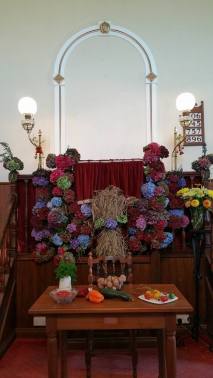
Harvest: Friday 30th September 2016

roger-thomas-sept-16-pulpit14536751_1757579351182093_1253927603_o14571995_1757579244515437_1264196090_o14536501_1757579394515422_2010155050_o14522479_1757579387848756_144387476_o14572543_1757579427848752_819412074_o
Our Harvest service was taken by Roger Thomas of Aberystwyth, who preached from John 15:8, ‘By this my Father is glorified, that you bear much fruit and so prove to be my disciples.’

At this time of year we thank God for His goodness throughout the year, but especially now. We are gathered to say thank you, ‘While the earth remains, seedtime and harvest, cold and heat, summer and winter, day and night, shall not cease’ (Genesis 8:22). God has kept His promise, He has been good to us.

The portion of scripture this verse comes from is part of the Parable of the Vine, spoken in the Upper Room the night before Jesus was betrayed.

Notice Jesus says, ‘By this my Father is glorified.’ Look at how Jesus refers to God as ‘my Father.’ He is saying He is God’s Son – one of the fundamentals of Christianity. Jesus is God’s Son. Millions of people believe in Jesus – He was a good man – however, few believe He was God’s Son. Muslims believe Jesus was a prophet but not God’s Son. We don’t all worship the same God. The Baptism of Jesus declares Jesus to be God’s Son, ‘And a voice came from heaven, ‘You are my beloved Son, with whom I am well pleased’ (Mark 1:11) The miracles of Jesus declare Jesus is God’s Son, ‘Believe me that I am in the Father and the Father is in me, or else believe on account of the works themselves’ (John 14:11). The transfiguration of Jesus declares Jesus is God’s Son, ‘And a voice came out of the cloud, saying, ’This is my Son, my Chosen One. Listen to Him!’ (Luke 9:35). His resurrection declares He is God’s Son, ‘(He) was declared to be the Son of God in power according to the Spirit of holiness by His resurrection from the dead, Jesus Christ our Lord’ (Romans 1:4). It is essential we believe this.

John 3:36 ‘Whoever believes in the Son has eternal life, whoever does not obey the Son shall not see life, but the wrath of God remain on him.’ If we reject God’s Son, we reject God the Father.  ‘No one who denies the Son has the Father’ (1 John 2:23).

‘By this my Father is glorified.’ This is our purpose in this world – to glorify God. To glorify God is to praise and to tell others how good God is, not to glorify ourselves or another person.  Matthew 5:16 ‘In the same way, let your light shine before others, so that they may see your good works and give glory to your Father who is in heaven.’

Romans 15: 5-6 ‘May the God of endurance and encouragement grant you to live in such harmony with one another, in accord with Christ Jesus, that together you may with one voice glorify the God and Father of our Lord Jesus Christ.’

The purpose of the church is to glorify God. Is this true of us? Do we live to glorify God? Are we seeking to glorify God? Psalm 90 tells us that it is the purpose of all creation to glorify God. The psalmist in Psalm 148 tells of the angels, sun, moon, stars and heaven itself all glorifying God. The psalmist calls on the earth to glorify God, including all creatures, even those in the depths of the oceans as well as the weather.

We are told that to glorify God we need to bear much fruit – to do good works and have a godly character. ‘And so, from the day we heard, we have not ceased to pray for you, asking that you may be filled with the knowledge of His will in all spiritual wisdom and understanding, so as to walk in a manner worthy of the Lord, fully pleasing to Him, bearing fruit in every good work and increasing in the knowledge of God’ (Colossians 1:9-10). ‘But the fruit of the Spirit is love, joy, peace, patience, kindness, goodness, faithfulness, gentleness, self-control; against such things there is no law’ (Galatians 5:22).

How do we bear this fruit? The Parable of the Vine answers this question. Jesus, as He walked, would often see something and use this to teach. He said, ‘I am the vine; you are the branches. Whoever abides in me and I in him, he it is that bears much fruit, for apart from me you can do nothing’’ (John 15:5) Here we read of the branches that bear fruit. The branches are Christians, people who believe the gospel.

‘If you abide in me, and my words abide in you, ask whatever you wish, and it will be done for you’ (John 15:7). The person who has faith in Christ and who also keeps His commandments is like the branch in the vine, which receives sap and nutrients from the vine and produces grapes. By being in Christ we receive grace and His grace enables us to do the good works. We need to be in Christ by faith, believing in the gospel of repentance. We cannot bear fruit without Jesus Christ. It is the only way to bear fruit. Jesus refers to Himself as the only true vine. There is only one vine that can enable us to live a godly, fruitful life – Jesus Christ. Is there fruit to be seen in our lives? Do we see a godly character, a life of godliness? Are we in Christ? Have we believed the gospel message?

Jesus is God’s Son. He was in heaven with His Father, three in one. We are sinful because of what happened in the Garden of Eden. God has given us His law, yet we can’t keep His law. We deserve to be punished, God has to punish us. Punishment is Hell. But God loves us and doesn’t want us to perish so He sent His Son into the world. He kept the law we broke. On the cross of Calvary He took all our sin upon Himself and suffered the punishment of our sins. He died, was buried and rose again on the third day. This is the gospel message. Go to God, confess your sins. Have we asked God to forgive all our sins?

If there is no fruit in our lives we don’t see a life of godliness but a life where we live for ourselves. We are not in Christ. ‘I am the true vine, and my Father is the vinedresser. Every branch in me that does not bear fruit He takes away, and every branch that does bear fruit He prunes, that it may bear more fruit’ (John 15:1-2).

‘If anyone does not abide in me he is thrown away like a branch and withers; and the branches are gathered, thrown into the fire, and burned’ (John 15:6). This speaks of separation, of judgement and eternal Hell.

It we see fruit in our lives it is evidence, ‘Therefore, if anyone is in Christ, he is a new creation. The old has passed away; behold, the new has come’ (1 Corinthians 5:17).

In the Parable of the Vine Jesus teaches us that God helps us to bear fruit. The Father actively works in us so we can bear more fruit. Our God prunes, cleanses the Christian. How does He cleanse us? ‘’Already you are clean because of the word that I have spoken to you’ (John 15:3). The word cleanses us. This is an encouragement to read the word of God.

Another way He cleanses us is through trials. God allows trials into our lives to change us, to drive us to God in prayer, ‘For the moment all discipline seems painful rather than pleasant, but later it yields the peaceful fruit of righteousness to those who have been trained by it’ (Hebrews 12:11). ‘Count it all joy, my brothers, when you meet trials of various kinds, for you know that the testing of your faith produces steadfastness. And let steadfastness have its full effect, that you may be perfect and complete, lacking in nothing’ (James 1:2-4).

‘By this my Father is glorified, that you bear much fruit and so prove to be my disciples.’ (John 15:8) Do we bear ‘much fruit’? Do we see a godly character in each other? If not, prayer is the answer. Read the word. Ask God for more of His Holy Spirit. Another blessing of being in Christ is answered prayer (verse 7).

In summary, we are to glorify God, bear fruit, indeed, much fruit, by being in Christ.

Why does bearing fruit glorify God? Through our character and deeds, the fruit shows people what God is like. So when people see our gentleness they see the gentleness of God. When they see the way we talk to others, how we behave, they see the character of God. Through God’s grace we become more godly. ‘By this my Father is glorified, that you bear much fruit and so prove to be my disciples.’ (John 15:8)


September 24th 2016: Alex Coblentz

We were delighted to share fellowship with Alex and Mary Nell Coblentz from French Camp ARP Church, Mississippi last Sunday. Alex preached a wonderful message of encouragement from Hebrews 10: 35, “Therefore do not throw away your confidence, which has a great reward.”

Alex began by asking us, ‘What kind of believers might the writer of Hebrews be talking to?’ We learnt that the writer is not speaking to a crowd of unbelievers, he writes to those of Jewish faith who had come to Christ, those who had received the knowledge of the truth.

Verse 26 of this chapter tells us ‘For if we go on sinning deliberately after receiving the knowledge of the truth, there no longer remains a sacrifice of sins.’ Don’t throw the knowledge of the truth away! Sadly, many have thrown away their confidence. People who have a Christian background but not had a full conversion fall away in a crisis, they throw it all away. Young and old are drawn away by distractions, away from the call of Christ. We who believe are often puzzled by people who throw away their faith. It is not logical. At heart it is a spiritual issue, a matter of rebellion. There is a warfare going on in the hearts of men and women. There is an enemy, the deceiver who continues to seek who he may devour. People have sold their inheritance in the gospel. There are many whose faith is not as deep as it should be. Some reject Christ because prayers are not answered, some look at suffering and question how a God in heaven could allow this to happen. They have trusted in a God of their imagination and find no conversion.

In Hebrews, the whole thrust of the epistle is to point us to Christ – a better covenant that is sealed not with the blood of rams or bulls but Christ’s blood on the cross. The writer of Hebrews pleads with us not to throw our confidence away as it has been purchased with the blood of Christ.

‘Therefore, brothers, since we have confidence to enter the holy places by the blood of Christ, by the new and living way that he opened for us through the curtain, that is, through His flesh, and since we have a great priest over the house of God, let us draw near with a true heart in full assurance of faith, with our hearts sprinkled clean from an evil conscience and our bodies washed with pure water. Let us hold fast the confession of our hope without wavering, for he who promised is faithful’ (Hebrews 10: 19-23). This is our confidence. Our confidence is not in the church, the pastor, pensions or anything else which is temporal. Christ has purchased for us the curtain of the holy of holies, symbolising our free access to God.

Interspersed with these great statements in Hebrews there are warnings:

  • ‘Therefore we must pay much closer attention to what we have heard, lest we drift away from it’ (Hebrews 2:1). As long as we are moored close to God we are secure in that relationship. If we neglect the reading of scripture and the assembly of saints then the mooring becomes adrift.
  • ‘Take care, brothers, lest there be in any of you an evil, unbelieving heart, leading you to fall away from the living God’ (Hebrews 3:12). Every one of us still has the flesh. We may have an unbelieving heart, even though we are redeemed. We need to exhort one another every day. Look to blessing of fellowship in the church.

‘We have this as a sure and steadfast anchor of the soul, a hope that enters into the inner place behind the curtain, where Jesus has gone as a forerunner on our behalf, having become a high priest forever after the order of Melchizedek’ (Hebrews 6:19). Jesus is our anchor. He has gone before us, lived the perfect life and shed His blood for us, was resurrected and we will follow Him in the resurrection. Jesus has gone ahead of us, He is our anchor within the veil. As we continue to fight the headwinds of life, Christ is our anchor who will hold us fast.

  • ‘Therefore do not throw away your confidence, which has a great reward’ (Hebrews 10:35). We should not throw away our confidence. In Jesus, our high priest, we should draw near to God with a true heart.

‘Let us draw near with a true heart in full assurance of faith, with our hearts sprinkled clean from an evil conscience and our bodies washed with pure water’ (Hebrews 10:22). We need to hold fast. What a wonderful salvation we have in Jesus Christ!

  • ‘And let us consider how to stir up one another to love and good works, not neglecting to meet together, as is the habit of some, but encouraging one another, and all the more as you see the Day dawning’ (Hebrew 10:24). The fellowship of believers is a means of grace. Come to know each other and love each other, encourage one another. Don’t live in an isolated eggshell. The neglect of fellowship is a sin of ownership. If we let down our guard we become vulnerable to the attacks of the enemy.
  • ‘For if we go on sinning deliberately after receiving the knowledge of the truth, there no longer remains a sacrifice for sins’ (Hebrews 10:26). The sin of going on sinning deliberately. This is a fearsome and solemn warning. The exhortation is before us. We know the difference between right and wrong. There is a hardness that enters in if we continue to sin. Cry out to the Lord to have mercy on us. Cast our anchor with Jesus, the author and finisher of our faith, the anchor of our souls.

‘But recall the former days when, after you were enlightened, you endured a hard struggle with sufferings, sometimes being publicly exposed to reproach and affliction, and sometimes being partners with those so treated’ (Hebrews 10:32). The people he is writing this to are not comfortable Christians; they are believers who have suffered for their faith. There were people who needed encouragement, people who were possibly tempted to throw away their confidence because of persecution. Yet, amazingly, even in persecution, they joyfully accepted this. They knew their treasure was in heaven. If we put our confidence in the one who is the anchor of the soul, then in the day of trial or judgement we will stand firm.

“Therefore do not throw away your confidence, which has a  great  reward.” (Hebrews 10:35). We have this confidence. Do not give up now. ‘For you have need of endurance, so that when you have done the will of God you may receive what is promised.’ The anchor of our soul is this faith, ‘the righteous shall live by his faith’ (Habakkuk 2:4).

We have two paths before us: ‘But we are not those who shrink back and are destroyed, but those who have faith and preserve their souls’ (Hebrews 10:39). We can shrink back, withdrawing from the challenges of life, things which intimidate us, hoping things out there don’t impact me or hurt me. The other option is the call to take a stand for Jesus. We live in a throw-away society, we don’t value things. But our faith is not disposable. God calls us to exercise a faith that will endure – no matter wat may come. God will carry us, preserve our souls to the day of glory. What a day that will be when we behold Him face to face and be like Him!